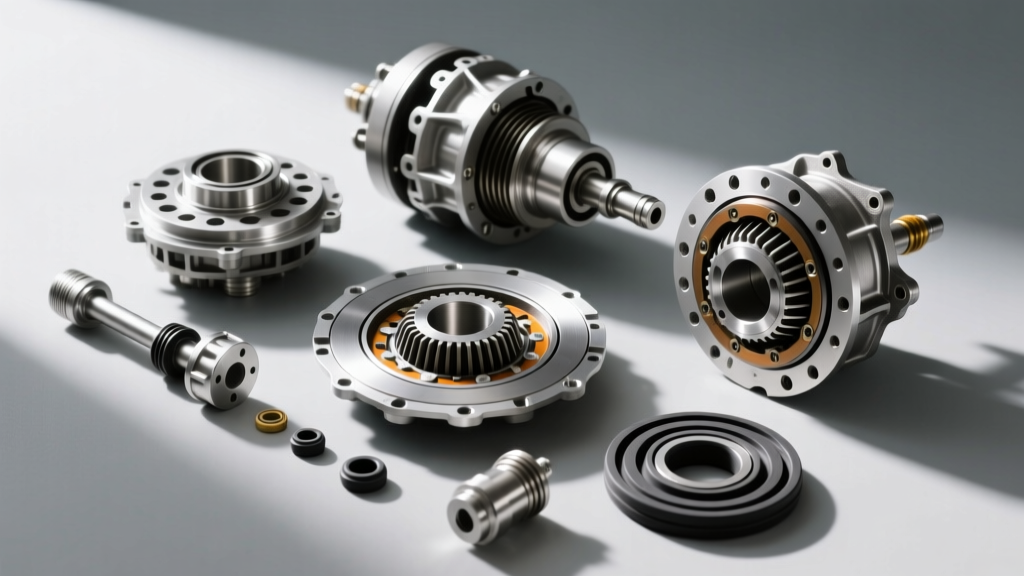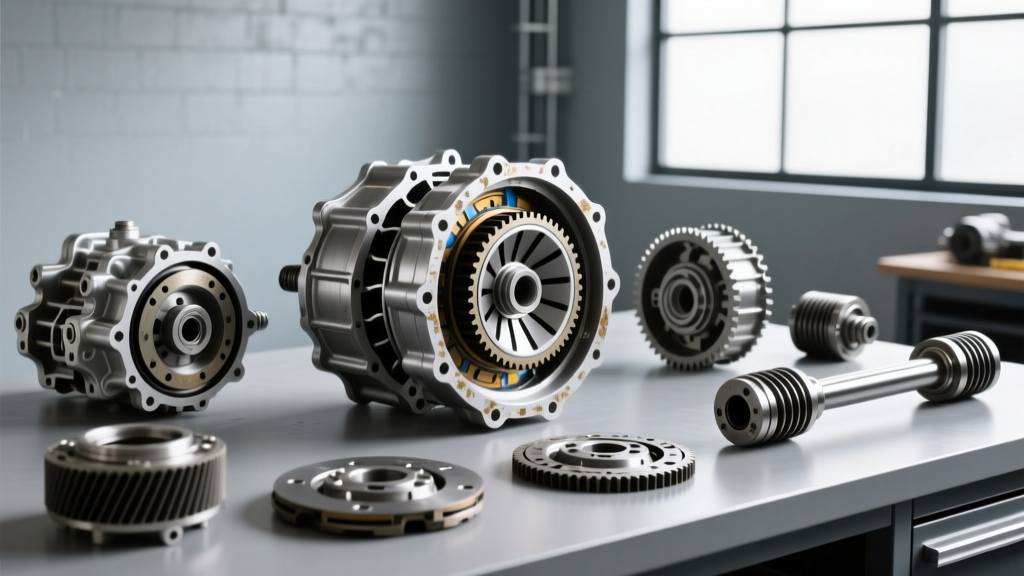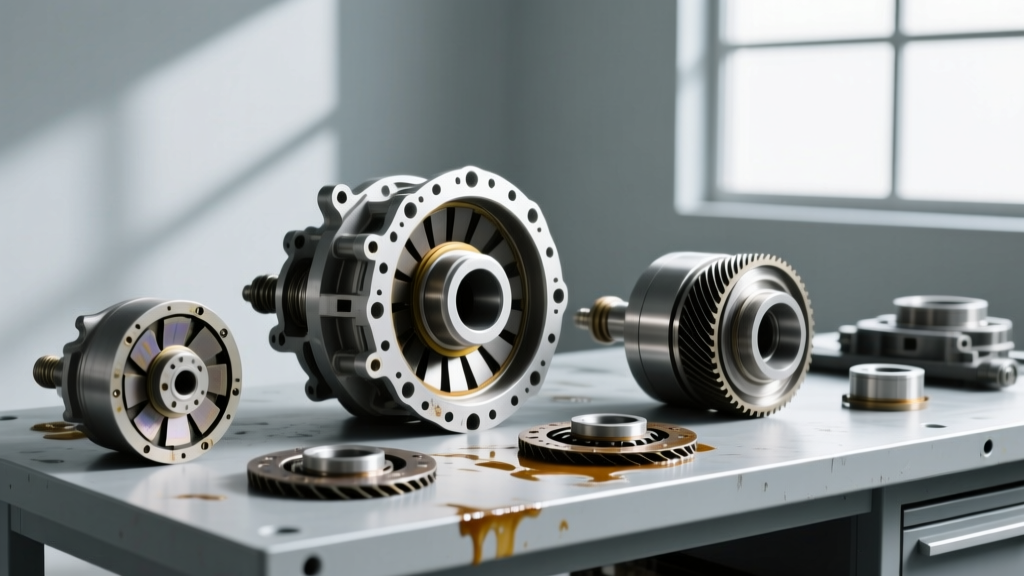
The Hidden Torque Converter in Modern CVTs
When most drivers and even some generalist mechanics think of a Continuously Variable Transmission (CVT), they picture a simple system of steel push-belts or chains riding on variable-diameter pulleys. However, modern CVTs found in millions of Honda, Nissan, Subaru, and Toyota vehicles are far more complex. To provide smooth launch characteristics, low-speed creep, and handle the torque multiplication required to get a 3,500-pound crossover moving from a dead stop, these transmissions utilize a traditional hydraulic torque converter. In models like the Honda CR-V, Nissan Rogue, and Subaru Outback, the CVT torque converter is a critical wear component that requires strict preventive maintenance to avoid the dreaded 'lockup shudder.'
As we navigate the 2026 automotive landscape, CVTs have become the dominant automatic transmission architecture for non-hybrid, front-wheel-drive-based platforms. Yet, torque converter clutch (TCC) shudder remains one of the most misdiagnosed drivability complaints in service bays today. This guide provides a deep-dive diagnostic protocol and preventive maintenance strategy to address CVT torque converter shudder before it leads to catastrophic friction material failure.
The Physics of Stick-Slip Shudder
To understand the fix, you must understand the failure mode. In a modern CVT, the Engine Control Module (ECM) and Transmission Control Module (TCM) command the torque converter clutch to apply very early—often in the 25 to 45 MPH range—to eliminate parasitic hydraulic losses and improve fuel economy. However, to prevent engine lugging and NVH (Noise, Vibration, and Harshness) transfer into the chassis, the TCM rarely commands a 100% rigid lockup. Instead, it commands a 'controlled slip' state, typically targeting a slip speed of 15 to 35 RPM.
This controlled slip relies entirely on the specialized friction modifiers present in CVT-specific transmission fluids. As the fluid ages, subjected to extreme shear forces from the belt/pulley interface and thermal degradation, these friction modifiers deplete. When the friction modifiers break down, the TCC apply surface loses its ability to slip smoothly. It transitions into a 'stick-slip' cycle: the clutch grabs, stops the slip, the ECM senses the RPM drop and reduces line pressure, the clutch slips again, and the cycle repeats dozens of times per second. This high-frequency oscillation is felt in the cabin as a rhythmic shudder, often mistaken for an engine misfire or a worn CV axle.
Diagnostic Protocol: Isolating the TCC Shudder
Before prescribing a fluid exchange or ordering a replacement torque converter, a rigorous diagnostic sequence must be followed to confirm the CVT torque converter is the root cause.
Step 1: Symptom Mapping and Road Test
TCC shudder has a very specific operational window. During your road test, bring the vehicle up to operating temperature (CVT fluid must be above 140°F / 60°C). Find a flat, straight road and accelerate gently. The shudder will almost always manifest between 30 and 50 MPH under light throttle application (10% to 15% Throttle Position Sensor reading).
Pro-Tip: If the shudder occurs during hard acceleration, or at idle in gear, you are likely dealing with a pulley clamping pressure issue, a failing stepper motor (common on Nissan RE0F10A / JF011E units), or a primary drive belt slip, not a torque converter issue.
Step 2: Scan Tool Telemetry
Connect a bi-directional scan tool and monitor the TCC Slip Speed PID (Parameter Identification Data). Command the TCC to apply via the scan tool if necessary, or drive in the shudder window.
- Normal Operation: TCC Slip Speed holds steady between 10 and 40 RPM.
- Shudder Confirmed: TCC Slip Speed oscillates rapidly between 0 RPM and 80+ RPM in a sawtooth pattern.
- Complete Failure: TCC Slip Speed remains above 150 RPM, indicating the friction material has completely worn away and the clutch cannot apply.
For authoritative diagnostic flowcharts on CVT telematics, technicians frequently reference the Sonnax Technical Resources library, which provides excellent breakdowns of hydraulic apply circuits and solenoid duty cycles.
Preventive Maintenance: The Fluid Exchange Strategy
If the scan tool confirms stick-slip shudder and the fluid has not been serviced, the immediate corrective action is a precise drain-and-fill procedure. Never perform a pressurized machine flush on a CVT. CVTs generate microscopic metal particulate from the chain and pulley interface. This debris is safely captured by internal magnets and the pickup strainer. A pressurized flush can dislodge this debris, forcing it into the delicate TCC apply orifices in the valve body, permanently ruining the transmission.
The Honda HCF-2 Drain and Fill Procedure
Honda CVTs (found in the Civic, Accord, CR-V, and HR-V) are highly sensitive to fluid degradation. Honda's HCF-2 fluid contains proprietary friction modifiers specifically engineered for their lockup clutch dynamics.
- Level the vehicle on a flat surface and bring the CVT to operating temperature.
- Remove the 18mm drain plug. Crucial: You must replace the aluminum crush washer (Honda Part # 90471-PX4-000) to prevent leaks and ensure proper torque seating.
- Reinstall the drain plug and torque to exactly 36 lb-ft (49 Nm). Over-torquing can crack the aluminum transmission casing.
- Remove the 10mm dipstick/fill tube bolt and add exactly 3.1 to 3.4 quarts of OEM Honda HCF-2 fluid.
- Perform a 'memory reset' using the scan tool to clear the learned TCC apply adaptions, forcing the TCM to relearn the friction coefficient of the fresh fluid.
Nissan NS-3 and Subaru CVTF-II Considerations
Nissan's RE0F10A and RE0F11A CVTs require NS-3 fluid. Unlike Honda's sealed-style drain, Nissan requires dropping the stamped steel transmission pan to access the internal strainer and clean the rare-earth magnets. Failure to clean these magnets leads to restricted fluid flow to the TCC apply circuit. Subaru's Lineartronic CVTs (TR690 and TR580) utilize CVTF-II or CVTF-III fluid and feature an external spin-on filter that must be replaced during every fluid exchange to maintain proper lockup clutch hydraulic pressure.
OEM CVT Fluid Specifications and Maintenance Data
Using the incorrect fluid in a CVT torque converter system will result in immediate shudder or total transmission failure. The friction coefficients of standard ATF (like Dexron VI or Mercon LV) are entirely incompatible with CVT lockup clutches. Below is a reference table for the most common CVT torque converter systems on the road today.
| OEM / Platform | Required Fluid | Total System Capacity | Drain & Fill Volume | Drain Plug Torque Spec |
|---|---|---|---|---|
| Honda / Acura (CVT) | Honda HCF-2 | ~ 8.5 Quarts | 3.1 - 3.4 Quarts | 36 lb-ft (49 Nm) |
| Nissan / Infiniti (Xtronic) | Nissan NS-3 | ~ 10.5 Quarts | 4.5 - 5.0 Quarts | 25 lb-ft (34 Nm) |
| Subaru (Lineartronic) | Subaru CVTF-II / III | ~ 12.0 Quarts | 5.5 - 6.5 Quarts | 31 lb-ft (42 Nm) |
| Toyota (Direct Shift-CVT) | Toyota CVTF FE | ~ 7.5 Quarts | 3.5 - 4.0 Quarts | 30 lb-ft (41 Nm) |
Advanced Fixes: When Maintenance Isn't Enough
If a double drain-and-fill procedure (performed 500 miles apart) and a TCM adaptation reset do not eliminate the shudder, the friction material on the torque converter clutch disc is permanently glazed or worn through to the steel backing plate. At this stage, no chemical additive or 'shudder fix' in a bottle will save the unit. The Automatic Transmission Rebuilders Association (ATRA) consistently warns against using aftermarket friction modifiers in CVTs, as they can alter the belt-to-pulley friction coefficient, causing catastrophic belt slip.
When the torque converter must be replaced, the transmission must be removed. This is an opportune time to replace the rear main engine seal, the flexplate bolts (always use new TTY bolts and apply the correct threadlocker), and the transmission input shaft seal. Furthermore, the external transmission cooler lines must be flushed manually to remove contaminated fluid and friction material debris before installing the new torque converter.
Cost Breakdown: Maintenance vs. Replacement
Understanding the financial stakes highlights why preventive maintenance is non-negotiable for CVT-equipped vehicles.
- Preventive Drain & Fill (Parts & Fluid only): $45 - $80
- Shop Performed Drain & Fill (Labor + OEM Fluid): $180 - $250
- Aftermarket 'Shudder Fix' Additives: $15 - $30 (Not recommended for CVTs)
- Torque Converter Replacement (Parts): $400 - $900 (OEM or High-Quality Remanufactured)
- Complete R&R Labor & Fluids: $900 - $1,600
- Total Out-the-Door TC Replacement Cost: $1,300 - $2,500+
Final Thoughts on CVT Longevity
The CVT torque converter is a masterpiece of modern hydraulic engineering, bridging the gap between traditional automatic drivability and infinite-ratio efficiency. However, its reliance on microscopic friction modifiers makes it highly vulnerable to neglected maintenance schedules. By adhering to strict 30,000-mile drain-and-fill intervals, utilizing only OEM-specified fluids, and monitoring TCC slip data via OBD-II telemetry, technicians and enthusiasts can effectively eliminate shudder and extend the life of the CVT well past the 200,000-mile mark. For further reading on CVT hydraulic circuit diagnostics, the AA1Car CVT Transmission Guide offers excellent foundational schematics.