The Calculus of Comfort: Transmission Evolution and Shift Mapping
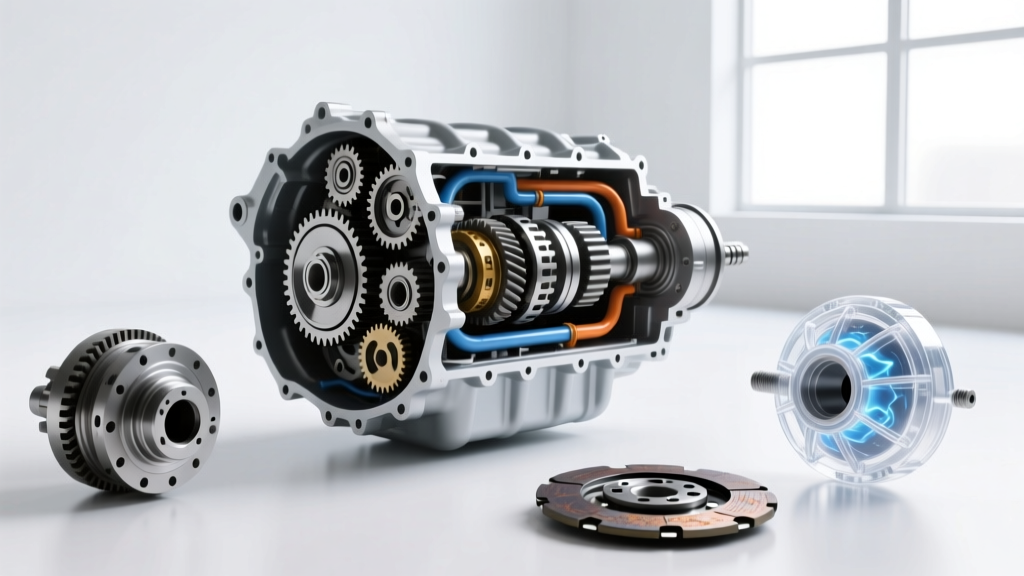
The evolution of the automotive transmission has transitioned from purely mechanical and hydraulic governance to highly complex, software-defined powertrain management. In the era of the GM TH350, shift quality was dictated by physical governor weights, throttle valves, and accumulator spring rates. Today, modern transmissions like the ZF 8HP70 or the GM 10L90 rely on 32-bit Transmission Control Modules (TCMs) executing millions of calculations per second. As we navigate the automotive landscape of 2026, the primary differentiator in drivetrain refinement is no longer just gear count, but the mathematical elegance of the shift algorithms. Specifically, the ability to model clutch apply curves and pulley ratio transitions using advanced calculus is what separates a luxury-grade powertrain from a subpar, jerky commuter vehicle.
Why TCU Engineers Ask: How to Prove Differentiability of a Function?
At the core of modern shift calibration is the concept of 'jerk'—the rate of change of acceleration. To achieve a seamless torque phase and inertia phase during a clutch-to-clutch shift, the hydraulic pressure apply curve must be perfectly smooth. When writing the C-code for the TCM's shift schedules, calibration engineers must rigorously understand how to prove differentiability of a function to ensure the left-hand and right-hand limits of the derivative match exactly at the handoff point between the off-going and on-coming clutches.
If the mathematical function representing the solenoid's Pulse Width Modulation (PWM) duty cycle is continuous but not differentiable at the 120-millisecond mark (the typical start of the inertia phase), the first derivative (acceleration) will experience a step-change. This mathematical discontinuity translates directly into physical driveline shock, often measured as a spike exceeding 15 m/s³ of jerk. Proving differentiability ensures that the transition from the torque phase (where engine torque is transferred between clutches) to the inertia phase (where the turbine speed is synchronized) is imperceptible to the vehicle's occupants.
The Hardware Reality: Solenoids and Hydraulic Limits
Mathematical proofs must eventually command physical hardware. Consider the Bosch 0260130001 proportional solenoid valves used in many ZF and Aisin valve bodies. These solenoids modulate line pressure from 0 to 18 bar (260 psi) in roughly 250 milliseconds. If the TCM commands a non-differentiable pressure spike, the physical spool valve inside the mechatronic unit experiences hydraulic hammer. This not only degrades shift quality but accelerates wear on the valve body bore. During assembly, the mechatronic sleeve bolts on a ZF 8HP must be torqued to exactly 10 Nm to prevent microscopic flexing that could alter the hydraulic volume and invalidate the engineer's differentiable pressure models.
R&D Cost Analysis: Pricing the Mathematical Validation
Developing these mathematically continuous shift functions requires massive capital expenditure. OEMs and Tier 1 suppliers (like Jatco, Aisin, and ZF) spend millions per transmission family to validate that their shift functions remain differentiable across all thermal and load states. Below is a breakdown of the typical R&D and validation costs associated with transmission shift mapping in 2026.
| R&D Asset / Service | Estimated Cost (2026) | Role in Shift Function Validation |
|---|---|---|
| MATLAB/Simulink Powertrain Blockset | $18,500 / year per seat | Used to model the continuous derivatives of clutch pressure and torque handoff. |
| dSPACE SCALEXIO HIL Rig | $350,000 - $450,000 | Hardware-in-the-Loop testing to simulate edge-case thermal degradation of friction materials. |
| AVL Drivetrain Dyno Time | $1,800 / day | Physical validation of the mathematical models under 1000+ Nm of input torque. |
| Senior Calibration Engineer | $110 - $145 / hour | Manual tuning of PID controllers to ensure continuous derivatives across temperature maps. |
According to MathWorks automotive transmission modeling resources, utilizing simulated environments to prove the continuity and differentiability of shift maps reduces physical dyno time by up to 35%, saving OEMs roughly $1.2 million per development cycle. However, the initial capital outlay for dSPACE HIL simulation hardware remains a significant barrier to entry for smaller aftermarket TCM tuning companies.
Economics of Continuity: CVT vs. Stepped Automatics
The cost and complexity of proving differentiability scale dramatically depending on the transmission architecture. In a stepped automatic like the Ford 10R80, engineers only need to prove the differentiability of the shift function at discrete nodes (e.g., the 3-4 shift, the 4-5 shift). The function is piecewise; between shifts, the clutches are either fully locked or fully open, requiring no complex derivative mapping.
Conversely, a Continuously Variable Transmission (CVT) like the Jatco JF016E (CVT8) requires a globally differentiable ratio map. The primary and secondary pulley pressures (which can exceed 35 bar to prevent chain slip under high torque) must be adjusted continuously as a function of vehicle speed and throttle position. The JF016E holds 7.1 liters of Nissan NS-3 fluid, and the hydraulic control unit must constantly modulate the stepper motors to maintain the exact belt radius. If the ratio function $R(t)$ is not differentiable at every point, the result is the infamous 'rubber-band' effect or micro-stutters that plague early CVT designs. Consequently, Jatco and Subaru spend approximately 40% more on CVT software calibration than on traditional stepped automatics, purely to ensure the infinite ratio transitions remain mathematically smooth.
The Billion-Dollar Cost of Non-Differentiable Friction Models
When OEMs cut corners on the mathematical validation of their transmission functions, the financial fallout is catastrophic. The most prominent example of a non-differentiable friction model failure is the Ford PowerShift (DPS6) 6-speed dry dual-clutch transmission. Ford's calibration engineers modeled the dry clutch friction coefficient ($\mu$) as a relatively linear, continuous function. However, in real-world stop-and-go traffic, dry clutch friction exhibits severe non-linearities and stick-slip boundaries where the derivative of the friction function approaches infinity or becomes undefined.
Because the TCM could not accurately predict the torque transfer at these non-differentiable boundary points, the DPS6 suffered from violent low-speed shudder, premature clutch wear, and mechatronic unit failures. The resulting class-action lawsuits, warranty extensions, and brand damage cost Ford upwards of $4.2 billion. This historical failure serves as a grim reminder to modern powertrain engineers: failing to account for the limits of differentiability in friction material modeling will inevitably result in massive financial liability.
2026 Outlook: AI and Neural Shift Mapping
As of 2026, the industry is shifting away from manual calculus proofs toward machine learning. OEMs are now utilizing reinforcement learning algorithms trained on vast datasets of real-world driving telemetry to auto-generate shift maps. These neural networks inherently produce continuous, differentiable output functions, effectively bypassing the need for manual limit proofs by human engineers. While this reduces the $145/hr calibration engineering overhead, it shifts the cost burden to massive cloud-compute clusters and advanced data-logging hardware integrated into prototype mules. Furthermore, as SAE International technical papers frequently highlight, AI-generated shift maps still require physical HIL validation to ensure the neural network doesn't output a mathematically smooth but hydraulically impossible pressure request. Ultimately, whether through manual calculus or artificial intelligence, the pursuit of the perfect, differentiable shift function remains the most expensive and critical endeavor in modern transmission evolution.