The Diagnostic Dilemma: Bellhousing Squeals vs. HVAC Noises
When a rhythmic metallic squeak, chirp, or rattle emanates from the front of the engine bay, novice mechanics and DIYers frequently jump to a costly conclusion. Because the noise often fluctuates with engine RPM, it is commonly misdiagnosed as an internal engine bearing failure, a failing accessory drive pulley, or a malfunctioning HVAC component. In fact, one of the most common misdiagnoses in modern manual transmission vehicles involves confusing a worn manual clutch fork and pivot ball with a failing magnetic AC compressor coil or pulley bearing.
Understanding the true ac compressor clutch repair cost versus the labor-intensive reality of a transmission clutch fork replacement is critical for accurate troubleshooting in 2026. Pulling a transmission to replace a $15 clutch fork pivot ball, only to realize the noise was a $45 AC compressor clutch coil, is a nightmare scenario for any shop or home mechanic. This guide provides expert-level diagnostic protocols to isolate clutch fork and pivot issues from HVAC compressor noises, complete with precise torque specs, wear limits, and cost breakdowns.
The Anatomy of Clutch Fork and Pivot Ball Wear
To accurately diagnose a manual transmission clutch noise, you must understand the mechanical leverage at play. The clutch fork acts as a lever, with the pivot ball serving as the fulcrum. When you depress the clutch pedal, hydraulic pressure from the slave cylinder pushes the fork, which in turn drives the throw-out bearing (TOB) against the pressure plate diaphragm fingers.
The Failure Cascade of a Worn Pivot Ball
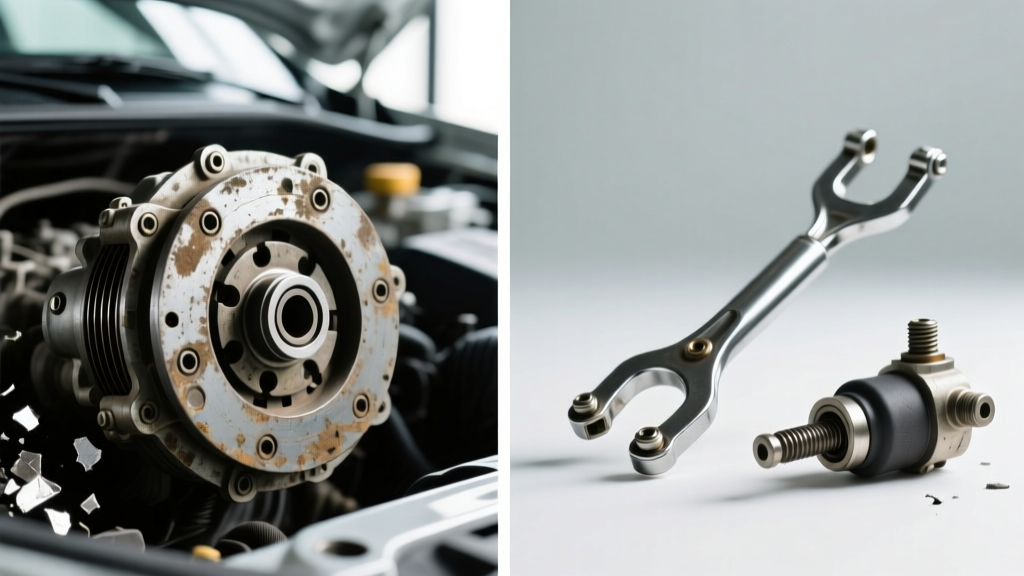
The pivot ball is typically a hardened steel stud threaded into the bellhousing or transmission case. Over tens of thousands of clutch actuations, the clutch fork's internal contact pad wears a groove into the spherical surface of the pivot ball. According to drivetrain component experts at Sonnax, once the wear groove on a pivot ball exceeds 0.020 inches in depth, the clutch fork geometry is fundamentally altered.
- Uneven TOB Wear: The altered pivot point forces the throw-out bearing to ride at a slight angle against the pressure plate fingers, causing asymmetric bearing wear and a high-pitched squeal during pedal take-up.
- Clutch Chatter: A severely worn pivot ball introduces lateral slop into the fork. During engagement, this slop translates into harmonic vibrations (chatter) felt through the chassis, particularly in high-torque applications like the Tremec T56 Magnum or Ford MT82.
- Fork Snapping: In extreme cases, the stress concentration caused by a worn, off-center pivot point can cause stamped-steel OEM clutch forks to fatigue and snap, resulting in immediate loss of clutch disengagement.
Critical Wear Measurements and Torque Specs
When inspecting the bellhousing, measure the pivot ball diameter with a micrometer. If the ball has worn flat spots or a groove deeper than 0.020", replacement is mandatory. When installing a new pivot ball stud, proper torque is vital to prevent it from backing out under vibration. For example, the OEM specification for the Tremec T56 Magnum pivot ball stud is exactly 15 lb-ft, applied with a medium-strength threadlocker (such as Loctite 243) to prevent migration.
Decoding the AC Compressor Clutch Repair Cost
Before dropping the transmission to inspect the clutch fork, you must definitively rule out the AC system. The AC compressor clutch assembly consists of a pulley (with an internal bearing), a magnetic coil, and a friction plate. When the magnetic coil engages, it pulls the friction plate against the spinning pulley, locking the compressor shaft to the engine's serpentine belt drive.
A failing AC pulley bearing will emit a continuous whine or growl that changes with engine RPM, while a slipping friction plate or weak magnetic coil will produce a sharp chirp or metallic click. Because the AC compressor cycles on and off (or engages when the defroster is activated), this noise can easily be mistaken for a clutch fork squeaking during pedal engagement.
2026 Pricing Breakdown: AC Clutch vs. Manual Fork
When evaluating the ac compressor clutch repair cost, it is vital to understand that you often do not need to replace the entire compressor assembly or evacuate the refrigerant. If the compressor shaft spins freely by hand, a skilled technician can use a specialized puller tool to remove and replace just the clutch coil, pulley, and friction plate assembly on the front of the compressor.
| Diagnostic & Repair Metric | Manual Clutch Fork / Pivot Ball | AC Compressor Clutch Assembly |
|---|---|---|
| Typical 2026 Parts Cost | $15 - $85 (Fork, Pivot, TOB) | $120 - $280 (Coil, Pulley, Plate Kit) |
| Average Labor Time | 6.0 - 9.5 Hours (Trans Removal) | 1.0 - 2.0 Hours (Front of Engine) |
| Total Estimated Repair Cost | $850 - $1,600+ | $270 - $550 |
| Primary Noise Trigger | Clutch pedal free-play take-up | HVAC system cycling / Max Cold setting |
| Noise Location | Bellhousing / Firewall area | Front accessory drive / Serpentine belt |
Data sourced from current OEM and aftermarket pricing baselines via RockAuto and standard industry labor guides. As the table illustrates, misdiagnosing an AC clutch issue as a transmission issue can result in over $1,000 in unnecessary labor charges.
Expert Troubleshooting: Isolating the Noise Source
To separate a clutch fork pivot issue from an AC compressor clutch failure, follow this systematic isolation protocol:
Step 1: The HVAC Toggle Test
Start the engine and let it idle in neutral with the clutch pedal fully released (TOB not touching the pressure plate). Turn the cabin fan to high, but set the temperature to full hot and ensure the AC compressor is disengaged. Listen for the noise. Next, press the AC button to "Max Cold" or turn on the rear window defroster (which automatically engages the AC compressor to dehumidify the cabin). If the metallic squeal or chirp immediately begins or changes pitch when the compressor relay clicks, you are dealing with an AC compressor clutch issue, not a clutch fork.
Step 2: The Clutch Pedal Free-Play Test
With the AC system turned completely off, slowly depress the clutch pedal by hand. The exact moment the pedal moves past its free-play (usually 0.5 to 1.0 inches of travel) and the throw-out bearing makes contact with the spinning pressure plate fingers, a worn clutch fork pivot will emit a distinct "chirp-chirp" or squeaking sound. If the noise only occurs during this specific millimeter of pedal travel and ceases when the pedal is fully depressed or fully released, the manual clutch fork, pivot ball, or TOB is the culprit.
Step 3: The Stethoscope Probe
Using a mechanical automotive stethoscope, carefully probe the AC compressor body (avoiding the spinning belt and pulley). If the bearing is failing, the vibration and growl will be deafening through the stethoscope. Next, probe the transmission bellhousing inspection cover or the slave cylinder pushrod area. A squeaking clutch fork pivot will transmit sharp, metallic harmonic vibrations directly through the bellhousing casting. Refer to Tremec technical service bulletins for specific bellhousing inspection points on T56 and Magnum applications.
Best Practices for Clutch Fork and Pivot Replacement
If your diagnostics confirm the manual clutch system is at fault, simply swapping the worn parts is not enough. Expert transmission builders adhere to strict best practices to ensure longevity and prevent warranty comebacks.
Upgrading the Pivot Ball and Fork
OEM stamped steel forks and soft steel pivot balls are prone to premature wear, especially in vehicles producing over 400 lb-ft of torque. Upgrade to a forged aluminum clutch fork with a replaceable hardened steel or bronze pivot pad. Bronze pivot balls are highly recommended for high-performance applications because bronze is self-lubricating and sacrifices itself rather than gouging the clutch fork. Always apply a high-temperature molybdenum disulfide (moly) grease to the contact point between the fork and the pivot ball, but never allow grease to contaminate the clutch disc or flywheel friction surface.
Bellhousing Alignment and Runout
A worn clutch fork is often a secondary symptom of a misaligned bellhousing. If the bellhousing is not perfectly concentric with the engine crankshaft, the transmission input shaft will bind, forcing the clutch fork to twist laterally on the pivot ball. Before installing the new fork and pivot, use a dial indicator to measure the bellhousing bore runout. The maximum allowable Total Indicator Reading (TIR) for most modern manual transmissions is 0.005 inches. If runout exceeds this spec, install offset dowel pins to correct the alignment. Ignoring bellhousing runout will destroy your new pivot ball and throw-out bearing in under 10,000 miles.
Summary: Don't Pull the Trans for an AC Coil
The intersection of HVAC diagnostics and manual transmission repair is a trap that catches many off guard. By understanding the precise mechanical triggers of clutch fork and pivot ball wear, and by accurately calculating the ac compressor clutch repair cost, you can save thousands of dollars and dozens of hours of labor. Always isolate the noise using the HVAC toggle and pedal free-play tests before unbolting the driveshaft, and when it is time to rebuild the bellhousing, prioritize upgraded metallurgy and strict bellhousing runout tolerances.