The Semantic Gap: CVT Grease vs. Hydraulic ATF
When mini-bike enthusiasts and off-road mechanics search for 'Coleman CT200U torque converter fluid issues,' they are usually encountering a severe mechanical misnomer. Unlike the hydraulic automatic transmissions found in full-size vehicles (such as the GM 6L80 or ZF 8HP) which rely on liters of Automatic Transmission Fluid (ATF) to multiply torque and cool the stator, the Coleman CT200U utilizes a dry Continuously Variable Transmission (CVT). In the small engine community, this CVT pulley system—most commonly the Comet TAV-2 upgrade kit (Part # 218353A)—is universally referred to as a 'torque converter.'
Because the system is inherently dry, the drive belt and pulleys should never be exposed to liquids. Therefore, when a CT200U owner reports 'fluid leaking from the torque converter,' they are actually witnessing one of three distinct lubrication failures from adjacent drivetrain components. As of 2026, diagnosing these cross-contamination issues is critical, as fluid on the 5/8-inch drive belt will cause catastrophic slip, glazing, and eventual strand failure. Below, we break down the exact sources of these 'fluid' leaks, how to identify them, and the expert best practices for resolving them.
Diagnosing the Leak: Identifying the Contaminant
To properly address Coleman CT200U torque converter fluid issues, you must first perform a visual and olfactory inspection of the slinging liquid. The color, viscosity, and smell will immediately tell you which seal or lubrication boundary has failed.
1. Driven Pulley Grease Separation (The Most Common Culprit)
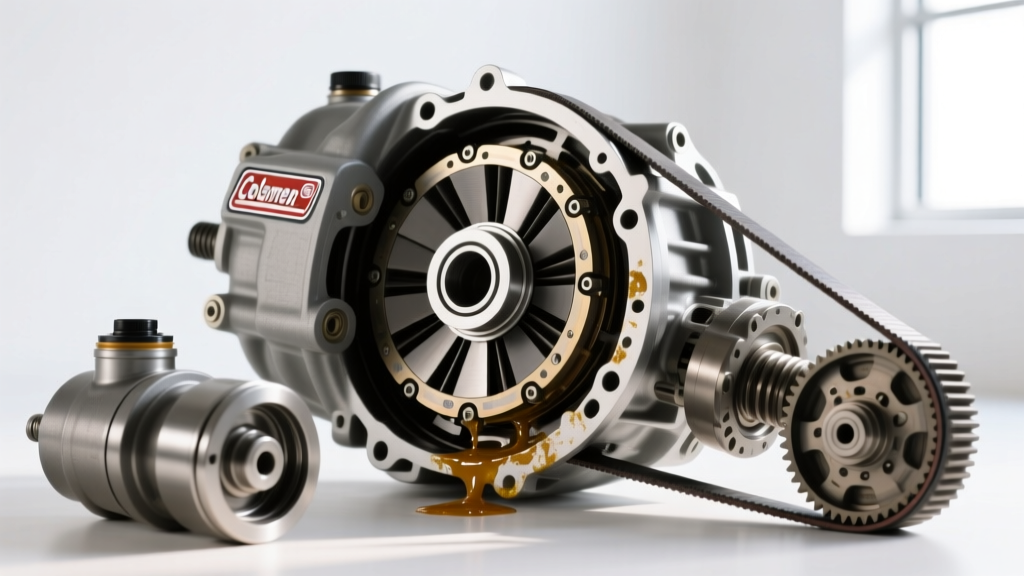
The driven pulley (the larger, spring-loaded pulley on the jackshaft) contains an internal cam and gear mechanism that requires lubrication. From the factory, this is packed with a lithium-complex EP2 grease. Under heavy load, high ambient temperatures, or prolonged wide-open-throttle (WOT) riding, cheap or degraded grease can experience 'oil bleed.' The base oil separates from the thickener and slings out of the pulley housing onto the belt.
- Symptom: Clear, amber, or slightly yellowish oily residue on the inside of the belt guard and the face of the pulleys.
- Fix: Complete teardown of the driven pulley, solvent cleaning, and repacking with high-temp synthetic moly grease (e.g., Mobilith SHC 220).
2. Gearbox Oil Migration
The stock Coleman CT200U features a small internal gear-reduction transmission case located behind the engine block. This gearbox requires SAE 80W-90 gear oil. If the output shaft seal (where the jackshaft or sprocket exits the case) degrades, gear oil will weep outward, traveling down the chain or directly onto the CVT belt if the bike has been converted to a jackshaft-mounted torque converter.
- Symptom: Thick, dark amber fluid with a highly pungent, sulfuric 'rotten egg' smell characteristic of hypoid gear oil.
- Fix: Drain the gearbox, replace the output shaft oil seal (typically a 20x35x5mm or similar metric seal depending on the exact year), and refill to the exact 3.5 oz capacity.
3. Crankshaft Seal Blowout from Engine Overfill
The 196cc overhead valve (OHV) engine on the CT200U has a strict oil capacity of 0.6 quarts (approximately 19 oz). A common mistake among novice owners is overfilling the engine oil. Excess crankcase pressure, combined with the lateral stress of a misaligned drive belt, can blow out the PTO-side crankshaft seal. This results in 10W-30 engine oil pumping directly onto the driver pulley (the engine-side torque converter component).
- Symptom: Light brown or black oily mist coating the engine sideplate, the driver pulley, and the belt. Smells like burnt motor oil.
- Fix: Drain engine oil to the correct 19 oz level, replace the crankshaft seal (19x35x5mm), and ensure the driver pulley is perfectly aligned to prevent lateral crank loading.
CT200U Drivetrain Lubrication Specification Chart
Maintaining the correct fluid boundaries is the key to preventing torque converter contamination. Use this reference chart for your 2026 maintenance schedule.
| Component | Lubricant Type | Capacity / Amount | Service Interval |
|---|---|---|---|
| 196cc Engine Crankcase | 10W-30 or 10W-40 Small Engine Oil | 0.6 Quarts (19 oz) | Every 20 Hours / 6 Months |
| Internal Gearbox (Stock) | SAE 80W-90 Gear Oil | ~3.5 oz (Fill to plug) | Every 50 Hours / Annually |
| TAV-2 Driven Pulley (CVT) | Lithium Complex EP2 / Moly Grease | 2-3 oz (Pack cavity 80%) | Every 100 Hours or if Slipping |
| Jackshaft Bearings | High-Temp Wheel Bearing Grease | Light packing | As needed / Annually |
Step-by-Step: Re-Greasing the Comet TAV-2 Driven Pulley
If your diagnosis confirms that the 'fluid' is actually separated grease from the driven pulley, you must rebuild the pulley assembly. Simply wiping the belt is a temporary band-aid; the grease will continue to bleed until the internal cavity is serviced.
- Remove the Pulley: Use a 14mm or 5/8-inch wrench to remove the retaining nut on the jackshaft. (Note: Apply an impact wrench or use a strap wrench to hold the pulley, as the shaft will spin). Slide the driven pulley off the splined jackshaft.
- Disassemble: Carefully remove the outer sheave. Be mindful of the main torsion spring and the internal plastic cam guides. Take a photo of the ramp orientation before pulling it apart.
- Clean: Spray all metal components, cams, and gears with a non-chlorinated brake cleaner (such as CRC Brakleen). Wipe away all old, separated grease and metallic particulates. Do not use harsh solvents on the rubber belt; replace the belt (Dayco 8327 or Gates 25-3030) if it has absorbed oil into its cord matrix.
- Repack: Apply a high-quality synthetic lithium-complex grease. Comet Industries officially recommends greases meeting the EP2 specification. Fill the internal gear cavity roughly 80% full. Overfilling will cause immediate hydraulic lock and blow out the seal upon reassembly.
- Reassemble & Torque: Reinstall the spring and outer sheave. Torque the retaining nut to 20-25 ft-lbs. Apply a drop of Blue Loctite (243) to the threads to prevent vibration-induced backing out.
Expert Tip: Never use standard multi-purpose chassis grease in a TAV-2 driven pulley. The shear forces generated by the internal cam mechanism will break down standard greases in under 10 hours of ride time, leading to rapid oil bleed and immediate belt slip.
Preventative Best Practices for Belt Longevity
Resolving Coleman CT200U torque converter fluid issues goes beyond fixing leaks; it requires addressing the root mechanical stresses that cause seals to fail. The most common cause of premature crankshaft seal failure (and subsequent engine oil leaks onto the CVT) is improper belt tension and pulley misalignment.
When installing a torque converter kit on the CT200U, ensure that the engine-side driver pulley and the jackshaft-driven pulley are perfectly parallel. Use a straight edge across the faces of both pulleys. If the belt tracks inward or outward, it places immense lateral side-load on the engine's PTO bearing and crank seal. This side-load will warp the seal lip, allowing 10W-30 engine oil to bypass the seal and coat the torque converter.
Furthermore, always check the CT200U's engine breather tube. If the engine is overfilled, or if the bike is frequently operated on steep inclines, oil can be pushed through the crankcase breather into the airbox, or blow past the dipstick O-ring, creating the illusion of a torque converter fluid leak. By adhering strictly to the 19 oz oil capacity and utilizing the correct EP2 grease in your CVT upgrade, you will eliminate cross-contamination and ensure your drivetrain operates flawlessly for years to come.
For further technical specifications, always refer to the Coleman Powersports Official Manuals and the Comet Industries Technical Documentation. Advanced fabrication and alignment tips can also be sourced from the NR Racing Mini-Bike Tech Archives.