The Fundamental Divide: Hydrodynamics vs. Mechanical Friction
When diagnosing driveline slip or shudder, technicians and enthusiasts often draw parallels between the automatic transmission's torque converter and the manual transmission's friction clutch. Both serve the primary function of decoupling the engine's rotational mass from the transmission input shaft to allow for gear changes and idle stability. However, comparing a manual clutch to a torque converter is an exercise in contrasting pure mechanical friction with complex hydrodynamics and electro-hydraulic lockup mechanisms. Understanding these mechanical differences is the only way to accurately contextualize the torque converter replacement price versus a manual clutch job in 2026.
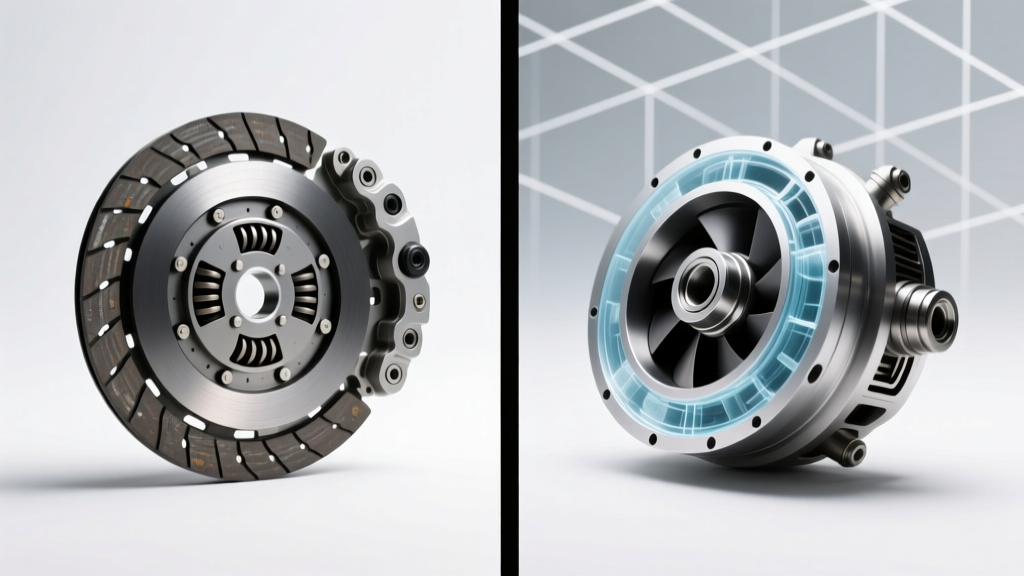
A manual clutch relies on the massive clamping force of a diaphragm spring to sandwich a friction disc between the flywheel and pressure plate. In contrast, a modern torque converter utilizes a fluid coupling mechanism (impeller, turbine, and stator) for torque multiplication, supplemented by a Torque Converter Clutch (TCC) for 1:1 mechanical lockup. When either system fails, the transmission must typically be removed from the vehicle, but the internal economics, collateral damage risks, and diagnostic pathways diverge sharply.
Deconstructing the Torque Converter Replacement Price
The torque converter replacement price is frequently higher than a standard manual clutch job, not necessarily due to the cost of the component itself, but because of the intricate ecosystem it inhabits. Modern automatic transmissions like the GM 6L80E, Ford 10R80, and ZF 8HP70 rely on the torque converter as a vital hydraulic pump drive and fluid reservoir.
Component and Fluid Economics
An OEM remanufactured torque converter for a GM 6L80E (e.g., GM part number 24253902) typically ranges from $350 to $600. High-performance billet units from manufacturers like Circle D or Precision Industries can push this to $1,200+. However, the hidden cost lies in the fluid and filtration. Replacing a torque converter requires draining the cooling lines, the transmission pan, and the converter itself. A 6L80E requires roughly 11.2 quarts of Dexron VI or equivalent synthetic ATF for a dry fill. At 2026 pricing of $12 to $25 per quart for premium synthetic fluids, fluid costs alone can exceed $250.
The Collateral Damage Factor: Valve Body Contamination
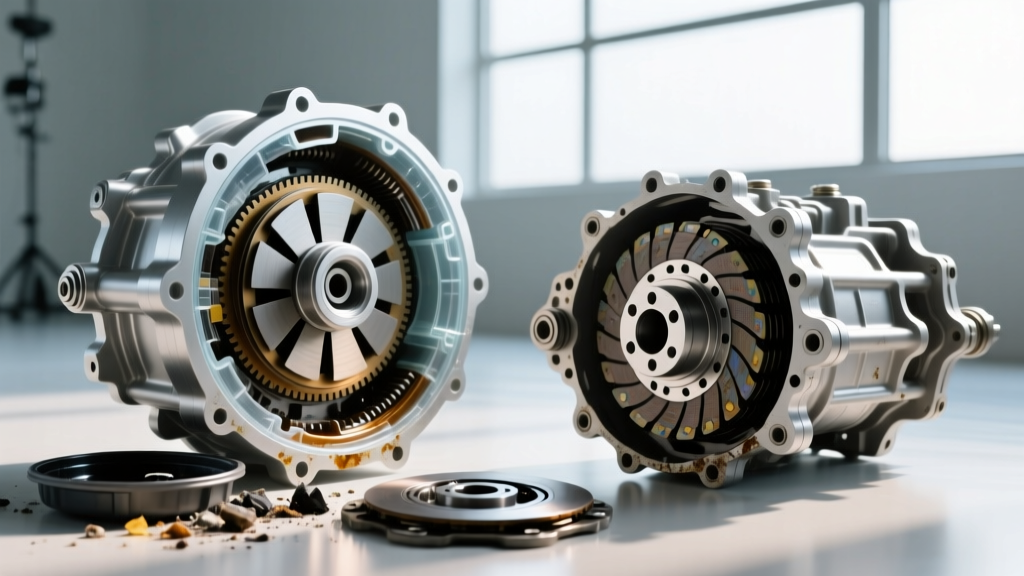
According to technical bulletins from Sonnax, a failing TCC friction lining does not simply disappear. The degraded friction material and metallic debris from a failing stator one-way clutch are flushed directly into the transmission's main sump and valve body. This debris routinely lodges in the TCC apply valve and Pulse Width Modulation (PWM) solenoid screens. Therefore, a legitimate torque converter replacement rarely occurs in isolation; it mandates a complete transmission flush, pan drop, filter replacement, and often a valve body bore repair or solenoid replacement to prevent the new converter from experiencing immediate TCC shudder.
Manual Clutch Replacement: The Mechanical Counterpart
Manual clutch replacement economics are driven by heavy cast-iron components and hydraulic actuation systems. A typical clutch kit (such as a LuK RepSet or Sachs Performance kit) includes the pressure plate, friction disc, and release bearing, costing between $250 and $600.
The Dual Mass Flywheel (DMF) Multiplier
The true cost escalator in manual clutch replacements is the Dual Mass Flywheel. Modern diesel and high-torque gasoline applications utilize DMFs to absorb torsional vibrations that would otherwise shatter the transmission input shaft. According to engineering data from Schaeffler Aftermarket, the internal arc springs of a DMF degrade over time. If a technician replaces the clutch but ignores a fatigued DMF, the resulting harmonic vibration will destroy the new friction disc's marcel springs within 5,000 miles. A replacement DMF adds $600 to $1,400 to the parts ledger.
Hydraulic Throwout Bearings
Unlike older cable-actuated systems, modern manual transmissions (like the Tremec T56 Magnum) utilize Concentric Slave Cylinders (CSC) or hydraulic throwout bearings. Because these components are subjected to intense heat and rotational forces inside the bellhousing, they must be replaced concurrently with the clutch, adding $150 to $350 to the parts cost.
2026 Cost & Labor Comparison Matrix
The following table illustrates the real-world financial and labor differences between replacing a torque converter in a common automatic versus a clutch assembly in a comparable manual application, based on 2026 national average shop rates of $165/hour.
| Parameter | GM 6L80E (Torque Converter) | Tremec T56 Magnum (Manual Clutch) |
|---|---|---|
| Primary Component Cost | $400 - $800 (Reman/Billet TC) | $350 - $600 (LuK/Sachs Clutch Kit) |
| Secondary/Mandatory Parts | $250 (Fluid), $80 (Filter/Seals) | $800 (DMF), $200 (CSC/TOB) |
| Labor Book Time (R&R Trans) | 6.5 - 8.5 Hours | 5.5 - 7.0 Hours |
| Collateral Damage Risk | High (Valve Body/Solenoid contamination) | Moderate (Pilot bearing, rear main seal) |
| Total Estimated Price (2026) | $1,800 - $3,200 | $1,600 - $2,800 |
Hydraulic Lockup vs. Diaphragm Clamp Loads
To understand why the symptoms of failure differ, one must examine how these components apply force. A manual clutch pressure plate generates mechanical clamping force via a steel diaphragm spring. A heavy-duty performance clutch might exert 3,200 lbs of clamping force directly against the friction material. When this spring fatigues due to heat cycling, the clutch slips under high load, generating immense heat that glazes the friction disc and cracks the flywheel friction surface.
Conversely, the TCC inside a torque converter applies via hydraulic pressure routed through the transmission input shaft and turbine hub. The ZF 8HP transmission, for example, utilizes a highly sophisticated PWM solenoid to modulate TCC apply pressure, allowing for controlled micro-slip (often less than 20 RPM) to dampen engine vibrations during lockup. When the TCC friction lining wears, the transmission control module (TCM) commands higher hydraulic pressure to maintain lockup. This over-pressurization frequently blows out the TCC apply valve bore in the aluminum valve body, a failure mode entirely unique to automatic systems.
Symptomatology: Diagnosing Slip, Shudder, and Drag
Because both systems manage the connection between engine and driveline, their failure symptoms can appear similar to the untrained eye, but require vastly different diagnostic approaches.
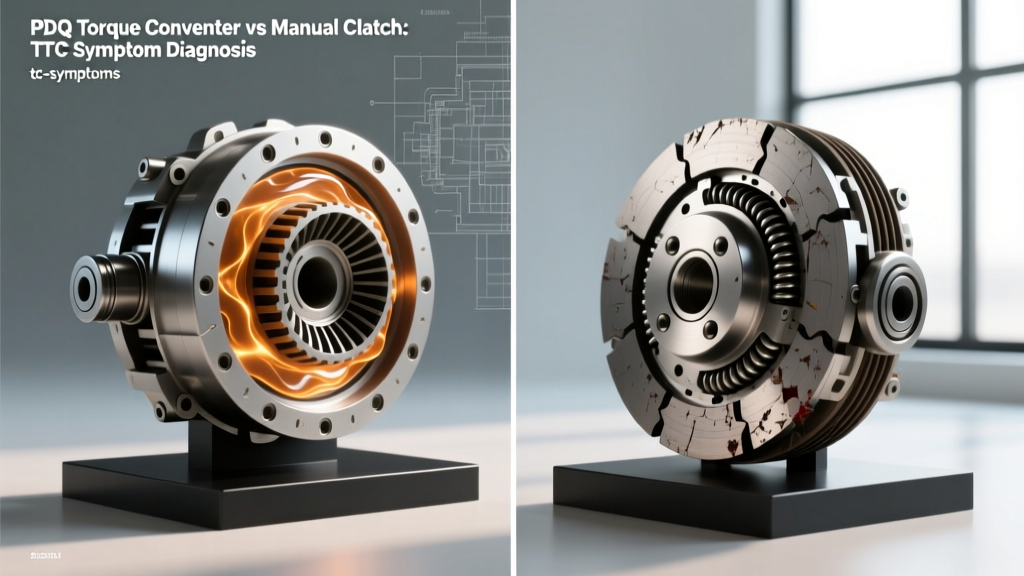
- TCC Shudder (Torque Converter): Typically felt as a rhythmic vibration (often likened to driving over rumble strips) at 40-55 mph under light throttle. This occurs when the degraded TCC friction material fails to maintain the TCM's commanded micro-slip, causing the clutch to rapidly grab and release. Diagnosis requires monitoring TCC slip RPM via an OBD-II bi-directional scanner; erratic slip data points to hydraulic or friction failure.
- Friction Disc Slip (Manual Clutch): Manifests as a flare in engine RPM without a corresponding increase in vehicle speed, usually under heavy load or in higher gears. Unlike TCC shudder, mechanical clutch slip is continuous and worsens as the disc material physically wears down to the rivets.
- Stator Failure (Torque Converter): If the one-way clutch inside the stator seizes, the vehicle will exhibit severe power loss and overheating at highway speeds. If it freewheels in both directions, the vehicle will suffer from sluggish, delayed acceleration from a stop due to a lack of torque multiplication.
- Clutch Drag (Manual): Occurs when the hydraulic system fails to fully retract the pressure plate, or the input shaft splines become corroded. This results in grinding gears during shifts, particularly when engaging first or reverse from a stop.
Precision Installation: Torque Specs and Clearances
Whether paying the torque converter replacement price or funding a manual clutch overhaul, the longevity of the repair hinges on exact installation tolerances.
Torque Converter Pilot Clearance
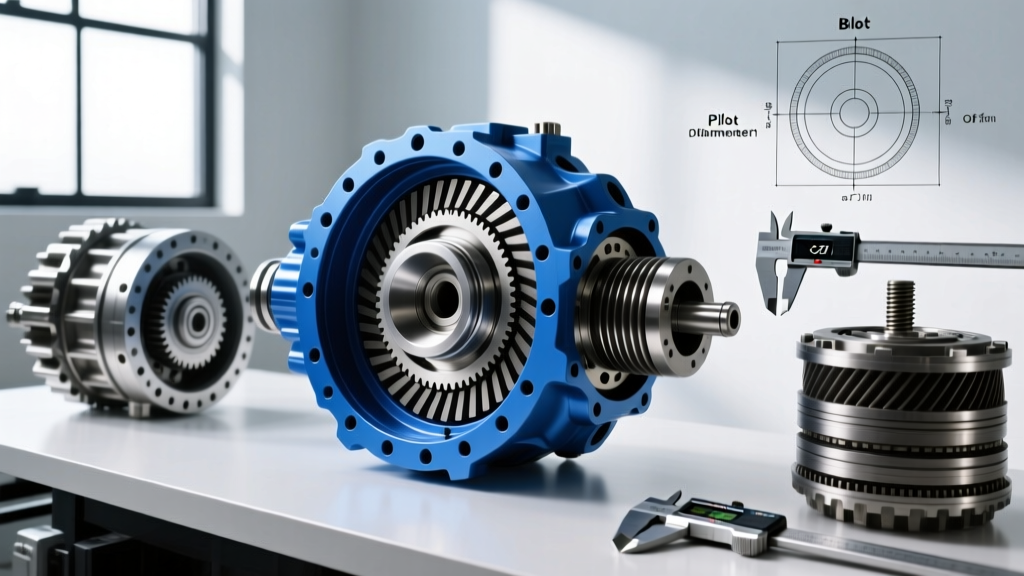
A critical, often overlooked step in TC installation is measuring the pilot clearance—the gap between the torque converter's center pilot hub and the engine crankshaft bore. Using a straightedge and dial calipers, technicians must verify a clearance of 0.125 to 0.250 inches. If the converter is not fully seated into the transmission oil pump gears before bolting it to the flexplate, tightening the flexplate bolts will pull the converter forward, instantly destroying the oil pump upon engine startup.
Fastener Specifications
- TC to Flexplate: Typically M10x1.5 bolts. Must be torqued to 35-45 lb-ft using a star pattern. Threadlocker is highly recommended due to the rotational shear forces.
- Clutch Pressure Plate to Flywheel: Typically M8x1.25 bolts. Must be torqued to 35-55 lb-ft (depending on OEM spec) in a strict crisscross star pattern to prevent warping the diaphragm spring housing.
- Transmission Bellhousing to Engine Block: Often requires torque values upwards of 70-85 lb-ft. Misalignment here will cause catastrophic wear to the manual clutch release bearing or the automatic transmission's front pump bushing.
Ultimately, while the manual clutch relies on brute mechanical force and simpler hydraulics, the modern torque converter is a marvel of integrated fluid dynamics and computer-controlled friction. The torque converter replacement price reflects not just the cost of a welded steel vessel, but the necessity of preserving the delicate hydraulic ecosystem of the modern automatic transmission.