The Hybrid Paradox: Do Hybrids Even Have Torque Converters?
When discussing hybrid powertrains, a common misconception is that all of them rely solely on planetary gearsets and electric motor-generators, completely eliminating the traditional torque converter. While this is true for Toyota’s e-CVT (Power Split Device) architecture found in the Prius and RAV4 Hybrid, it is entirely false for a massive segment of the hybrid market. As of 2026, millions of hybrid and Plug-in Hybrid Electric Vehicles (PHEVs) on the road utilize traditional hydraulic torque converters to manage engine starts, provide low-speed creep, and buffer torsional vibrations between the internal combustion engine (ICE) and the electric traction motors.
Transmissions like the Ford HF35/HF45 eCVT, the Hyundai/Kia 6F24 and 8AT PHEV setups, and the ZF 8HP Gen 3/4 PHEV variants (found in BMW, Jeep, and Chrysler applications) all feature highly specialized torque converters. Because these units must endure the extreme thermal and mechanical cycling of auto-stop/start events and regenerative braking, recognizing the signs of torque converter problems in these vehicles requires a completely different diagnostic approach than in conventional ICE vehicles.
Hybrid Architectures: Where the Torque Converter Lives
Before diagnosing a fault, you must understand the mechanical layout. In a PHEV with a traditional automatic transmission, the electric motor is often sandwiched between the engine and the torque converter, or integrated directly into the transmission bell housing. The torque converter's primary job shifts from just 'multiplying torque' to acting as a high-speed disconnect and torsional damper during ICE auto-stop events.
| Transmission Model | Common Applications | TC Architecture & Function |
|---|---|---|
| Ford HF35 / HF45 | Escape Hybrid, Maverick Hybrid | Traditional TC with lockup clutch. Used to smooth ICE auto-starts and provide reverse/creep. |
| ZF 8HP (Gen 3/4 PHEV) | BMW X5 xDrive45e, Jeep Wrangler 4xe | TC with integrated centrifugal pendulum absorber (CPA) and torsional damper for NVH reduction. |
| Hyundai/Kia 6F24 / 8AT | Tucson PHEV, Sorento PHEV | TC connects the HSG (Hybrid Starter Generator) and TM (Traction Motor) to the ICE flywheel. |
| Toyota P810 / P910 | Prius, RAV4 Hybrid | None. Uses a planetary gearset and damper assembly instead of a fluid coupling. |
Critical Signs of Torque Converter Problems in Hybrids
Because the hybrid control module (HCM) constantly manipulates the torque converter clutch (TCC) and engine state, failures manifest in ways that often trick technicians into diagnosing high-voltage battery or motor-generator faults. Here are the most accurate indicators of a failing hybrid torque converter.
1. Auto-Stop/Start Shudder and Lurching
In a hybrid, the ICE shuts off at stoplights to save fuel and reduce emissions. When the brake pedal is released, the electric motor spins the engine via the transmission. If the TCC solenoid is sticking in the applied position, or if the TC lockup clutch material is warped, the engine will fail to disconnect smoothly from the drivetrain. This results in a violent lurch or shudder exactly when the vehicle transitions from EV mode back to ICE mode. Technicians often misdiagnose this as a failing engine mount or a high-voltage inverter fault.
2. Regenerative Braking Jerk (TCC Drag)
During regenerative braking, the traction motor acts as a generator, sending current back to the hybrid battery. The torque converter must remain completely unlocked to allow the wheels to drive the motor independently of the ICE. If the TC clutch is dragging due to contaminated fluid or a scored apply piston, the mechanical link to the dormant engine creates parasitic drag. The driver will feel a distinct 'jerk' or hesitation at low speeds (usually between 15-25 mph) as the regenerative braking ramps up, often accompanied by a drop in MPGe.
3. P0A0F: Engine Failed to Start (Misdiagnosis)
While DTC P0A0F generally points to an engine mechanical failure or a 12V starter issue in conventional cars, in hybrids like the Ford Escape Hybrid, the ICE is cranked by the traction motor through the torque converter. If the torque converter stator one-way clutch seizes, or if internal fluid pressure is too low to support the TCC unlock sequence, the traction motor cannot spin the engine fast enough to achieve ignition. The PCM sets P0A0F, but the root cause is hydraulic or mechanical failure inside the TC.
4. High-Frequency NVH in EV Mode
Advanced PHEV transmissions like the ZF 8HP use a Centrifugal Pendulum Absorber (CPA) inside the torque converter to cancel out engine vibrations. If the CPA pins wear out or the internal damper springs fracture, you will hear a high-frequency metallic rattle or feel a buzzing vibration through the floorpan, even when the vehicle is operating purely in EV mode and the ICE is completely off. The broken components rattle against the TC housing due to the torsional pulses from the electric traction motor.
Diagnostic Protocol: Separating TC Faults from Electrical Gremlins
Diagnosing hybrid drivetrain complaints requires strict adherence to data logging. You cannot rely on a simple test drive. Follow this protocol to isolate the torque converter:
- Commanded vs. Actual TCC Slip: Using a bi-directional OBD2 scanner, monitor the TCC Slip Speed PID. In a healthy hybrid HF35 or ZF 8HP, slip should be exactly 0 RPM when locked, and >100 RPM when unlocked. If you see erratic slip numbers (e.g., bouncing between 20 and 80 RPM) while cruising in ICE mode, the TC clutch friction material is degraded.
- Auto-Stop Pressure Test: Hook up a transmission pressure gauge to the TCC apply circuit. Command an auto-stop event via the scanner. Watch the pressure drop. If pressure remains high (>15 PSI) while the engine is commanded off, the TCC control valve in the valve body is sticking, or the TC apply piston is mechanically bound.
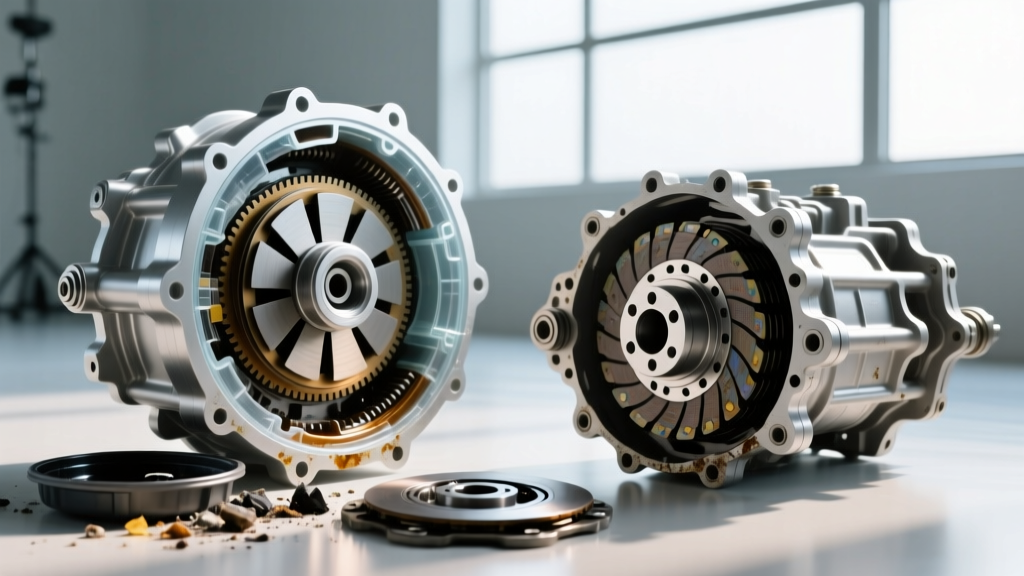
- Fluid Analysis for Hybrid ATF: Hybrid transmissions use ultra-low viscosity fluids to maximize efficiency (e.g., Ford MERCON ULV or ZF LifeguardFluid 8). These fluids are highly sensitive to thermal breakdown. Pull a sample from the dipstick or drain plug. If the fluid smells burnt or contains heavy metallic glitter, the TC stator bearing or lockup clutch has catastrophically failed. ZF Aftermarket strictly mandates that any PHEV showing TC shudder must have the fluid analyzed before condemning the mechatronic unit.
Expert Technician Note: Never perform a 'stall test' on a modern hybrid PHEV in the traditional manner. Holding the brake and applying throttle to flash-stall the torque converter can instantly overheat the integrated electric motor stator and fry the high-voltage inverter due to the lack of airflow and coolant flow at zero vehicle speed. Rely on PID data and solenoid command testing instead.
Replacement Costs, Fluid Specs, and Torque Specifications
Replacing a torque converter in a hybrid is significantly more expensive than in a conventional vehicle due to the need to safely depressurize and isolate the high-voltage system, remove the integrated electric motor, and handle specialized low-viscosity fluids. Below is a breakdown of real-world 2026 repair data for common hybrid platforms.
| Vehicle / Trans | TC Part Number (Ref) | Avg. Repair Cost | Fluid Spec & Capacity | TC-to-Flexplate Torque |
|---|---|---|---|---|
| Ford Maverick Hybrid (HF45) | 7R6Z-7902-A (Variant) | $1,400 - $1,900 | MERCON ULV (5.7L Total) | 26 Nm (19 lb-ft) |
| BMW X5 45e (ZF 8HP75) | ZF 1087.298.359 | $2,800 - $3,600 | ZF LifeguardFluid 8 (9.5L) | 45 Nm (33 lb-ft) |
| Hyundai Tucson PHEV (6F24) | 46000-3D300 | $1,600 - $2,200 | ATF SP-IV (7.1L Total) | 35 Nm (26 lb-ft) |
The Importance of Exact Fluid Match
According to SAE International technical papers on hybrid powertrain efficiency, using a standard high-viscosity ATF (like conventional MERCON V or Dexron VI) in a hybrid torque converter will cause immediate TCC shudder and drastically reduce EV range. The ultra-low viscosity (ULV) fluids are engineered to minimize churning losses inside the torque converter while maintaining the exact friction coefficient required for the carbon-fiber lockup clutch linings. Always verify the fluid specification on the transmission pan sticker before performing a flush.
Summary
Diagnosing the signs of torque converter problems in hybrid vehicles requires an understanding of how the ICE, electric motors, and hydraulic coupling interact. By focusing on auto-stop shudder, regenerative braking anomalies, and precise TCC slip data, technicians can avoid misdiagnosing high-voltage components and accurately target the mechanical heart of the hybrid transmission. Always prioritize safety protocols when working around PHEV bell housings, and never compromise on OEM-specified ultra-low viscosity fluids.