The Overlooked Variables in Clutch Throwout Bearing Replacement
When executing a clutch throwout bearing replacement, novice mechanics and generalist shops often treat the release bearing as an isolated wear item. However, in high-torque manual transmissions like the Tremec T-56 Magnum, the Ford MT82, or the classic GM Muncie, the throwout bearing is frequently just the victim of underlying geometry issues. The true culprits of premature bearing failure, pedal chatter, and inconsistent engagement are the clutch fork and the pivot ball (or pivot stud). Ignoring these components during a teardown guarantees a comeback job, degraded pedal feel, and potential collateral damage to the transmission input shaft.
From an expert diagnostic perspective, the release bearing, fork, and pivot form a single kinematic triangle. If one vertex is compromised, the entire actuation system suffers. This guide details the best practices for diagnosing, measuring, and upgrading clutch fork and pivot assemblies to ensure a flawless clutch throwout bearing replacement.
Diagnostic Framework: Fork Pads and Pivot Geometry
Before installing a new release bearing, a meticulous inspection of the actuation mechanism is mandatory. The clutch fork acts as a lever, multiplying the hydraulic or mechanical force from the slave cylinder to overcome the pressure plate's diaphragm spring. This leverage generates immense localized friction at two primary contact points: the fork pads and the pivot ball.
1. Clutch Fork Pad Wear and Asymmetry
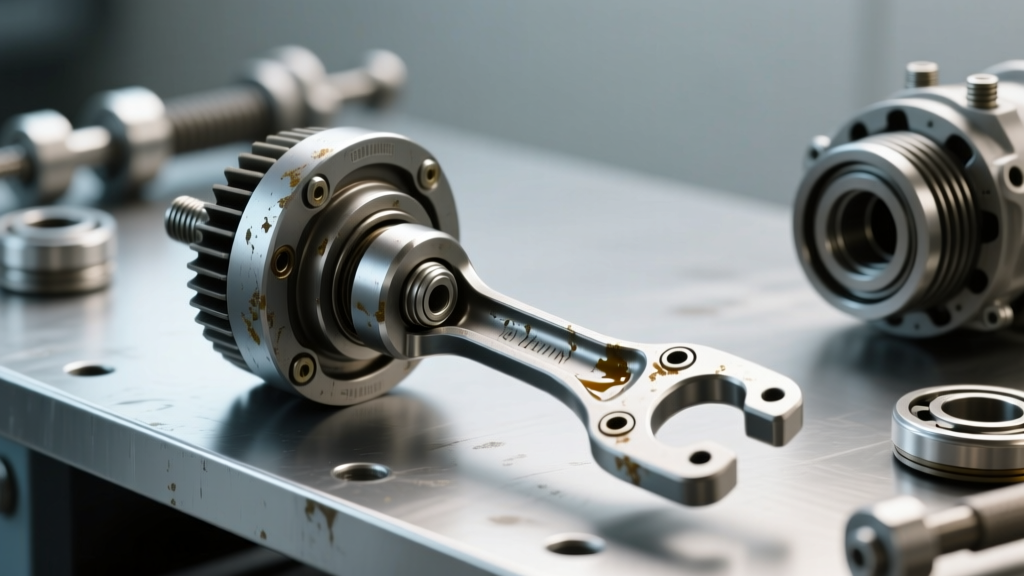
The fork contacts the throwout bearing's collar via two machined pads or stamped dimples. Over tens of thousands of clutch cycles, these contact points wear down, altering the resting position of the bearing and changing the clutch pedal's engagement point.
- OEM Thickness: Typically 0.250 inches (6.35mm) for heavy-duty cast or stamped forks.
- Wear Limit: If pad thickness measures below 0.200 inches, the fork must be replaced. Continuing to use a worn fork forces the slave cylinder to over-extend, risking piston pop-out or hydraulic line over-pressurization.
- Asymmetrical Wear: If one pad is worn significantly more than the other, it indicates a bent fork, a misaligned bellhousing, or a warped transmission bearing retainer collar. This asymmetry will cause the new bearing to bind, leading to catastrophic failure within a few thousand miles.
2. Pivot Ball Grooving and Stud Back-Out
The pivot point endures extreme lateral and axial loads. In GM LS applications utilizing a Tremec T-56, the pivot ball rides inside a machined recess on the fork. If the pivot ball is made of soft aluminum or low-grade steel, the high clamp loads of modern performance pressure plates will cause the fork to eat into the pivot, creating a deep groove.
Expert Insight: Never reuse a stock aluminum or soft-steel pivot ball when upgrading to a high-clamp-load aftermarket pressure plate (e.g., 2,800+ lbs clamp force). The increased lateral load will mushroom the soft pivot, resulting in a spongy pedal, accelerated fork wear, and eventual mechanical binding.
Hydraulic vs. Mechanical Actuation Stressors
The type of actuation system heavily influences how fork and pivot issues manifest. In mechanical linkage setups (common in classic muscle cars and older trucks), the Z-bar and linkage geometry often introduce side-loading to the fork. This side-loading accelerates asymmetric wear on the pivot ball and the inner bore of the fork. Conversely, hydraulic concentric slave cylinders (CSC) eliminate the fork entirely, but traditional hydraulic external slave setups (like those on the Ford MT82 or Tremec Magnum) are highly susceptible to fork flex.
When an external hydraulic slave cylinder pushes a stamped steel fork, the hydraulic pressure is unyielding. If the fork flexes under load, the throwout bearing does not travel in a perfectly straight line, causing it to scrape against the transmission input shaft bearing retainer. This metal-on-metal scoring destroys the retainer and ruins the new throwout bearing.
Wear Thresholds and Replacement Criteria
Use the following measurement matrix during your inspection to determine whether to reuse, replace, or upgrade the fork and pivot components.
| Component | Measurement Parameter | Replace Threshold | Recommended Upgrade Path |
|---|---|---|---|
| Fork Pads | Thickness / Contact Surface | Less than 0.200 inches or deep grooving | Billet Aluminum or Heavy-Duty Stamped Steel (e.g., Ford Performance M-7515-A) |
| Pivot Ball | Diameter / Sphericity | Less than 0.980 inches or visible flat spots | Hardened Tool Steel (e.g., McLeod 16910 Adjustable Pivot) |
| Pivot Stud | Thread engagement / Stretch | Backed out more than 0.020 inches | ARP Chromoly Stud with High-Strength Threadlocker |
| Fork Pivot Bore | Inner Diameter (ID) | Greater than 1.015 inches (wallowing) | Bronze Bushing Insert or Complete Billet Fork Replacement |
Platform-Specific Case Studies: MT82 and T-56 Magnum
The Ford MT82 Fork Flex Dilemma
The Getrag MT82 transmission, found in 2011-2023 Mustang GTs and Shelby models, is notorious for clutch actuation issues when paired with aftermarket clutches. The OEM stamped steel fork is designed for the relatively low clamp load of the factory clutch. When owners install aggressive twin-disc or high-clamp single-disc setups, the hydraulic slave cylinder forces the fork to bend rather than fully depressing the pressure plate fingers. This flex causes incomplete disengagement, gear grinding, and premature throwout bearing wear. The best practice for any MT82 clutch throwout bearing replacement involving an aftermarket clutch is to simultaneously install a heavy-duty billet or reinforced steel fork.
The Tremec T-56 Pivot Stud Back-Out
In GM F-body and Corvette applications using the T-56, the pivot ball is threaded into the bellhousing or engine block via a 3/8-16 stud. Due to the intense heat cycling of the bellhousing and the vibration of the drivetrain, these studs are prone to backing out. If the stud backs out by even 0.050 inches, the clutch geometry shifts dramatically. The throwout bearing is forced to contact the pressure plate fingers at an angle, leading to catastrophic finger wear, bearing disintegration, and severe clutch chatter. Applying the correct threadlocker and adhering to precise torque specs is non-negotiable.
Execution Best Practices and Torque Specifications
A successful repair requires strict adherence to fastener torque specs and thread-locking protocols. Guesswork here leads to immediate drivability complaints.
Critical Torque Specs and Thread-Locking Protocols
- Pivot Stud to Block/Bellhousing (3/8-16 thread): 35 to 40 lb-ft. You must apply Loctite 271 (High-Strength Red) to the first three threads to prevent thermal backing-out. Allow 24 hours for full cure before subjecting the vehicle to track use.
- Bellhousing to Engine Block (M10 x 1.5 bolts): 37 to 45 lb-ft. Always verify bellhousing concentricity using a dial indicator mounted to the crankshaft flange; runout must not exceed 0.005 inches. Excessive runout forces the fork and pivot out of alignment, guaranteeing throwout bearing failure.
- Slave Cylinder Pushrod Nut (Adjustable setups): 18 to 22 lb-ft. Ensure there is exactly 0.050 to 0.100 inches of free-play at the fork to prevent the bearing from riding constantly against the pressure plate fingers.
Cost Analysis: OEM Replacement vs. Performance Upgrades
Budgeting for a comprehensive actuation overhaul prevents secondary failures and saves the customer from paying for duplicate transmission removal labor. Below is a realistic 2026 pricing breakdown for addressing fork and pivot issues during a transmission-out service.
| Component | OEM Replacement Cost | Aftermarket Upgrade Cost | Labor Time Impact |
|---|---|---|---|
| Clutch Fork | $45 - $85 | $140 - $260 (Billet/HD) | +0.2 hrs |
| Pivot Ball and Stud | $15 - $30 | $55 - $95 (Hardened/ARP) | +0.1 hrs |
| Throwout Bearing | $40 - $90 (SKF/Timken) | $120 - $220 (Hydraulic/Ceramic) | Base Time |
| Bellhousing Dowels | $20 - $40 (Offset pair) | N/A | +0.5 hrs (if machining required) |
Sourcing, Clearancing, and Final Verification
When sourcing components, rely on established powertrain manufacturers. For release bearings, SKF Automotive and Timken remain the industry standard for OEM-style replacements, offering superior heat-treated contact surfaces. For performance applications requiring adjustable geometry, consulting specialists like McLeod Racing ensures you receive matched fork-and-pivot assemblies designed to handle extreme clamp loads without deflection.
Furthermore, reviewing installation documentation from Tremec is vital when dealing with Magnum or T-56 bellhousing clearances. Aftermarket billet forks are often thicker than OEM stamped units and may require minor clearancing (grinding) near the bellhousing ribs to prevent binding at maximum stroke. Always cycle the fork by hand through its full range of motion before mating the transmission to the engine block.
Ultimately, treating the fork and pivot as consumable wear items—rather than permanent hard parts—during every clutch throwout bearing replacement is the hallmark of expert-level drivetrain service. Measure twice, apply the correct threadlocker, verify bellhousing alignment, and torque to spec to ensure a rattle-free, perfectly modulated clutch pedal for the next 100,000 miles.