When you search for a clutch slipping fix, the immediate assumption is often a worn friction disc. However, as any seasoned drivetrain technician will tell you, true engagement and disengagement issues frequently originate outside the bellhousing. For beginners, understanding the difference between a mechanical failure and a hydraulic fault is the key to saving hundreds of dollars in unnecessary transmission removal labor. In this 2026 guide, we break down the exact diagnostic steps, torque specifications, and component tolerances required to accurately diagnose and resolve clutch slip and drag.
The Anatomy of Engagement: How the System Actually Works
Think of your clutch hydraulics like a medical syringe. When you press the pedal, the master cylinder pushes fluid through a hard line to the slave cylinder. This slave cylinder actuates a release fork, which presses the throw-out bearing against the pressure plate diaphragm springs.
- Disengagement: The springs compress, lifting the pressure plate off the friction disc, disconnecting the engine from the transmission.
- Engagement: Releasing the pedal allows the springs to clamp the disc against the flywheel, transferring torque.
If your vehicle is slipping under load (RPMs rise without a corresponding increase in vehicle speed), the clamping force is compromised. If it grinds when shifting (disengagement drag), the disc isn't fully releasing.
Diagnostic Matrix: Slip vs. Drag
Before ordering parts, use this diagnostic matrix to isolate your specific clutch engagement issue.
| Symptom | Primary System at Fault | Beginner-Friendly Test |
|---|---|---|
| RPMs flare in high gear under heavy throttle | Friction Disc / Flywheel / Weak Pressure Plate | Stall test in 4th gear (if RPMs don't immediately stall the engine, the disc is slipping). |
| Grinding into 1st or Reverse gear | Hydraulics / Master Cylinder Bypass | Pump the pedal 3 times rapidly. If shifting improves, the master cylinder is internally bypassing. |
| Pedal feels spongy or sinks to the floor | Hydraulic Leak / Air in Line | Inspect the bellhousing inspection cover for DOT fluid weeping. |
| Car creeps forward with clutch fully depressed | Drag / Warped Disc / Incorrect Free-Play | Measure pedal free-play with a ruler against the firewall. |
Step 1: The Hydraulic Clutch Slipping Fix (Master & Slave Cylinders)
A spongy pedal or incomplete disengagement is rarely a mechanical clutch failure; it is almost always hydraulic. Modern vehicles use DOT 3 or DOT 4 brake fluid for the clutch circuit. Because DOT fluid is hygroscopic (absorbs moisture), its boiling point drops over time, leading to vapor lock and a loss of hydraulic pressure.
Bleeding and Master Cylinder Bypass
If your clutch slips or fails to disengage after sitting in traffic, the master cylinder piston seals may be worn, allowing fluid to bypass internally.
- Check Free-Play: Ensure the pushrod between the pedal and master cylinder has a slight clearance (typically 0.04 to 0.12 inches). Zero clearance keeps the fluid return port blocked, causing the clutch to slip as fluid expands with heat.
- Reverse Bleed: Gravity bleeding often fails on modern concentric slave cylinders (CSC). Use a reverse bleeder to push fluid from the slave cylinder nipple up to the master reservoir, forcing air out naturally.
Note: For vehicles equipped with Magura hydraulic systems (found in some European and heavy-duty applications), do not use DOT fluid. These require specific mineral oils to prevent seal degradation.
Step 2: Mechanical Linkage and Pedal Free-Play Specs
Incorrect pedal free-play is a leading cause of premature clutch wear. If the throw-out bearing is constantly resting against the pressure plate fingers due to zero free-play, it will generate immense heat and cause the clutch to slip.
Real-World Specifications (Honda & Tremec)
- Honda K-Series (K20/K24): The clutch pedal free-play should measure between 0.16 and 0.24 inches (4-6mm) at the pedal pad. Adjust this via the 12mm locknut on the master cylinder pushrod. A common OEM replacement master cylinder is the Exedy HMC01.
- Tremec T56 Magnum (Manual RWD): For external slave setups, ensure the clutch fork pivot ball stud is torqued to exactly 30 lb-ft with a medium-strength threadlocker. The air gap between the throw-out bearing face and the pressure plate fingers must be verified; typically, 0.100 to 0.150 inches of free travel is required before the bearing makes contact.
Flywheel Runout: The Hidden Cause of Engagement Slip
Even with a brand-new pressure plate and friction disc, your clutch will slip and chatter if the flywheel surface is uneven. Flywheel runout refers to the lateral deviation of the friction surface as it spins.
Measuring Runout
Using a magnetic base dial indicator mounted to the engine block, place the needle against the flywheel friction surface. Rotate the crankshaft manually.
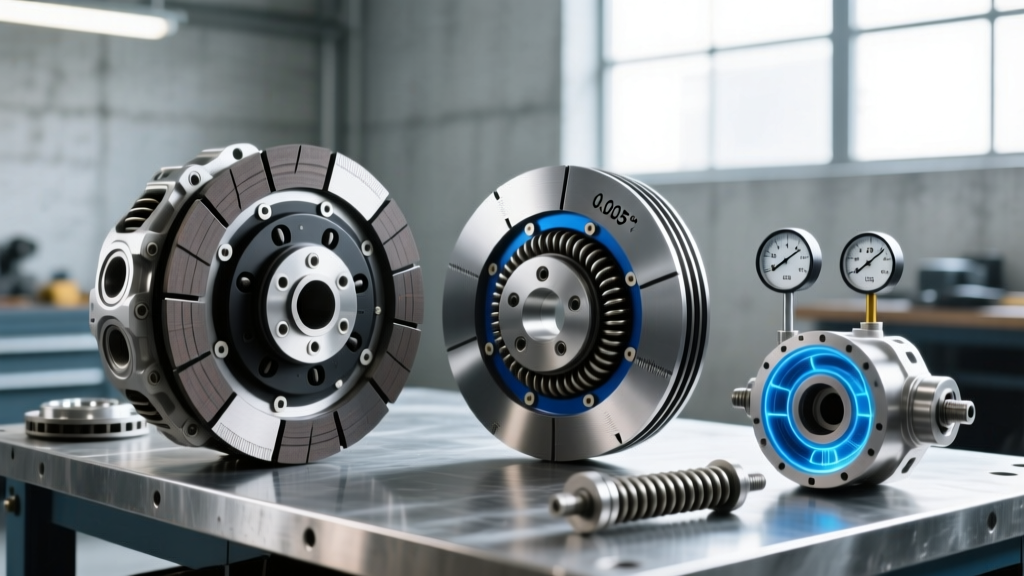
- Acceptable Runout: Less than 0.004 inches (0.10mm).
- Marginal Runout: 0.005 to 0.008 inches. This will cause minor chatter during initial engagement but may bed in over time.
- Failure Point: Greater than 0.008 inches. The pressure plate cannot compensate for this variance, leading to localized hot spots, glazing, and eventual clutch slip.
If your vehicle features a solid cast-iron flywheel, a local machine shop can resurface it for roughly $60 to $120. However, if the flywheel has deep heat cracks (checking) or is a stepped flywheel that has been machined past its minimum thickness specification, it must be replaced. Always verify the step height using a caliper and straight edge; for many Nissan and Subaru applications, the step height must remain between 0.020 and 0.040 inches to ensure the pressure plate maintains proper clamping geometry.
The Dual-Mass Flywheel (DMF) Dilemma
If you drive a modern turbocharged manual or a Dual-Clutch Transmission (DCT) like the VW/Audi DQ250 6-speed, your vehicle likely uses a Dual-Mass Flywheel. The DMF contains internal arc springs designed to absorb torsional vibrations.
When these internal springs break or wear out, the flywheel can no longer maintain a flat friction surface. This results in severe clutch chatter, slipping under load, and a distinct rattling noise at idle.
How to Measure DMF Wear
According to Sachs Automotive, you can check DMF health without removing the transmission by measuring rotational free-play. Using a specialized dial indicator or a marked reference point, the rotational play between the primary and secondary flywheel masses should not exceed 1.5mm (or roughly 3 degrees of rotation). If the secondary mass rocks back and forth with a metallic clunk, the DMF is destroyed. No friction disc replacement will fix this; the entire flywheel assembly must be replaced.
2026 Repair Cost & OEM Part Number Reference
To help you budget your repair, we have compiled current market pricing and verified part numbers for common engagement and disengagement fixes. You can cross-reference these on platforms like RockAuto or directly through Tremec distributors.
| Component / Fix | OEM / Premium Part Number | Est. Parts Cost (2026) |
|---|---|---|
| Clutch Master Cylinder (Honda K20) | Exedy HMC01 / Honda 46920-SNA-A05 | $45 - $85 |
| Concentric Slave Cylinder (GM LS/T56) | Sachs SH5015 | $70 - $120 |
| Dual-Mass Flywheel (VW 2.0T TSI) | Sachs 2290 601 017 | $650 - $850 |
| Hydraulic Line Upgrade (Stainless Braided) | Techna-Fit Custom Clutch Line | $35 - $60 |
| Flywheel Resurfacing (Local Machine Shop) | N/A (Service) | $60 - $120 |
Final Thoughts on Drivetrain Diagnostics
Finding the correct clutch slipping fix requires methodical elimination. Never assume the friction disc is dead until you have verified hydraulic pressure, measured pedal free-play, and inspected the flywheel surface. By understanding the precise tolerances of your master cylinder, slave travel, and flywheel runout, you can confidently diagnose engagement issues and avoid paying for unnecessary transmission-pulling labor. Keep your hydraulic fluid flushed every two years, respect your pedal free-play specs, and your drivetrain will deliver seamless power transfer for miles to come.