The Financial Reality of Clutch Hydraulic System Bleeding Procedures
When your manual transmission vehicle develops a spongy pedal or struggles to engage gears, the culprit is often air trapped in the hydraulic lines. Performing proper clutch hydraulic system bleeding procedures is not just a mechanical necessity; it is a financial decision. In 2026, with shop labor rates averaging between $140 and $195 per hour, understanding the cost breakdown of bleeding a clutch slave cyl (cylinder) is critical for both DIY enthusiasts and budget-conscious drivers. This comprehensive cost analysis dissects the expenses associated with DIY bleeding, professional shop rates, tooling investments, and the hidden financial nightmares that can arise from neglected hydraulic maintenance.
DIY vs. Professional Service: The Core Cost Matrix
Before turning a single wrench, you must decide who will perform the bleed. The cost disparity between doing it yourself and hiring a professional is staggering, primarily due to the billable hours shops assign to hydraulic diagnostics and fluid flushing.
| Service Route | Estimated Cost (2026) | Time Investment | Best For |
|---|---|---|---|
| DIY (Basic Gravity/Pedal Bleed) | $15 - $35 (Fluid only) | 1 - 2 Hours | External slaves, simple setups, tight budgets |
| DIY (Pressure/Vacuum Tools) | $65 - $140 (Tools + Fluid) | 45 - 90 Minutes | Internal slaves, ABS-integrated systems, solo mechanics |
| Independent Shop Labor | $120 - $220 | 1 - 1.5 Billable Hours | Drivers lacking tools or time |
| Dealership Service Center | $180 - $350+ | 1.5 - 2 Billable Hours | Warranty-covered vehicles, complex OEM procedures |
Note: If the clutch slave cyl requires replacement rather than just a bleed, parts will add $40 to $180 for external units, and $150 to $450 for internal Concentric Slave Cylinders (CSC), plus transmission removal labor.
Tooling & Equipment: Investing in the Right Bleeder
Cheap tools cost you time and fluid; quality tools pay for themselves by preventing air ingestion. When bleeding a clutch slave cyl, the volume of the system is small (typically 0.5L to 1.0L total capacity), but the lines are often routed high above the master cylinder, creating natural air traps.
1. Vacuum Bleeders (Cost: $35 - $80)
Tools like the Mityvac MV6835 Vacuum Brake Bleeder use suction to pull fluid from the master cylinder down through the slave. While affordable, vacuum bleeders can pull air past the threads of the bleed nipple if the threads are worn, leading to a false diagnosis of a failing master cylinder. Pro Tip: Wrap the bleed screw threads in Teflon tape or use a specialized thread sealant when vacuum bleeding to prevent false air ingestion.
2. Pressure Bleeders (Cost: $50 - $150)
Pressure systems, such as those from Motive Products, attach directly to the master cylinder reservoir and push fluid down at 10-15 PSI. This is the gold standard for bleeding internal clutch slave cyl setups found in modern vehicles like the Ford Mustang (MT-82 transmission) or GM Camaro (Tremec T56 Magnum). A quality Motive Power Bleeder costs around $75 and includes a universal cap that fits most DOT fluid reservoirs.
3. Speed Bleeders (Cost: $15 - $25 per pair)
Upgrading your stock bleed nipple to a Russell Performance Speed Bleeder (e.g., Part #639510 for M8x1.0 or #639520 for M10x1.0 threads) features an internal check valve. This allows a single person to pump the clutch pedal without air being sucked back into the line when the pedal returns. At $18 a pair, this is the most cost-effective hardware upgrade for frequent track-day drivers who bleed their hydraulics monthly.
Fluid Chemistry & Pricing: DOT 3 vs. DOT 4 vs. DOT 5.1
The hydraulic fluid you choose directly impacts both your wallet and the boiling point of your clutch system. Clutch systems endure immense heat, especially when the slave cylinder is located inside the transmission bellhousing (Internal CSC), where ambient temperatures can exceed 250°F (121°C).
- Standard DOT 3 (e.g., Valvoline, Prestone): ~$6 to $10 per liter. Dry boiling point: 205°C (401°F). Adequate for daily drivers with external slave cylinders, but prone to vapor lock in high-heat bellhousings.
- High-Performance DOT 4 (e.g., Motul RBF 600): ~$22 to $28 per liter. Dry boiling point: 312°C (594°F). According to Motul's official specifications, this fluid is engineered for high thermal resistance. This is the mandatory choice for internal clutch slave cyl applications to prevent fluid boil and pedal fade.
- DOT 5.1 (e.g., Castrol SRF or Liqui Moly): ~$18 to $35 per liter. High wet boiling point, hygroscopic (absorbs water). Excellent for modern European vehicles (like those with ZF or Getrag manual transmissions) that specify DOT 5.1 from the factory.
Expert Warning: Never use DOT 5 (Silicone-based) fluid in a standard hydraulic clutch system. It is not hygroscopic, meaning water will pool in the lowest point of the system (the clutch slave cyl), causing severe internal corrosion and catastrophic seal failure.
Hidden Costs: The Internal vs. External Slave Cylinder Dilemma
The most critical cost variable in clutch hydraulic system bleeding procedures is the physical location of the slave cylinder. Misdiagnosing a bad bleed can lead to catastrophic financial overspending.
External Slave Cylinders (The Budget-Friendly Scenario)
Found on older vehicles, Honda K-Series engines, and many Jeep Wranglers (AX15/NV3550 transmissions). The slave is mounted on the outside of the bellhousing.
Bleeding Difficulty: Low.
Hidden Cost Risk: Minimal. If the bleed nipple snaps off due to corrosion, you simply replace the entire slave cylinder assembly. A replacement OEM Aisin or Luk external slave costs between $45 and $90 on RockAuto, and installation takes 20 minutes.
Internal Concentric Slave Cylinders (CSC) (The Financial Minefield)
Standard on most modern manual cars (e.g., GM LS platforms, Ford Coyote, Nissan CD009). The slave cylinder wraps around the transmission input shaft inside the bellhousing.
Bleeding Difficulty: High. Air naturally rises to the top of the bellhousing, making it incredibly difficult to purge without specialized reverse-bleeding or high-pressure techniques.
Hidden Cost Risk: Extreme. If you strip the internal bleed nipple, or if the CSC seal blows out during a high-pressure bleed attempt, the transmission must be removed from the vehicle to access the part. In 2026, a shop will charge 6 to 9 hours of labor ($850 - $1,750) just to drop the transmission and replace a $180 internal slave. Always use a reverse bleeder or strictly monitor pressure (never exceed 15 PSI) when bleeding an internal clutch slave cyl.
Step-by-Step Cost-Effective Reverse Bleeding Procedure
To minimize fluid waste and eliminate the need for a second person (saving you the cost of buying a friend lunch or paying a shop), reverse bleeding is the most efficient method for stubborn clutch hydraulics. This pushes fluid from the slave cylinder UP to the master cylinder, naturally carrying air bubbles with the flow of gravity.
- Preparation ($0): Extract all old, degraded fluid from the master cylinder reservoir using a turkey baster. Refill with fresh DOT 4 fluid to the MAX line.
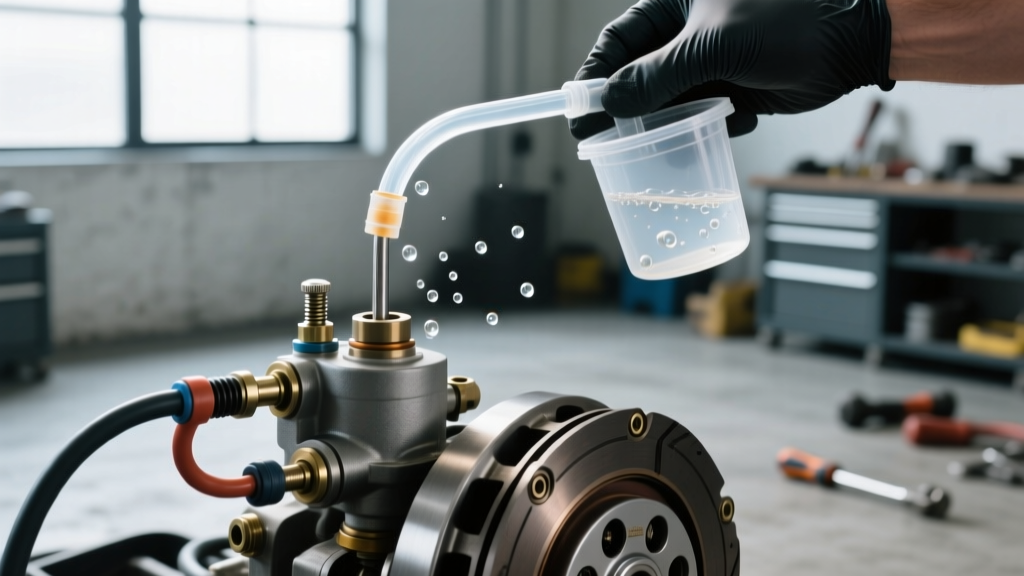
- Tool Setup ($40 tool cost): Attach a reverse fluid injector (like the Motive Products Power Bleeder adapted for reverse, or a specialized syringe kit) to the clutch slave cyl bleed nipple.
- Thread Sealing ($1 cost): Apply a small amount of silicone paste or Teflon tape to the bleeder threads to ensure vacuum/pressure integrity.
- Injection (Free): Slowly push new fluid upward. Watch the master cylinder reservoir closely. Do not let it overflow, as DOT fluid will strip paint and ruin engine bay plastics.
- Torque Specifications (Crucial): Once the fluid runs clear and bubble-free, close the bleed nipple. The standard torque spec for an M8x1.0 steel bleed screw into an aluminum or cast-iron slave body is strictly 8 to 12 Nm (6 to 9 lb-ft). Over-torquing will snap the screw, instantly converting a $20 DIY job into a $500+ repair.
- Pedal Testing: Pump the clutch pedal 15-20 times to seat the internal seals and verify a firm engagement point.
Final Verdict: Protecting Your Drivetrain Investment
Bleeding a clutch slave cyl is a masterclass in preventive maintenance. Spending $25 on high-temp DOT 4 fluid and a basic pressure bleeder every two years prevents the premature wear of your clutch friction disc and throwout bearing. When approaching clutch hydraulic system bleeding procedures, respect the torque specs, understand the thermal limits of your fluid, and always factor in the physical location of your slave cylinder before applying excessive air pressure. By mastering this cost-effective DIY procedure, you keep your manual transmission shifting crisply and your wallet intact.