The Hidden Lifeline of Your Manual Transmission
When diagnosing a spongy pedal, a dragging clutch, or erratic gear engagement, enthusiasts often immediately suspect the friction disc, pressure plate, or throw-out bearing. However, the root cause frequently lies within the hydraulic system—specifically, the degradation of the fluid inside the clutch line. As we navigate the 2026 automotive landscape, where high-torque EV conversions utilizing manual gearbox adaptations and hybrid manual-assist systems are becoming more prevalent, thermal management and hydraulic stability are more critical than ever.
The hydraulic clutch line operates under immense pressure and extreme thermal stress, particularly where the slave cylinder mounts near the exhaust or transmission bell housing. Using the incorrect fluid, or neglecting to flush hygroscopic fluids, leads to vapor lock, internal master cylinder corrosion, and catastrophic slave cylinder failure. This preventive maintenance guide breaks down the chemistry, specifications, and real-world maintenance protocols for clutch hydraulic fluids.
Decoding FMVSS 116: What the DOT Ratings Actually Mean
In the United States, all glycol and silicone-based brake and clutch fluids must meet the Federal Motor Vehicle Safety Standard (FMVSS) No. 116. This standard dictates minimum dry and wet boiling points, viscosity parameters, and chemical compatibility. Understanding these thresholds is vital for selecting the right fluid for your specific clutch line setup.
| Fluid Type | Base Chemistry | Min Dry Boiling Point | Min Wet Boiling Point | Hygroscopic? |
|---|---|---|---|---|
| DOT 3 | Glycol-Ether | 205°C (401°F) | 140°C (284°F) | Yes |
| DOT 4 | Glycol-Ether / Borate | 230°C (446°F) | 155°C (311°F) | Yes |
| DOT 5.1 | Glycol-Ether / Borate | 260°C (500°F) | 180°C (356°F) | Yes |
| DOT 5 | Silicone-Based | 260°C (500°F) | 180°C (356°F) | No |
| LHM / LHM+ | Mineral Oil | N/A (OEM Specific) | N/A | No |
Glycol vs. Silicone vs. Mineral Oil: The Chemical Divide
DOT 3, DOT 4, and DOT 5.1 (Glycol-Ether)
The vast majority of modern manual vehicles—from a Subaru WRX with a 6-speed manual to a Porsche 911 GT3—utilize glycol-ether-based fluids. These fluids are hygroscopic, meaning they actively absorb moisture from the atmosphere through microscopic pores in rubber clutch lines and reservoir breathers. While DOT 4 remains the factory standard for most OEMs (such as BMW and Ford), upgrading to a high-performance DOT 4 (like Motul RBF 600) or DOT 5.1 provides a significantly higher wet boiling point, safeguarding against vapor lock during track use or heavy towing.
DOT 5 (Silicone-Based)
DOT 5 is silicone-based and hydrophobic (it does not absorb water). While it sounds ideal for a classic car that sits in a garage for months, DOT 5 is generally not recommended for high-performance clutch lines. Silicone fluid is highly compressible compared to glycol, resulting in a spongy pedal feel. Furthermore, any water that enters the system will pool in low spots (like the slave cylinder), leading to localized boiling and severe corrosion.
LHM and Mineral Oils
Vehicles manufactured by Citroën, Peugeot, and certain classic Rolls-Royce models utilize a centralized hydraulic system that relies on Mineral Oil (LHM/LHM+). Never introduce glycol-based DOT fluid into an LHM system. The seals in these master and slave cylinders are formulated exclusively for mineral oil; glycol fluids will cause the EPDM rubber seals to swell, dissolve, and fail within miles.
Preventive Maintenance: Flushing the Clutch Line
Moisture Absorption and Wet Boiling Points
Because the clutch slave cylinder is often subjected to radiant heat from the exhaust and transmission casing, fluid temperatures can easily exceed 100°C (212°F). If your DOT 4 fluid has absorbed 3% water by volume (which typically takes 18 to 24 months), its boiling point plummets from 446°F down to the 311°F threshold. Once the fluid boils, it turns into a compressible gas, and your clutch pedal will drop to the floor without disengaging the transmission.
Pro-Tip: Invest in an electronic brake fluid moisture tester (measuring dielectric constant). If the tester indicates >2% moisture content in the clutch master cylinder reservoir, it is time for an immediate flush, regardless of mileage.
Real-World Flush Intervals and Costs
- OEM Interval: Every 2 years or 30,000 miles.
- Track/Heavy-Duty Interval: Every 1 year or before every competitive season.
- DIY Cost: $15 to $35 for premium fluid (e.g., Castrol SRF Racing or Endless RF-650).
- Professional Labor: $90 to $160 for a dealership or specialist to perform a pressure bleed.
Edge Cases: Internal Slaves and Clutch Delay Valves
Ford Internal Slave Cylinders (Tremec TR-3450 / MT-82)
In vehicles like the Ford Mustang GT equipped with the MT-82 or older Tremec TR-3450 transmissions, the Concentric Slave Cylinder (CSC) is located inside the bell housing. If the hydraulic fluid degrades and boils, or if the rubber clutch line expands under pressure, the CSC can over-extend and pop out of its bore, requiring a transmission drop to fix. Preventive maintenance here mandates using a high-temperature DOT 4 fluid and upgrading the factory rubber clutch line to a braided stainless-steel line (such as those from Goodridge or Earl's) to eliminate volumetric expansion.
Honda/Acura Clutch Delay Valves (CDV)
Many modern Honda and Acura manuals feature a Clutch Delay Valve inside the slave cylinder or clutch line to smooth out engagement for novice drivers. When flushing the clutch line on these vehicles, the CDV can trap air and old fluid. To properly bleed these systems, technicians must often remove the CDV or use a high-pressure reverse bleeder to force fluid upward, ensuring no micro-bubbles remain trapped behind the valve restriction.
Bleeder Valve Torque Specifications and Hardware Care
One of the most common failures during a DIY clutch line flush is snapping the bleeder screw on the slave cylinder. Most OE slave cylinders (such as those manufactured by FTE/Valeo or LuK) utilize soft aluminum or cast iron bodies with delicate bleeder screws.
- M8 x 1.0 Bleeder Screws: Torque to 7 to 10 Nm (62 to 88 lb-in).
- M10 x 1.0 Bleeder Screws: Torque to 12 to 15 Nm (106 to 132 lb-in).
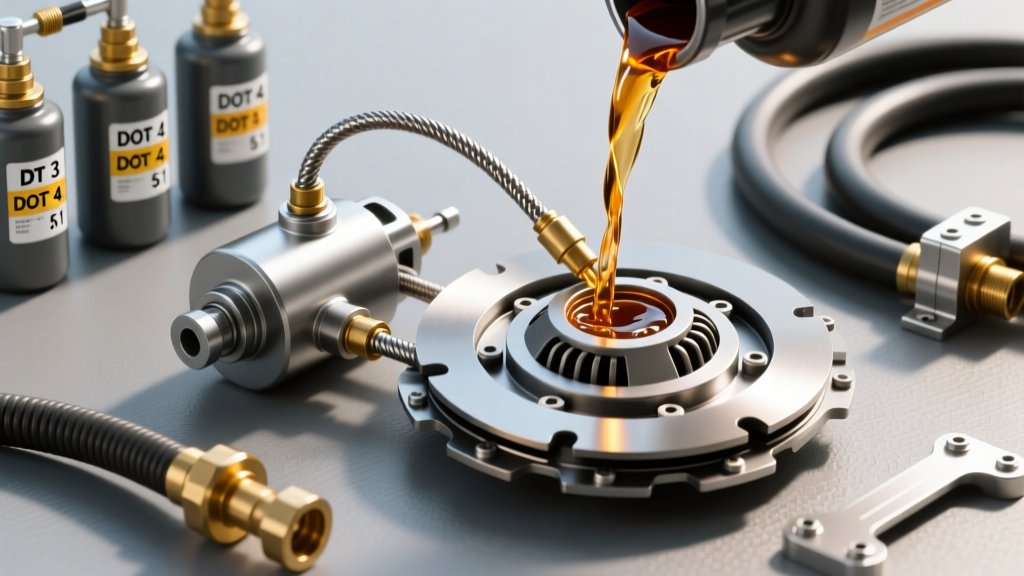
Always use a 6-point flare nut wrench or a dedicated bleeder wrench to avoid rounding the hex head. If utilizing a vacuum bleeder (like the Mityvac MV6835), be aware that vacuum can pull air past the threads of the bleeder screw, giving the illusion of air in the clutch line. A pressure bleeder (such as the Motive Products 109) set to 15-20 PSI is the industry standard for safely pushing old, moisture-laden fluid out of the master cylinder, through the clutch line, and out of the slave cylinder without introducing false aeration.
Conclusion
Your clutch line is only as reliable as the fluid flowing through it. By understanding the chemical differences between DOT ratings, respecting the hygroscopic nature of glycol fluids, and adhering to strict 24-month flush intervals, you can prevent catastrophic slave cylinder failures and maintain a crisp, predictable pedal feel. Whether you are daily driving a commuter hatchback or tracking a high-horsepower build, precise fluid selection and meticulous bleeding procedures are the ultimate preventive maintenance tools.