When diagnosing a mechanical issue, reviewing a warranty booklet, or simply trying to understand how your compact SUV operates, the terms powertrain and drivetrain are frequently—and incorrectly—used interchangeably. For owners of the Chevrolet Trax, understanding the exact mechanical boundary between these two systems is critical, especially when dealing with the unique all-wheel-drive (AWD) configurations of the first generation or the front-wheel-drive (FWD) setup of the 2024–2026 models.
In this beginner-friendly explainer, we will use the Chevy Trax drivetrain and powertrain as our primary case study. We will break down the exact components, fluid capacities, torque specifications, and real-world failure points (like the infamous Gen 1 PTU issues) so you know exactly what you are paying for when a mechanic quotes a repair.
The Core Distinction: Generation vs. Delivery
The easiest way to separate the two systems is by their primary function:
- The Powertrain is the generation system. It creates the rotational force (torque) required to move the vehicle.
- The Drivetrain is the delivery system. It takes that rotational force from the powertrain and routes it to the wheels that are in contact with the road.
What Makes Up the Chevy Trax Powertrain?
Regardless of whether you are driving a 2017 AWD model or a 2026 FWD model, the powertrain consists of two main assemblies:
- The Engine: First-generation models (2015–2022) utilize the 1.4L Ecotec LE2 turbocharged inline-4. The redesigned second-generation (2024–2026) uses the newer 1.2L Ecotec LIH turbocharged inline-3.
- The Transmission: Gen 1 models are paired with the GM 6T40 6-speed automatic transaxle. Gen 2 models use an updated, lighter 6-speed automatic designed specifically for the 1.2L platform.
If your engine throws a timing chain code, or your 6T40 transmission experiences a solenoid body failure, you are dealing with a powertrain issue.
What Makes Up the Chevy Trax Drivetrain?
Everything bolted to the output shaft of the transmission and extending outward to the wheel hubs is considered the drivetrain. The configuration of the Chevy Trax drivetrain depends entirely on the generation and drivetrain layout (FWD vs. AWD).
Gen 1 AWD vs. Gen 2 FWD: A Drivetrain Comparison
The most complex version of the Chevy Trax drivetrain is found in the 2015–2022 AWD models. Because the 6T40 transmission is inherently a FWD transaxle, GM had to engineer a workaround to send power to the rear wheels. This resulted in a multi-piece drivetrain that is highly prone to specific, expensive failures.
| Feature | Gen 1 AWD Drivetrain (2015–2022) | Gen 1 & 2 FWD Drivetrain (All Years) |
|---|---|---|
| Power Routing | Transaxle ➔ PTU ➔ Prop Shaft ➔ Rear Diff ➔ Rear Axles | Transaxle ➔ Intermediate Shaft ➔ Front Half-Shafts |
| Key Unique Component | Power Transfer Unit (PTU) | Passenger-side Intermediate Shaft |
| Common Failure Point | PTU internal bearing starvation | Torn outer CV boots / Axle nut backing out |
| Avg. Repair Cost (2026) | $1,400 – $2,200 (PTU Replacement) | $250 – $450 (CV Axle Assembly) |
Deep Dive: The Gen 1 AWD PTU Problem
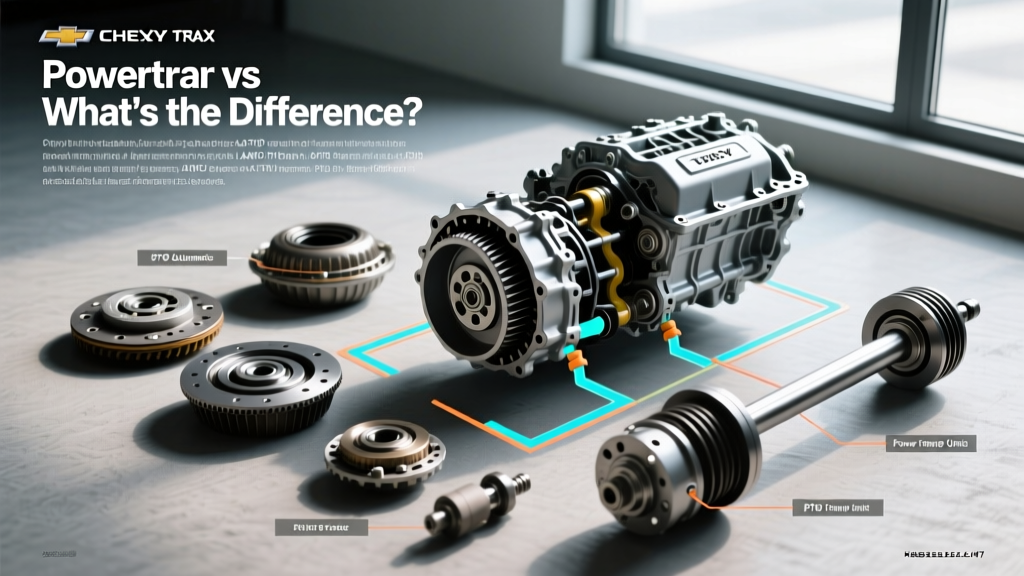
If you own a first-generation AWD Trax, you must understand the Power Transfer Unit (PTU). The PTU is essentially a transfer case bolted directly to the side of the 6T40 transmission. It uses an internal gearset to split torque front-to-rear.
The Engineering Flaw: The PTU is mounted perilously close to the exhaust catalytic converter. Furthermore, it holds a minuscule amount of fluid—typically just 0.4 quarts (approx. 380ml) of 75W-85 synthetic gear oil. Because of the extreme heat soak from the exhaust and the low fluid volume, the internal bearings of the PTU frequently overheat, score, and ultimately disintegrate. When this happens, you will hear a distinct whining or grinding noise from the passenger side of the engine bay that changes pitch with vehicle speed, not engine RPM.
Pro-Tip from the Garage: If you are buying a used Gen 1 AWD Trax, put it on a lift and look at the PTU. If you see caked-on black grime around the PTU seal, it means the unit has been weeping fluid, accelerating internal bearing failure. According to NHTSA complaint databases, PTU seizure is one of the most common drivetrain-related complaints for this generation.
Real-World Maintenance: Fluids and Torque Specs
Whether you are performing DIY maintenance or verifying a mechanic's invoice, having the exact specifications for the Chevy Trax drivetrain and powertrain is vital. Below are the critical service numbers for the widely serviced Gen 1 (1.4L / 6T40) platform.
Powertrain Fluid Capacities
- 6T40 Automatic Transmission: 6.0 Quarts (5.7 Liters) of ACDelco Dexron VI ATF. (Note: A dry fill is 9.0 quarts, but a standard drain-and-fill yields about 6.0 quarts).
- Engine Oil (1.4L LE2): 4.2 Quarts (4.0 Liters) of 5W-30 Full Synthetic (dexos1 approved).
Drivetrain Fluid Capacities (AWD Models Only)
- PTU (Power Transfer Unit): 0.4 Quarts (380 ml) of 75W-85 Synthetic Gear Oil. Crucial: Many shops claim this is a 'sealed' lifetime unit. It is not. It must be extracted via the fill plug using a fluid pump every 30,000 miles to prevent catastrophic bearing failure.
- Rear Differential: 0.6 Quarts (570 ml) of 75W-85 Synthetic Gear Oil.
Drivetrain Fastener Torque Specifications
When replacing front CV axles (half-shafts), improper torque is a leading cause of drivetrain vibration and premature hub bearing wear. Always use a calibrated torque wrench.
- Front Hub/Bearing Assembly Bolts: 90 Nm (66 lb-ft).
- Front Axle Shaft Nut (M12/M14 depending on year): Typically 210 Nm (155 lb-ft). Note: Some model years utilize a torque-to-yield (TTY) axle nut that requires a specific torque plus an additional degree turn. Always replace TTY nuts; never reuse them.
- Lower Ball Joint Pinch Bolt: 50 Nm (37 lb-ft).
How Warranties Treat the Chevy Trax Drivetrain vs Powertrain
The distinction between these two systems becomes incredibly important when your vehicle is in the shop and you are hoping for warranty coverage. Chevrolet's standard factory warranty includes a 5-year/60,000-mile Powertrain Limited Warranty. But what does that actually cover?
According to the official Chevrolet Owner Center warranty guidelines, the Powertrain warranty explicitly covers the internal, lubricated parts of the engine and the transmission (like the 6T40 torque converter, valve body, and planetary gears).
Where the Drivetrain Falls Short in Warranty Coverage: While the AWD PTU and rear differential internal gears are generally covered under the powertrain/drivetrain warranty if they fail due to manufacturer defect, wear-and-tear drivetrain components are strictly excluded. If your Chevy Trax drivetrain experiences the following, you will be paying out of pocket:
- Torn CV axle boots and clicking CV joints.
- Worn U-joints on the AWD propeller shaft.
- Leaking axle seals (unless the leak directly caused internal transmission/differential failure).
- Vibrations caused by unbalanced or bent driveshafts from road debris impact.
Diagnosing Noises: Is it the Powertrain or the Drivetrain?
As a Trax owner, you can perform basic diagnostic triage based on the sounds your vehicle makes while driving. Resources like GM Authority frequently highlight how turbo and transmission quirks can mimic drivetrain failures.
- Whining that changes with Engine RPM (in Park/Neutral): This is a powertrain issue. It could be the 1.4L turbo wastegate, a failing engine accessory bearing, or internal transmission pump whine.
- Clicking/Popping when Turning: This is a classic drivetrain issue. The outer CV joint on your front half-shaft has lost grease due to a torn boot and the bearings are failing.
- Clunking upon Acceleration/Deceleration: In AWD models, this points to drivetrain slack. It could be worn U-joints on the prop shaft, or a failing rear differential coupling.
- Shuddering at 40-50 MPH under light throttle: This is a known 6T40 powertrain issue, often related to a failing torque converter clutch (TCC) solenoid or degraded transmission fluid, rather than a drivetrain axle problem.
Summary
Understanding the boundary between the Chevy Trax drivetrain and powertrain saves you time, money, and frustration. The powertrain (engine and 6T40 transmission) generates the power, while the drivetrain (axles, PTU, and differentials) delivers it to the pavement. By adhering to strict maintenance intervals—especially the severely neglected PTU fluid service on AWD models—and knowing the exact torque specs for drivetrain components, you can easily push your Trax well past the 150,000-mile mark.