The Context Behind the 2019 Jeep Cherokee Rear Differential Recall
The fifth-generation Jeep Cherokee (KL platform) introduced a highly sophisticated, fully automatic four-wheel-drive system known as Active Drive. While this system provides excellent all-weather traction, it has not been without its engineering hurdles. When owners and mechanics search for the 2019 Jeep Cherokee rear differential recall, they are typically referring to a cluster of Technical Service Bulletins (TSBs) and extended warranty campaigns related to the Rear Drive Module (RDM). Unlike traditional solid-axle differentials found on the Wrangler, the KL Cherokee utilizes an independent rear suspension with a bolted-in RDM that houses the ring and pinion, bearings, and, on Active Drive II models, an Electronic Limited-Slip Differential (ELSD) clutch pack.
Water intrusion, premature bearing wear, and Power Transfer Unit (PTO) seal degradation have plagued early KL models, prompting FCA (now Stellantis) to issue service campaigns and software updates to manage clutch pack engagement and prevent catastrophic gear failure. If you own or service a 2019 Cherokee, understanding the intersection of these recall-related failure modes and proactive rear differential service is critical for preserving the drivetrain.
Symptom Diagnosis: Is Your Rear Drive Module Failing?
Before performing a fluid exchange, it is vital to diagnose the exact nature of the noise or vibration. The RDM operates under high stress, and symptoms of failure often mimic standard gear wear but can actually point to the very defects covered under the 2019 Jeep Cherokee rear differential recall and associated TSBs.
1. High-Pitched Whining (40-65 MPH)
A consistent whine that changes pitch with vehicle speed—but not engine RPM—usually indicates ring and pinion gear wear or improper bearing preload. In the 2019 Cherokee, this is frequently caused by microscopic water intrusion past the axle seals, which emulsifies the 75W-85 synthetic gear oil and destroys its hydrodynamic film. If the fluid looks like a chocolate milkshake upon draining, the RDM bearings are likely compromised.
2. Clunking or Shuddering on Engagement
If you feel a distinct 'clunk' from the rear of the vehicle when shifting from Reverse to Drive, or a shudder during tight, low-speed turns, the issue may lie within the ELSD clutch pack (Active Drive II) or the RDM's internal dog clutches. Stellantis released wiTECH 2.0 software updates to recalibrate the clutch pack engagement pressures. A fluid change alone will not fix a shudder caused by outdated RDM calibration software.
3. Fluid Weeping from the PTO or Axle Seals
Inspect the front of the RDM where the driveshaft connects. The PTO seal is a known weak point. If gear oil is slung onto the exhaust or rear crossmember, the seal has failed. Running the RDM low on fluid will starve the pinion bearing, leading to a $2,500+ complete RDM replacement.
Expert Diagnostic Tip: Always check your VIN against the NHTSA Recall Database or Mopar Owner Connect before paying out of pocket for an RDM replacement. Certain 2018-2019 KL Cherokees are covered under extended powertrain warranties for specific internal bearing and seal failures.
OEM Fluid Specifications and Hardware Data
Using the correct fluid is non-negotiable for the KL Cherokee's RDM. The Active Drive system relies on specific friction modifiers to prevent chatter in the ELSD clutch packs and to ensure the dog clutches engage smoothly without grinding. Do not substitute standard 80W-90 or generic 75W-90 gear oils, as they lack the necessary friction modifiers and viscosity profiles required by the ZF-designed rear module.
| Specification / Component | OEM Requirement / Value | Part Number / Notes |
|---|---|---|
| Rear Diff Fluid Type | 75W-85 Synthetic Gear & Axle Lubricant | Mopar PN 68218655AA (or 05016790AC) |
| RDM Fluid Capacity | 1.15 Liters (approx. 38.8 fl oz) | Buy 2 quarts to ensure complete fill |
| Drain Plug Torque | 34 Nm (25 lb-ft) | 14mm Hex / Allen bit required |
| Fill Plug Torque | 34 Nm (25 lb-ft) | 14mm Hex / Allen bit required |
| ELSD Clutch Pack Fluid | Specific ELSD Fluid (If separated) | Consult TSB; usually integrated in RDM |
Comprehensive Rear Differential Service Procedure
Performing a rear differential service on the 2019 Cherokee is straightforward, but it requires strict adherence to torque specifications and fill-level verification. Because the RDM does not have a traditional removable differential cover, the service is performed via drain and fill plugs located on the rear housing.
Step 1: Vehicle Preparation and Safety
Raise the vehicle on a professional two-post lift or support it securely on four jack stands. The vehicle must be perfectly level to ensure an accurate fluid fill. If the Cherokee is tilted forward or backward, the fluid level will be incorrect, leading to either starvation of the pinion bearing or over-pressurization and seal blowout.
Step 2: The 'Fill-First' Rule
Before touching the drain plug, locate the fill plug on the rear-facing side of the RDM housing. Use a 14mm Allen socket to break it loose. Never drain a differential before confirming you can remove the fill plug. If the fill plug is seized or stripped, you will be left with an empty RDM and a stranded vehicle.
Step 3: Draining and Magnetic Plug Analysis
Place a drain pan capable of holding at least 2 liters beneath the RDM. Remove the lower drain plug. Allow the fluid to drain completely; this may take up to 15 minutes as the cold 75W-85 oil is highly viscous. Inspect the magnetic drain plug closely:
- Normal: A fine, dark grey metallic paste. This is standard clutch and gear wear.
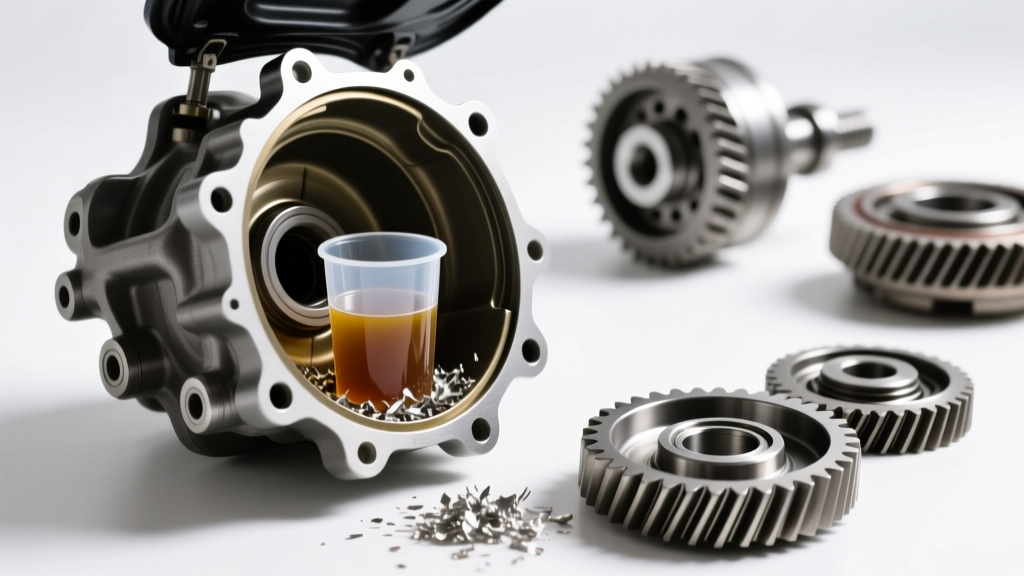
- Abnormal: Large metallic shards, chunks of steel, or brass-colored flakes. Brass indicates cage or synchronizer wear; steel chunks indicate catastrophic bearing or ring gear failure. If you see chunks, a fluid change will not save the RDM; it requires a teardown or replacement.
Step 4: Refilling to the Weep Hole
Reinstall and torque the drain plug to 25 lb-ft (34 Nm). Using a fluid transfer pump, inject the Mopar 75W-85 Synthetic Gear Oil into the fill hole. The RDM is full when the fluid reaches the absolute bottom lip of the fill plug opening and begins to weep out. Allow the excess to drip until it slows to a halt, then reinstall and torque the fill plug to 25 lb-ft.
Advanced Troubleshooting: When a Fluid Change Isn't Enough
If you have completed the service and verified the fluid level, but the vehicle still exhibits symptoms associated with the 2019 Jeep Cherokee rear differential recall, you must look beyond the gear oil.
ELSD Calibration via wiTECH 2.0
For Active Drive II models equipped with the Electronic Limited-Slip Differential, the clutch pack requires precise hydraulic pressure mapping. If the battery was recently disconnected, or if the fluid was severely degraded, the ELSD may have adapted to poor friction coefficients. A certified technician must connect the Stellantis wiTECH 2.0 scan tool to perform an 'ELSD Clutch Pack Learn' procedure. This forces the clutch pack to cycle through its engagement spectrum, recalibrating the pressure sensors.
Driveshaft and CV Joint Inspection
Sometimes, what sounds like a whining rear differential is actually a failing rear driveshaft CV joint or a worn center support bearing. To isolate the RDM, use a chassis ear (electronic stethoscope) clipped to the RDM housing and the rear crossmember during a road test. If the noise is isolated strictly to the RDM housing and correlates with the chocolate-milk fluid diagnosis, the internal tapered roller bearings have suffered spalling due to water contamination. At this stage, sourcing a remanufactured RDM or a low-mileage unit from a salvage yard is the only viable repair, as rebuilding the KL RDM requires proprietary bearing preload shims and ZF-specific tooling not readily available to independent shops.
Proactive maintenance using the exact Mopar 75W-85 specification, combined with vigilant monitoring of the PTO and axle seals, remains the best defense against the failure modes that prompted the 2019 Jeep Cherokee rear differential recall and TSB campaigns. Always document your fluid services with mileage and dates to maintain a clear history for warranty claim purposes.