The Tribology of Limited Slip Differentials
Understanding how to check differential fluid in a limited slip differential (LSD) requires far more than simply verifying the fluid level against the fill plug. Unlike an open differential, which primarily relies on fluid for gear splash lubrication and cooling, an LSD introduces complex clutch packs, helical gear meshes, or viscous couplings that generate immense localized shear forces. When you operate a clutch-type LSD—such as the Eaton Posi-Trac, Auburn Pro-Series, or Ford's 8.8-inch Traction-Lok—the internal friction materials rely entirely on the boundary lubrication provided by the gear oil and its specific chemical additives.
As of 2026, modern synthetic gear oils have vastly improved thermal stability, but the fundamental mechanics of the clutch pack remain unchanged. If the fluid degrades, the static friction coefficient exceeds the dynamic friction coefficient, resulting in the notorious 'stick-slip' phenomenon known as axle chatter. This technical deep-dive will walk you through the exact procedures, sensory diagnostics, and chemical requirements for maintaining a limited slip axle.
Step-by-Step: How to Check Differential Fluid Safely
Before breaking loose any bolts, you must adhere to the golden rule of axle service: always remove the fill plug before removing the drain plug. If your fill plug is seized or stripped, draining the axle will leave your vehicle immobile until the housing is removed and machined.
1. Vehicle Preparation and Safety
- Park the vehicle on a perfectly level surface. An inclined driveway will yield a false fluid level reading, potentially leading to under-filling and clutch pack starvation during high-load cornering.
- Lift the rear axle using a hydraulic floor jack and support it with heavy-duty jack stands placed under the axle tubes, not the leaf springs or control arms, to allow the suspension to hang naturally and keep the pinion angle at its resting ride height.
2. Cleaning and Plug Removal
Use a dedicated aerosol brake cleaner and a stiff nylon brush to clean the area surrounding the 3/8-inch or 1/2-inch square-drive fill plug. Differential housings accumulate a paste of road grime, metallic dust, and seeping oil that will contaminate your sample if not thoroughly cleaned. Insert a high-quality steel breaker bar or dedicated axle plug socket. Apply steady, counter-clockwise torque. If the plug resists, apply localized heat with a MAP gas torch to the cast iron or aluminum housing to break the threadlocker seal—avoid heating the plug itself, as thermal expansion will only tighten its grip.
3. The Level Verification Test
Insert your pinky finger or a dedicated bent dipstick tool into the fill hole. The correct fluid level is exactly at the bottom edge of the fill plug threads. If fluid immediately drips out, the level is correct. If you cannot touch the fluid, the axle is under-filled, and the upper ring gear teeth and clutch pack cooling channels are being starved of splash lubrication.
Sensory Diagnostics: Reading the Fluid's Story
Knowing how to check differential fluid also means knowing how to interpret its condition. Catch a small sample in a clean, clear glass or plastic receptacle and evaluate it using three sensory metrics:
Expert Tip: Never judge GL-5 gear oil by its color alone. The extreme pressure (EP) additives, specifically zinc dialkyldithiophosphate (ZDDP) and phosphorus compounds, naturally darken the oil to a deep amber or brownish-black within the first 500 miles. Color is a poor indicator of remaining useful life.
Olfactory Analysis (The Smell Test)
Standard GL-5 gear oil has a pungent, sulfurous odor. However, if the fluid smells distinctly like burnt marshmallows or acrid, scorched brake pads, the internal clutch packs have experienced severe slip and thermal degradation. The friction modifier additive has been completely depleted, and a full flush is mandatory.
Visual and Tactile Analysis
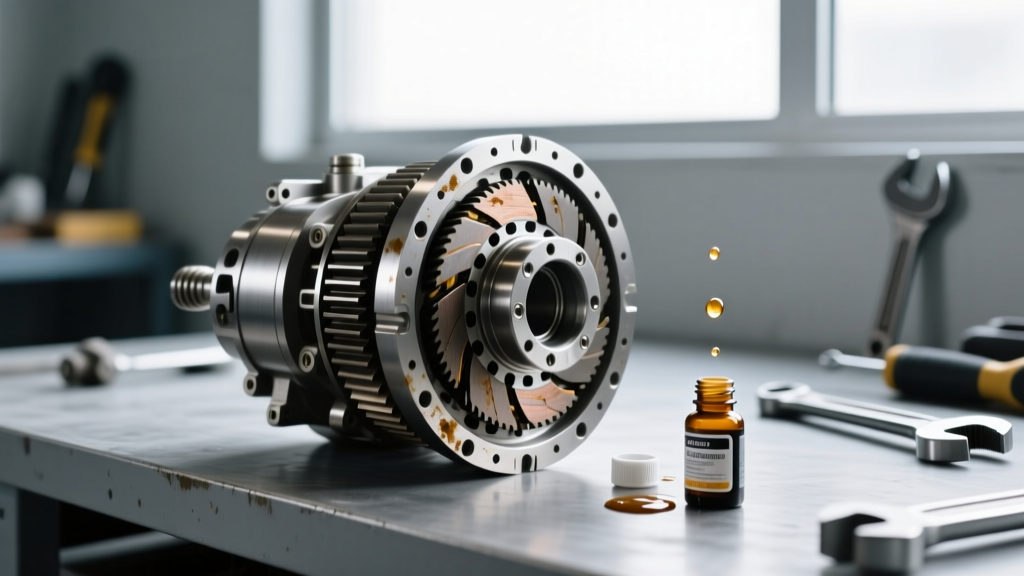
Rub a drop of the fluid between your thumb and index finger. A fine, silvery glitter is normal; this represents the expected microscopic wear of the ring and pinion gears during the initial break-in period and clutch pack bedding. However, if you feel distinct, jagged metallic particles, or if the drain plug magnet (if equipped) is covered in 'fuzz' or chunks larger than a grain of rice, you are witnessing catastrophic bearing or gear tooth failure. According to Yukon Gear & Axle Technical Articles, chunky metallic debris requires immediate teardown and inspection of the carrier bearings and pinion depth shims.
The Chemistry of Friction Modifiers
The most critical distinction when maintaining an LSD is the friction modifier (FM). Clutch-type limited slips require a specific chemical boundary layer to allow the clutches to slip smoothly during low-speed, tight-radius turns. Without this modifier, the clutches grab and release violently, causing chassis shudder and rapid wear to the clutch discs.
| LSD Type | Base Fluid Spec | Friction Modifier Required? | Common Additive Part Numbers |
|---|---|---|---|
| Clutch-Pack (Eaton, Auburn, Ford T-Lok) | API GL-5 75W-90 | Yes (Usually 2-4 oz) | Motorcraft XL-3, GM EOS (12377916), Red Line LSD Additive |
| Helical Gear (Torsen T-2, Eaton Truetrac) | API GL-5 75W-90 | No | N/A (Standard synthetic GL-5) |
| Viscous Coupling | API GL-5 75W-140 | No | N/A |
| Locking (Detroit Locker, Eaton G80) | API GL-5 75W-90 | No | N/A |
As detailed in AMSOIL's Gear Lube Basics guide, adding friction modifier to a helical gear LSD (like a Torsen) or a mechanical locker (like a Detroit Locker) will not damage the unit, but it is entirely unnecessary and reduces the locking torque capacity by lowering the friction coefficient of the gear meshes.
Precise Torque Specifications and Axle Capacities
Over-torquing differential plugs can crack cast-iron housings or strip aluminum threads, leading to expensive replacements. Always use a calibrated torque wrench when reinstalling plugs. Below are the standard specifications for the most common light-truck and SUV axles on the road today:
| Axle Model | Fluid Capacity | Fill Plug Torque | Cover Bolt Torque (if applicable) |
|---|---|---|---|
| Ford 8.8-inch (Super 8.8) | 3.75 - 4.0 Pints | 15 - 30 lb-ft | 28 - 38 lb-ft (12mm bolts) |
| GM 8.6-inch / 9.5-inch (10/14 Bolt) | 3.5 - 4.2 Pints | 20 - 25 lb-ft | 25 - 30 lb-ft |
| Dana 44 / Dana 44 HD | 3.5 - 4.0 Pints | 25 - 35 lb-ft | 30 - 40 lb-ft |
| Chrysler 8.25-inch | 3.5 Pints | 25 - 30 lb-ft | 30 lb-ft |
Diagnosing LSD Chatter: The Figure-8 Test
If you are checking the differential fluid because the driver has reported a binding sensation or 'hopping' during parking lot maneuvers, you must verify the clutch condition before condemning the fluid. Perform the Figure-8 test:
- Find an empty, paved parking lot.
- Roll the windows down and turn off the radio.
- Drive the vehicle in a tight, continuous figure-8 pattern at 5 to 10 mph, keeping the steering wheel at full lock or near full lock.
- Listen for a rhythmic 'clunk-bind-release' sound from the rear axle, and feel for lateral chassis shudder.
If chatter is present, drain the fluid, refill with fresh 75W-90 synthetic, and add the manufacturer-specified dose of friction modifier (e.g., 4 oz of Motorcraft XL-3). Drive the vehicle for 20 miles to allow the additive to penetrate the porous friction material of the clutch discs. If the chatter persists after 50 miles, the clutch packs are glazed or the preload S-springs have fatigued, requiring a complete differential rebuild.
Real-World 2026 Maintenance Costs
For DIY enthusiasts, a complete LSD fluid service using premium synthetics (like Red Line 75W-90 or Amsoil Severe Gear) and a dedicated friction modifier will cost between $45 and $65 in materials. If you opt for a professional shop, expect to pay between $120 and $180 for a rear differential service in 2026, factoring in current shop labor rates of $110-$160 per hour and environmental disposal fees. For heavy-duty towing applications, upgrading to a 75W-140 viscosity and installing an aftermarket differential cover with external cooling fins is highly recommended to manage the increased thermal load on the clutch packs.
Ultimately, knowing how to check differential fluid is your first line of defense against catastrophic axle failure. By combining precise level verification with sensory diagnostics and a strict adherence to friction modifier chemistry, you ensure your limited slip differential operates flawlessly, transferring torque exactly when and where you need it most.