Diagnosing Arctic Cat Rear Differential Failures
When rebuilding the Arctic Cat rear differential—commonly found in heavy-duty UTV and ATV platforms like the Prowler, Wildcat, and Alterra—precision is non-negotiable. These drivetrains endure extreme shock loads, deep water crossings, and abrasive trail debris. By 2026, many of these machines are logging high mileage, making differential bearing and seal replacement a critical maintenance procedure for off-road enthusiasts and fleet operators alike.
Before tearing into the housing, accurate diagnosis saves time and money. A failing pinion bearing typically produces a high-pitched whine that changes pitch during deceleration, while a worn carrier bearing generates a low-frequency rumble that vibrates through the chassis during steady-state cruising. Seal failures, on the other hand, present as visible fluid weeping around the axle tubes or the pinion yoke, often accompanied by a burnt gear oil smell if the fluid drops below the ring gear splash zone.
Seal Leaks vs. Bearing Whine: The Edge Cases
Do not automatically assume a wet axle tube means a bad axle seal. On many Arctic Cat rear differentials, a clogged or kinked differential vent tube will cause internal pressure to build up as the gear oil heats up. This pressure forces oil past perfectly good seals. Always inspect the vent hose routed to the frame before ordering replacement seals. Conversely, if you find metallic glitter suspended in the drained 75W-90 fluid, the tapered roller bearings have suffered spalling and require immediate extraction.
Teardown and Inspection Best Practices
Extracting the carrier from an Arctic Cat rear differential housing requires care to avoid scoring the aluminum bore. Always mark the bearing caps and the housing with a center punch before removal. The caps are line-bored at the factory with the housing; mixing them up or installing them backward will destroy your bearing alignment and guarantee premature failure.
Once the carrier is on the bench, use a dedicated bearing puller to remove the carrier bearings. Never pry behind the bearing cage with a screwdriver, as this will gouge the carrier seating surface. Inspect the ring and pinion gear teeth for pitting, step-wear, or spalling. If the gear set is compromised, replacing the bearings alone is a temporary band-aid; a full ring and pinion swap is required.
OEM vs. Aftermarket Bearing Cross-Reference (2026 Pricing)
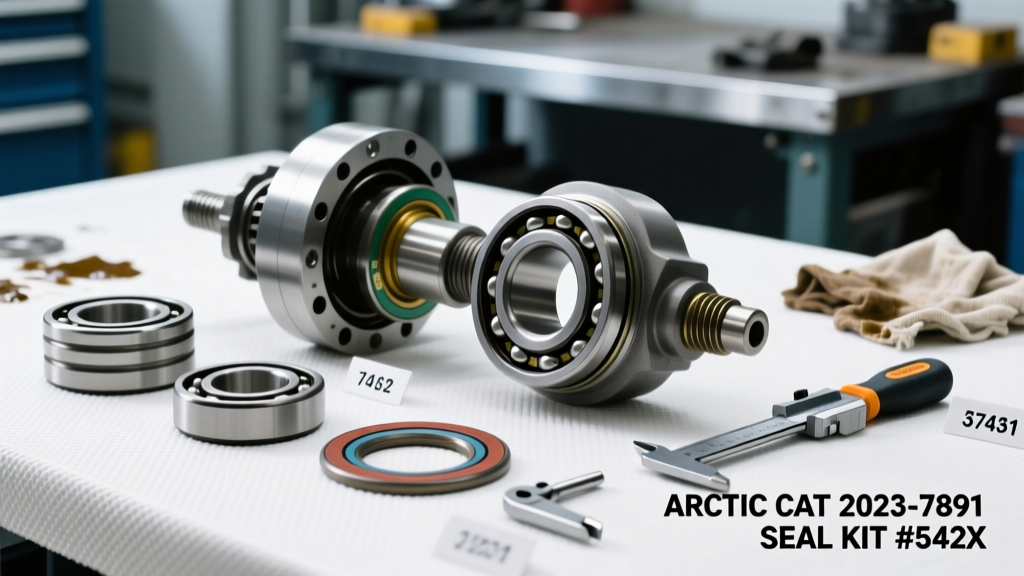
Sourcing high-quality tapered roller bearings is critical. While OEM Arctic Cat parts are reliable, premium aftermarket bearings from SKF or Timken offer identical or superior metallurgy, often at a lower price point. Below is a cross-reference guide for common Arctic Cat rear differential rebuilds.
| Component | Arctic Cat OEM Part # | SKF / Timken Equivalent | Typical Price (2026) |
|---|---|---|---|
| Carrier Bearing (Left/Right) | 0502-534 / 0502-535 | SKF 30205 J2 | $25 - $35 (Each) |
| Pinion Bearing (Inner) | 0502-516 | Timken SET-13 | $30 - $45 |
| Pinion Bearing (Outer) | 0502-517 | Timken SET-12 | $28 - $40 |
| Axle Shaft Seal | 0502-540 | SKF 18692 | $12 - $18 (Each) |
| Pinion Yoke Seal | 0502-541 | National 710112 | $10 - $15 |
Note: Always verify part numbers against your specific VIN or model year service manual, as Arctic Cat transitioned several drivetrain suppliers between the Textron acquisition and subsequent production years.
Expert Reassembly: Backlash, Preload, and Torque Specs
Reassembling the differential is where amateur mechanics fail and experts succeed. The goal is to achieve precise pinion depth, bearing preload, and ring gear backlash. According to SKF's technical guidelines on tapered roller bearings, improper preload will cause the bearings to overheat and seize within the first 50 miles of operation.
Setting Pinion Depth and Preload
If your Arctic Cat differential uses a crush sleeve for pinion preload, discard it. Expert builders universally recommend converting to a solid pinion spacer with selective shims. This eliminates the risk of over-crushing the sleeve, which leads to excessive drag and bearing burnout. Use an inch-pound torque wrench to measure rotating torque; target 12 to 18 in-lbs of drag for used bearings, or 18 to 24 in-lbs for brand-new bearings.
Dialing in Backlash
Mount a magnetic dial indicator to the housing and measure the ring gear backlash. The factory specification for most Arctic Cat UTV rear ends is between 0.006" and 0.010". Adjust the side bearing adjusters (or selective shims) equally to maintain carrier preload while dialing in the backlash. Once set, apply a thin coat of gear marking compound to three teeth on the drive and coast sides of the ring gear to verify the contact pattern. The pattern should be centered on the tooth face, slightly biased toward the heel under load.
Critical Torque Specifications
Use a calibrated torque wrench and fresh thread locker for all reassembly steps. Below are the standard torque specs for the majority of Arctic Cat solid-axle rear differentials:
- Ring Gear to Carrier Bolts: 60 ft-lbs (81 Nm) — Apply Red Loctite 271 to the threads. Do not reuse stretched bolts.
- Bearing Cap Bolts: 45 ft-lbs (61 Nm) — Ensure mating surfaces are completely clean and dry.
- Pinion Nut: 110 ft-lbs (149 Nm) — Use a holding tool on the yoke to prevent transferring shock loads to the pinion shaft splines.
- Axle Retainer Nuts: 35 ft-lbs (47 Nm)
Seal Installation and Fluid Selection
When pressing in the new axle and pinion seals, use a properly sized seal driver to ensure the seal seats squarely in the bore. A cocked seal will leak immediately. Crucially, pack the cavity between the seal lip and the garter spring with high-temperature waterproof grease (like marine-grade lithium complex). This prevents the seal lip from running dry and burning during the initial break-in period before the differential fluid splashes up to that height.
Choosing the Right Gear Oil
Arctic Cat originally specified AGL (All Gear Lube) for these differentials. For heavy-duty applications, towing, or aggressive trail riding, upgrading to a dedicated synthetic 75W-90 or 75W-140 gear oil provides superior film strength and thermal stability. Products like AMSOIL Synthetic AGL or Red Line ShockProof are formulated to handle the extreme shearing forces of hypoid gears and wet brake assemblies often found in these drivetrains.
Fill the differential to the bottom of the fill plug threads. For most Prowler and Wildcat models, this equates to roughly 32 to 40 fluid ounces. Overfilling will cause aeration and foaming, which leads to overheating and blown seals.
Pro-Tip for 2026 Rebuilds: After the first 50 miles of driving, drain and refill the differential fluid. The initial break-in period generates microscopic metallic debris from the new bearing races and gear teeth. Flushing this abrasive paste out early will double the lifespan of your rebuild.
By adhering to these exact tolerances, utilizing premium bearings, and following strict torque protocols, your Arctic Cat rear differential will deliver thousands of miles of reliable, noise-free operation, regardless of the terrain you conquer.