The Physics of Payload: How Heavy Clutch Cargos Destroy Drivetrains
For fleet managers, diesel technicians, and heavy-haul owner-operators, the manual transmission clutch remains the most vulnerable mechanical fuse in the drivetrain. When dispatching trucks rated for maximum Gross Combined Weight Ratings (GCWR), the rotational stress and thermal loads placed on the friction materials are exponential. In the commercial trucking and heavy-duty pickup sectors, we refer to these extreme payload scenarios as managing heavy clutch cargos—a situation where the sheer mass of the freight directly tests the shear limits, thermal thresholds, and torsional dampening capabilities of the clutch assembly.
Unlike passenger vehicles, commercial platforms like the Ford F-Series Super Duty equipped with the ZF S6-650 manual transmission, or the Ram Heavy Duty featuring the G56 manual gearbox, are frequently subjected to high-inertia starts on inclines. Hauling massive clutch cargos requires slipping the disc significantly longer to achieve vehicle momentum, generating surface temperatures that can exceed 800°F (426°C) in seconds. In this 2026 buyer’s guide and diagnostic manual, we will dissect the primary failure modes of heavy-duty clutches, perform root cause analysis on premature wear, and compare the top aftermarket clutch kits engineered to survive the most demanding freight routes.
Root Cause Analysis: Top 3 Commercial Clutch Failure Modes
Diagnosing a failed clutch requires more than just noting a slipping pedal. True root cause analysis demands a teardown inspection to correlate physical damage with operational habits and payload weights. Below are the three most catastrophic failure modes observed in trucks hauling extreme clutch cargos.
1. Thermal Degradation and Friction Material Glazing
When a driver rides the clutch pedal while creeping through a weigh station or attempting a hill-start with 30,000 lbs of trailer weight, the kinetic energy is converted into intense heat. Organic friction materials begin to outgas and glaze at approximately 500°F (260°C). Once glazed, the coefficient of friction plummets, leading to a feedback loop of more slipping and more heat.
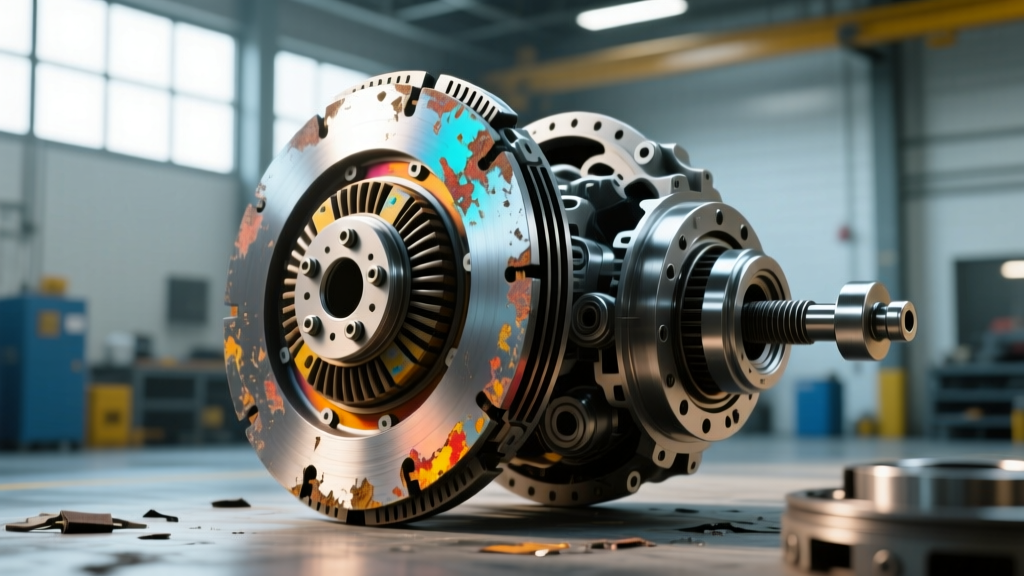
- Visual Symptom: The friction disc appears shiny, blackened, or glass-like. The flywheel and pressure plate will exhibit ‘bluing’ (oxidation from extreme heat) and micro-cracking (heat checking).
- Root Cause: Inadequate friction material for the specific clutch cargo weight, or operator error (riding the pedal). Upgrading to a sintered iron or ceramic puck disc is mandatory for fleets regularly exceeding 25,000 lbs GCWR.
2. Torsional Damper Spring Collapse
Diesel engines produce massive low-RPM torque spikes and inherent harmonic vibrations. The clutch disc hub contains torsional damper springs (and often polyurethane bump stops) designed to absorb these shockwaves before they reach the transmission input shaft. When hauling heavy clutch cargos, the engine is lugged at lower RPMs to maintain speed, amplifying torsional vibration.
- Visual Symptom: Broken or collapsed Marcel springs (the wavy springs between the friction facings), shattered hub windows, or sheared input shaft splines.
- Root Cause: Exceeding the torque capacity of the OEM torsional damper. Modified 6.7L Cummins or Powerstroke engines pushing over 800 lb-ft of torque will instantly destroy standard organic damper hubs if the payload is heavy.
3. Bellhousing Misalignment and Pilot Bearing Shear
The clutch release system relies on perfect concentricity. If the transmission bellhousing is misaligned relative to the engine block, the input shaft will bind, causing uneven wear on the release bearing and extreme side-loading on the pilot bearing. Under the heavy load of maximum clutch cargos, this side-loading leads to catastrophic pilot bearing seizure, which can rip the input shaft out of the transmission or crack the engine crankshaft flange.
- Visual Symptom: Asymmetrical wear patterns on the clutch fingers (diaphragm) or release bearing collar. The pilot bearing is seized or melted into the crankshaft bore.
- Root Cause: Manufacturing tolerances in the aluminum bellhousing, or failure to check runout during a previous clutch replacement.
Diagnostic Teardown Checklist for Fleet Technicians
Before ordering a replacement kit for a truck hauling heavy clutch cargos, technicians must complete this diagnostic checklist to prevent repeat failures:
- Measure Flywheel Step Height: Critical for diaphragm-style clutches. The step between the friction surface and the pressure plate mounting pad must be within 0.005" of OEM spec. Incorrect step height alters clamping load and causes premature release bearing failure.
- Check Bellhousing Runout: Mount a dial indicator on the engine block and sweep the bellhousing bore. Total Indicated Runout (TIR) must not exceed 0.005" (0.127mm). If it does, install offset dowel pins to correct the alignment.
- Inspect Release Fork Pivot Ball: Look for flat-spotting on the spherical pivot ball. A worn pivot changes the geometry of the clutch fork, leading to incomplete disengagement and gear grinding under load.
2026 Heavy-Duty Clutch Buyer’s Comparison Chart
Selecting the correct assembly is vital. Below is a comparison of top-tier clutch kits available in 2026, categorized by their suitability for varying levels of clutch cargos and torque outputs.
| Brand & Model | Friction Material | Torque Rating | Best Application | Est. Price (2026) |
|---|---|---|---|---|
| LuK RepSet Pro (OEM) | Organic / Full-Faced | 650 lb-ft | Light commercial, stock payload | $650 - $800 |
| Valair Quiet Triple Disc | Organic / Ceramic Blend | 1,100 lb-ft | Heavy towing, daily driving | $1,750 - $1,900 |
| South Bend SBC 3250-1 | Sintered Iron / Ceramic | 3,250 lb-ft | Extreme clutch cargos, sled pulling | $1,450 - $1,600 |
| Eaton Solo Advantage | Organic / Cerametallic | 2,250 lb-ft | Class 8 Semi-Trucks, Fleet use | $2,200 - $2,500 |
Expert Note: While sintered iron and full-ceramic pucks (like the South Bend 3250) offer unmatched holding power for the heaviest clutch cargos, they are inherently aggressive. They require higher pedal effort and can cause drivetrain shock (chatter) during low-speed parking maneuvers. For mixed-duty fleet trucks, a dual-disc organic/ceramic hybrid offers the best compromise between cargo-holding capability and driver comfort.
Installation Tolerances: Torque Specs and Runout Limits
Proper installation is just as critical as the component selection. Below are the baseline torque specifications for two of the most common heavy-duty manual transmissions found in commercial and heavy pickup applications. Always refer to the specific 2026 OEM service manual for your exact VIN.
Dodge Ram G56 Transmission (5.9L / 6.7L Cummins)
- Flywheel to Crankshaft Bolts: 129 lb-ft (175 Nm) + 90-degree turn. (Must use new torque-to-yield bolts).
- Pressure Plate to Flywheel: 35 lb-ft (47 Nm) in a star pattern.
- Bellhousing to Block: 74 lb-ft (100 Nm).
- Clutch Brake Squeeze: 0.50" to 0.75" from the floor mat for proper heavy-duty engagement.
Ford ZF S6-650 / S6-750 (6.4L / 6.7L Powerstroke)
- Flywheel to Crankshaft Bolts: 89 lb-ft (120 Nm) + 90-degree turn.
- Pressure Plate to Flywheel: 37 lb-ft (50 Nm).
- Concentric Slave Cylinder (CSC) Bleeding: Mandatory vacuum bleed at 25 inHg to prevent hydraulic aeration under heavy clutch cargo loads.
Final Verdict: Matching the Clutch to the Mission
Managing heavy clutch cargos is an exercise in thermal and mechanical management. If your fleet operates strictly within OEM GCWR limits and prioritizes driver comfort, the LuK RepXchange organic kits remain the gold standard for smooth engagement and reliable longevity. However, for severe-duty applications, modified diesels, and trucks that regularly start on steep grades with maximum payload, upgrading to a multi-disc setup from South Bend Clutch or Valair is a non-negotiable investment.
Ultimately, the root cause of most premature clutch failures is not the part itself, but a mismatch between the friction material’s thermal limits and the operational reality of the freight being hauled. By enforcing strict bellhousing runout checks, utilizing proper torque-to-yield fasteners, and selecting the correct friction compound for your specific clutch cargos, you can eliminate drivetrain downtime and keep your fleet moving through the 2026 freight season and beyond. For further reading on commercial drivetrain dynamics, consult the latest heavy-duty testing standards published by Eaton Vehicle Transmissions and the Society of Automotive Engineers (SAE).