The Acoustic Illusion: Class 8 Under-Hood Noise Isolation
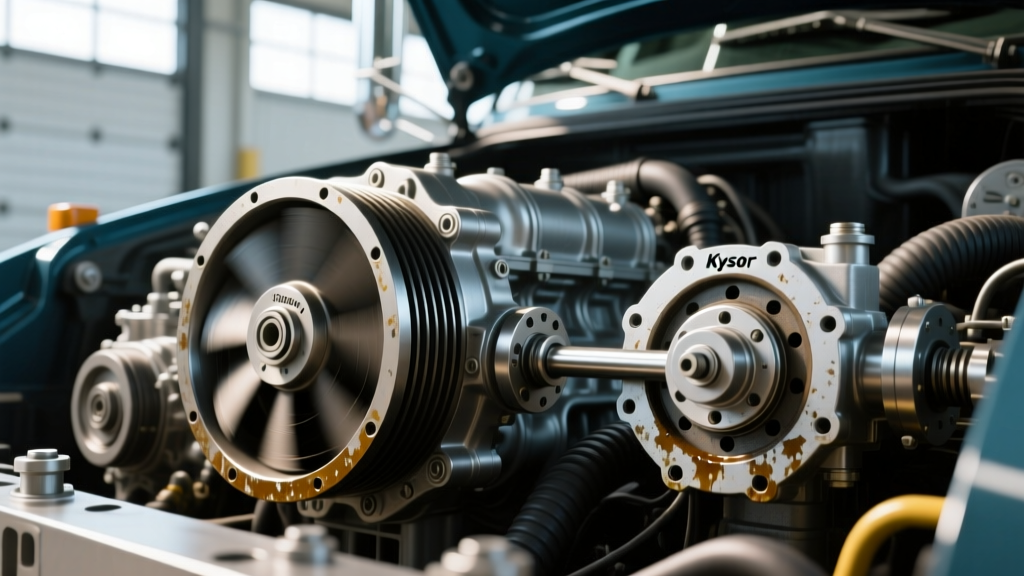
In the heavy-duty diesel sector, misdiagnosing under-hood rotational and engagement noises is a costly pitfall. As of 2026, while automated manual transmissions (AMTs) like the Eaton Endurant XD dominate over-the-road fleets, manual 10-, 13-, and 18-speed transmissions remain the backbone of severe-duty vocational, heavy-haul, and legacy Class 8 operations. When a driver reports a 'squealing, roaring, or grinding' noise during engine operation or pedal actuation, technicians often face an acoustic illusion: the resonant frequencies of the chassis can make a failing Kysor fan clutch (now manufactured under the Horton brand) sound remarkably similar to a binding transmission clutch fork and pivot assembly.
Differentiating between the thermal/air-actuated engagement of a front-mounted engine fan clutch and the mechanical friction of a rear-mounted bell housing clutch fork requires a systematic, data-driven diagnostic approach. This guide provides master-level best practices for isolating these specific failure modes, complete with OEM tolerances, torque specifications, and isolation protocols.
Decoding the Acoustic Signatures
To accurately diagnose the source of the noise, technicians must understand the distinct mechanical signatures of both systems. The cabin of a modern Freightliner Cascadia or Peterbilt 579 acts as an acoustic amplifier, masking the true origin of the sound.
The Kysor Fan Clutch Signature
Historically known as Kysor units (before Horton's acquisition), these thermal or on/off air-actuated fan clutches engage to pull air through the charge air cooler and radiator. A failing unit typically presents with:
- Thermal Bimetallic Coil Failure: Results in a continuous, high-decibel 'roar' as the fan remains locked in the engaged position, accompanied by excessive engine parasitic drag and fuel economy drops.
- Internal Bearing Whine: A high-pitched, metallic whine that scales directly with engine RPM, independent of clutch pedal position.
- Air Actuator Hiss/Click: On electronically controlled or air-actuated models, a distinct hiss or mechanical 'clack' from the front cover during engagement/disengagement cycles.
The Clutch Fork and Pivot Signature
The clutch fork translates hydraulic or mechanical pedal force into cross-shaft movement, pressing the release bearing against the clutch brake and diaphragm springs. Wear in this assembly yields entirely different acoustics:
- Dry Pivot Ball Squeak: A rhythmic, metal-on-metal chirp or squeak that is strictly synchronized with clutch pedal travel, completely independent of engine RPM.
- Cross-Shaft Bushing Grind: A low-frequency, gritty grinding sensation felt through the pedal and heard near the bell housing inspection cover, caused by the fork riding on a worn, out-of-round cross-shaft.
- Release Bearing Chatter: A continuous growl that only occurs when the pedal is depressed (loading the bearing), often misdiagnosed as a fan clutch bearing issue by inexperienced techs.
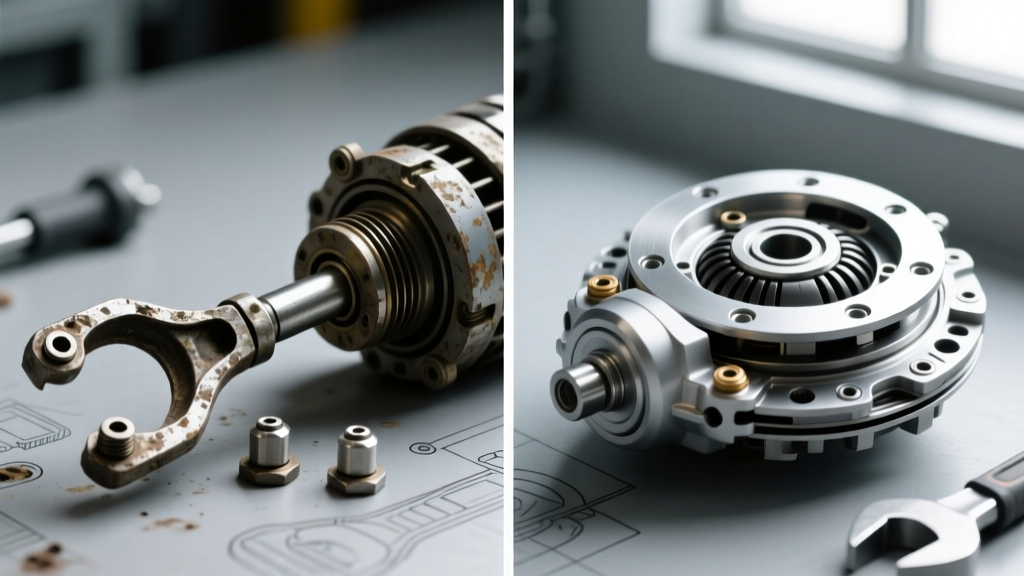
Clutch Fork and Pivot Anatomy: Failure Modes & Tolerances
When the acoustic signature points toward the bell housing, the inspection must shift to the clutch fork, pivot ball, and cross-shaft bushings. In Eaton Fuller heavy-duty setups, the pivot ball is threaded directly into the bell housing, and the fork's spherical cup rides against it. Lack of proper lubrication or contamination from clutch friction dust leads to rapid galling.
| Component | OEM Spec / Clearance | Failure Threshold | Common Part Number |
|---|---|---|---|
| Pivot Ball | Spherical dia. 1.500" | Wear flat > 0.015" | Eaton K-2348 |
| Fork Pivot Cup | Matches ball radius | Gouging or cracking | Eaton K-2349 |
| Cross-Shaft Bushing | ID 1.000" / Clr. 0.005" | Radial play > 0.020" | Eaton K-3059 Kit |
| Fork Pad Thickness | 0.375" | Worn to < 0.310" | Eaton 50060-11 |
Step-by-Step Isolation Protocol
Before dropping the transmission or removing the front engine cover, execute this non-invasive isolation protocol to confirm the fault and avoid unnecessary teardowns. For deeper Horton/Kysor fan clutch diagnostic procedures, refer to the manufacturer's latest thermal testing charts.
1. The Static Pedal Test (Engine OFF)
Have an assistant slowly depress and release the clutch pedal while you use a mechanic's stethoscope on the bell housing inspection cover. If the squeak or bind is present with the engine off, the Kysor fan clutch is entirely eliminated from the equation. The fault is 100% localized to the clutch fork pivot ball, cross-shaft bushings, or the release yoke.
2. The RPM Isolation Test (Engine ON, Transmission in Neutral)
With the clutch pedal fully released (engaged), rev the engine from idle to 1,500 RPM. If a high-pitched whine or roar scales linearly with engine RPM, suspect the fan clutch bearing or the transmission input shaft bearing. Do not touch the clutch pedal during this test.
3. The Load Transition Test
Depress the clutch pedal to the firewall. If a growling noise initiates only under pedal load, the release bearing is failing. If the fan clutch was previously suspected, note that a locked Kysor unit will cause severe engine vibration at idle due to the massive rotational mass of the cooling fan, a symptom not shared by a worn clutch fork.
Reassembly Best Practices: Lubrication and Torque Specs
If the diagnosis confirms clutch fork and pivot wear, proper reassembly is critical to prevent a comeback. The environment inside a Class 8 bell housing is highly contaminated with friction material dust.
The Lubrication Trap: A common apprentice mistake is packing the pivot ball and cup with standard chassis grease or heavy wheel bearing grease. This acts as a magnet for clutch dust, creating an abrasive grinding paste that will destroy the new pivot ball within 10,000 miles.
Best Practice: Apply a minimal, carefully controlled film of high-temperature Molybdenum Disulfide (Moly) paste or an aerospace-grade dry-film lubricant to the pivot cup. This provides extreme-pressure boundary lubrication without the tackiness that attracts dust.
Critical Torque Specifications
When reinstalling the clutch housing and fork assembly, adhere strictly to Eaton Roadranger service guidelines:
- Bell Housing to Engine Block (3/8"-16 UNC Bolts): 35 - 45 lb-ft (47 - 61 Nm). Ensure dowel pins are seated to prevent misalignment, which causes premature cross-shaft bushing wear.
- Pivot Ball Locknut: 60 - 70 lb-ft. The pivot ball must be adjusted to maintain proper release bearing free travel (typically 1/8" to 3/16" at the bearing face).
- Cross-Shaft Lever Pinch Bolt: 30 - 40 lb-ft. Apply a medium-strength threadlocker to prevent vibration-induced backing out.
2026 Cost Analysis: Fork Overhaul vs. Fan Clutch Replacement
Understanding the financial impact of these repairs helps service writers and fleet managers approve the correct diagnostic path.
- Clutch Fork & Pivot Overhaul (Requires Transmission Removal): Parts (Fork, Pivot Ball, Bushing Kit, Release Bearing) range from $250 to $450. However, the labor to pull a heavy-duty transmission and split the driveline averages 8-12 hours, pushing total shop costs to $1,400 - $2,200.
- Kysor/Horton Fan Clutch Replacement (Front of Engine): A replacement thermal or on/off fan clutch assembly costs between $600 and $1,100. Labor is typically 1.5 to 2.5 hours, resulting in a total shop cost of $850 - $1,400.
Because the labor disparity is massive, accurately isolating the noise via the static pedal test and stethoscope protocol is not just a matter of mechanical pride—it is a critical financial safeguard for the fleet. By mastering the acoustic differences between front-engine thermal fan clutches and rear-housing mechanical linkages, technicians ensure the right part is replaced on the first visit.