The Dreaded Dashboard Warning: Decoding the Shaking
You are cruising in your F30 335i or G20 M340i, and suddenly the iDrive screen flashes a yellow half-engine gear icon. The message reads: "Drivetrain Malfunction: Drive Moderately. Maximum Power not available." Simultaneously, the steering wheel, floorboards, and seat begin to vibrate or shake violently, either at idle or under heavy load. When owners search for solutions to a drivetrain malfunction BMW car shaking issue, they are almost always caught in a frustrating terminology trap. Is the transmission tearing itself apart? Is the engine on the verge of catastrophic failure?
To diagnose the problem accurately and avoid thousands of dollars in misdirected repair bills, you must understand the fundamental engineering boundaries between the powertrain and the drivetrain. As of 2026, with specialized Euro-shop labor rates averaging between $160 and $220 per hour, knowing exactly which system is failing is the difference between a $150 tune-up and a $4,500 transmission rebuild.
The Core Engineering Divide: Powertrain vs. Drivetrain
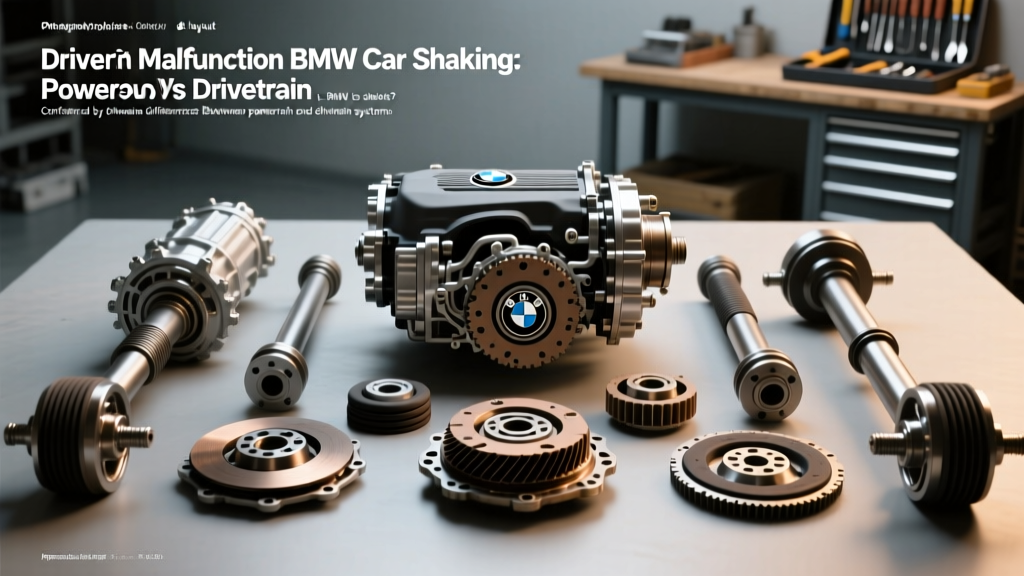
Before pulling out an OBD2 scanner, we must define our terms. While often used interchangeably by consumers and even some dealership service advisors, these two systems represent distinct phases of kinetic energy management.
1. The Powertrain (Power Generation)
The powertrain encompasses every component responsible for generating power and converting fuel into mechanical energy. In a modern BMW, this includes:
- The internal combustion engine (block, cylinder heads, pistons, valvetrain)
- Engine management systems (DME/ECU, sensors, VANOS solenoids)
- Fuel delivery and ignition systems (high-pressure fuel pumps, injectors, coils, spark plugs)
- Emissions control systems (catalytic converters, EGR valves)
2. The Drivetrain (Power Transfer)
The drivetrain takes the rotational energy created by the powertrain and transfers it to the drive wheels. It does not create power; it manages it. Components include:
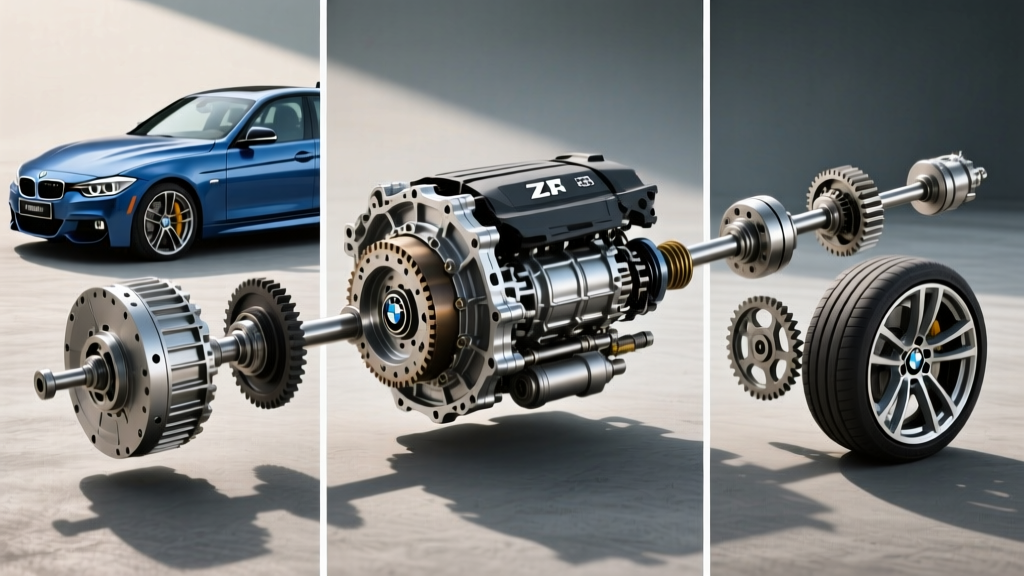
- The transmission (e.g., the ubiquitous ZF 8HP 8-speed automatic)
- The torque converter and flexplate
- Driveshafts, U-joints, and the Guibo (flex disc)
- Differentials (rear and front, if equipped with xDrive)
- CV axles and wheel hubs
The BMW Terminology Trap: Why the DME Lies to You
Here is the most critical piece of E-E-A-T (Experience, Expertise, Authoritativeness, and Trustworthiness) knowledge for BMW owners: BMW's Digital Motor Electronics (DME) uses the word "Drivetrain" as a consumer-facing umbrella term for almost all power-limiting faults.
When your BMW is shaking and throwing a "Drivetrain Malfunction" code, there is a 90% chance the issue is actually rooted in the powertrain (specifically, an engine misfire), not the drivetrain. The DME constantly monitors crankshaft rotational speed. If an ignition or fueling event fails, the crankshaft decelerates microscopically. The DME interprets this as a misfire, shakes the car due to unburnt fuel and cylinder imbalance, and triggers the "Drivetrain Malfunction" warning to protect the catalytic converters from raw fuel dumping.
Scenario A: Powertrain Shaking (The Misfire Culprits)
If the shaking is rhythmic, occurs at idle, worsens when the engine is cold, and is accompanied by a flashing check engine light or the iDrive warning, you are likely looking at powertrain ignition or fueling components. This is highly common on the N55, B58, and S58 engine platforms.
Ignition Coils and Spark Plugs
Modern BMW engines run high boost pressures and extreme cylinder pressures, which blow out weak sparks. A failing ignition coil or worn spark plug will cause a dead cylinder, resulting in severe engine shaking.
- Spark Plugs: OEM BMW Part # 12120040551 (or NGK 96670). These are M14x1.25 thread plugs. Crucial Spec: Torque to exactly 23 Nm (17 lb-ft). Over-torquing can crack the cylinder head threads; under-torquing leads to compression loss and plug ejection.
- Ignition Coils: Delphi GN10571 (OEM equivalent). Cost ranges from $45 to $65 per coil. If one fails at 60,000 miles, it is highly recommended to replace all six as a preventative measure.
- Estimated Repair Cost: $250 - $450 for parts and DIY labor, or $500 - $800 at an independent shop.
VANOS Solenoids and Timing Issues
If the engine is shaking and the DME detects camshaft timing deviations, it will throw a drivetrain code. The VANOS solenoids (Part # 11367587798) can become clogged with oil sludge if previous owners ignored 5,000-mile oil change intervals. Cleaning them with brake cleaner or replacing them ($80 each) often resolves the rough idle and shaking.
Scenario B: True Drivetrain Shaking (Mechanical Vibrations)
If the car does not shake at a standstill but vibrates violently through the chassis between 45 mph and 65 mph, or shudders specifically during gear shifts, you are dealing with a true drivetrain failure. The engine is running perfectly, but the rotational transfer is compromised.
The Guibo (Flex Disc) and Center Support Bearing
The Guibo is a rubber-bonded flex disc that connects the transmission output shaft to the driveshaft, absorbing rotational shock. When the rubber degrades, cracks, and tears, the driveshaft spins off-axis, causing a violent shaking that feels like the car is tearing itself apart from the center console.
- Part Number: OEM Guibo for F-Chassis (e.g., 26118680349 for many F30 models).
- Hardware & Torque Specs: You must use new M10x1.5 bolts. The factory torque specification for the flex disc to the transmission output flange is 56 Nm plus 90 degrees of angle torque. Never reuse the stretch bolts.
- Estimated Repair Cost: $150 for the part, but requires dropping the exhaust and driveshaft, pushing shop labor to $600 - $900.
ZF 8HP Torque Converter Shudder
The ZF 8-speed automatic (8HP45, 8HP50, 8HP70) is an engineering marvel, but it is sensitive to fluid degradation. If you experience a rhythmic shaking or shudder specifically when the torque converter locks up in 5th, 6th, or 7th gear at cruising speeds, the friction material inside the torque converter is failing, or the fluid has lost its shear stability.
Expert Note on ZF Fluids: While BMW claims their automatic transmission fluid is a "lifetime" fill, ZF Friedrichshafen AG officially recommends changing the fluid and pan every 60,000 to 80,000 miles (approx. 100,000 km) depending on driving style. The correct fluid is ZF LifeguardFluid 8 (Part # S671 090 312). A fluid exchange using the dial-temp method to check leveling at exactly 40°C (104°F) can cure mild torque converter shudder.
Diagnostic Matrix: Shaking Symptom vs. System Failure
Use this quick-reference table to isolate whether your BMW's shaking originates from the powertrain or the drivetrain.
| Symptom Profile | System at Fault | Likely Culprit | Est. Repair Cost (2026) |
|---|---|---|---|
| Shaking at idle, rough start, flashing dash warning | Powertrain (Engine) | Ignition Coil / Spark Plug Misfire | $150 - $600 |
| Shaking under heavy acceleration, loss of top-end power | Powertrain (Fueling) | High-Pressure Fuel Pump (HPFP) | $400 - $1,100 |
| Vibration at 50+ mph, shaking from center console | Drivetrain (Mechanical) | Failed Guibo (Flex Disc) | $600 - $950 |
| Shudder only during highway cruising (RPM lockup) | Drivetrain (Transmission) | ZF 8HP Torque Converter / Fluid | $350 (Flush) - $2,500 (Rebuild) |
| Clunking and shaking during tight low-speed turns | Drivetrain (Axles/Diff) | Worn CV Axle Joint or Diff Bushings | $500 - $1,200 |
Warranty Implications: What is Actually Covered?
Understanding the difference between these two systems is vital when dealing with dealership warranty claims. According to BMW USA Vehicle Protection guidelines, the standard 4-year/50,000-mile limited warranty covers almost all components. However, if you are relying on an extended Powertrain Warranty (often 5-year/60,000-mile or up to 100,000 miles on certified pre-owned models), the distinctions matter immensely.
- Covered by Powertrain Warranties: Engine block, cylinder heads, internal engine lubrication parts, transmission case, internal transmission gears, and torque converter.
- EXCLUDED from Powertrain Warranties: Spark plugs, ignition coils, engine mounts, driveshaft U-joints, the Guibo flex disc, CV axle boots, and differential fluid leaks. These are classified as "wear-and-tear" or "maintenance" items, or fall under the much shorter 2-year/24,000-mile parts warranty.
If your car is shaking due to a torn Guibo, an extended powertrain warranty will deny the claim. If the shaking is caused by a snapped timing chain guide inside the engine block, the powertrain warranty will cover the $4,000+ repair.
Final Diagnostics: Read the Codes, Don't Guess
Never throw parts at a shaking BMW based solely on the iDrive text warning. Purchase a BMW-specific bidirectional scanner (such as a Foxwell NT510 Elite or an Autel MaxiCOM) capable of reading DME shadow codes and misfire counters. If the scanner shows "Cylinder 4 Misfire Count: 450," you have a powertrain issue. Swap the coil from Cylinder 4 to Cylinder 1. If the misfire follows the coil, you have found your $60 fix. If the scanner shows clean misfire counters but you feel a vibration at 60 mph, put the car on a lift and inspect the drivetrain rubber and U-joints. By respecting the engineering boundary between power generation and power transfer, you will save time, money, and your sanity.
For those sourcing OEM and genuine components, utilizing reputable suppliers like FCP Euro's BMW Parts Catalog ensures you receive correct torque-to-yield hardware and matched electrical components, preventing secondary failures caused by cheap aftermarket imitations.