Understanding Acoustic Signatures in Omnidirectional Platforms
While traditional automotive FWD, RWD, and AWD layouts dominate consumer highways, the mecanum drivetrain has become the backbone of modern automotive manufacturing AGVs (Automated Guided Vehicles), heavy-duty autonomous transport platforms, and specialized omnidirectional utility vehicles. Unlike a standard solid axle or independent suspension setup, a mecanum configuration relies on independent hub drives, high-reduction planetary gearboxes, and multi-roller wheel assemblies to achieve lateral and diagonal movement.
Because these platforms operate under immense multi-directional scrubbing loads, NVH (Noise, Vibration, and Harshness) anomalies are often the first indicator of catastrophic component failure. Diagnosing noise in a mecanum drivetrain requires a systematic approach to isolate whether the acoustic fault originates from the planetary gear mesh, the CV spline couplings, or the individual 45-degree angled roller bearings. This step-by-step guide provides advanced technicians with the exact procedures, torque specifications, and failure-mode data required to accurately diagnose and rectify mecanum drivetrain noise.
Step 1: Acoustic Isolation and Baseline Testing
The most common mistake technicians make is attempting to diagnose a mecanum wheel while the platform is under load on the factory floor. Proper diagnosis requires lifting the vehicle onto a heavy-duty four-post lift or specialized AGV maintenance stand to allow all four omnidirectional wheels to spin freely.
Required Diagnostic Tools
- Wireless Chassis Ears: To isolate high-frequency gearbox whine from low-frequency roller rumble.
- Stroboscopic Tachometer: To correlate roller RPM with specific acoustic frequencies.
- Thermal Imaging Camera: To detect localized friction spikes in needle bearings or planetary sun gears.
- Automotive Stethoscope: For direct housing contact acoustic transfer.
Run the hub motors through a stepped RPM test: 500 RPM, 1500 RPM, and 3000 RPM. Listen for pitch changes. A noise that scales linearly with wheel RPM typically indicates a roller bearing or CV joint issue, whereas a high-pitched whine that correlates with the motor's input shaft speed (before the planetary reduction) points directly to internal gearbox gear-mesh degradation.
Step 2: Diagnosing Planetary Gearbox Whine and Grinding
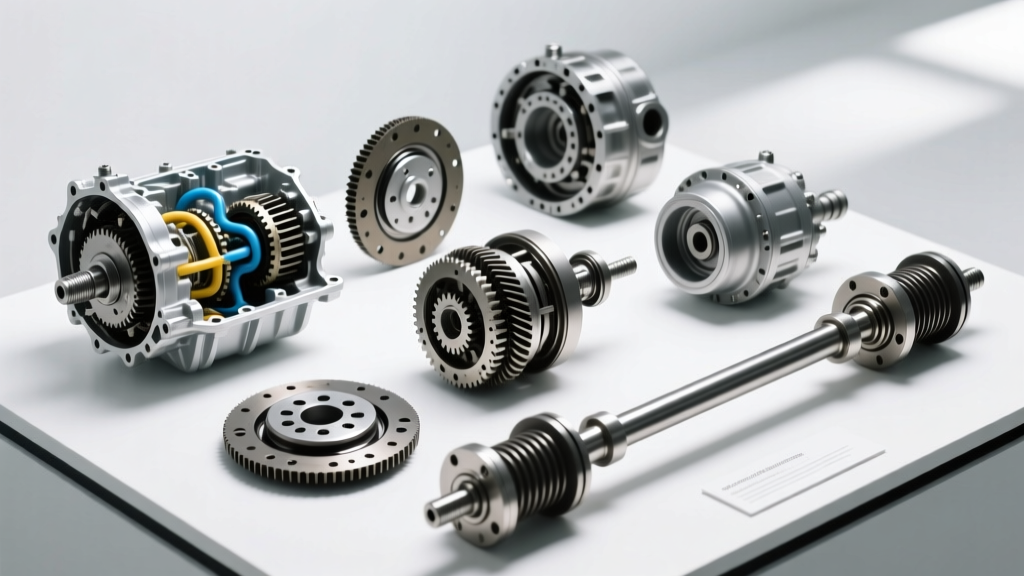
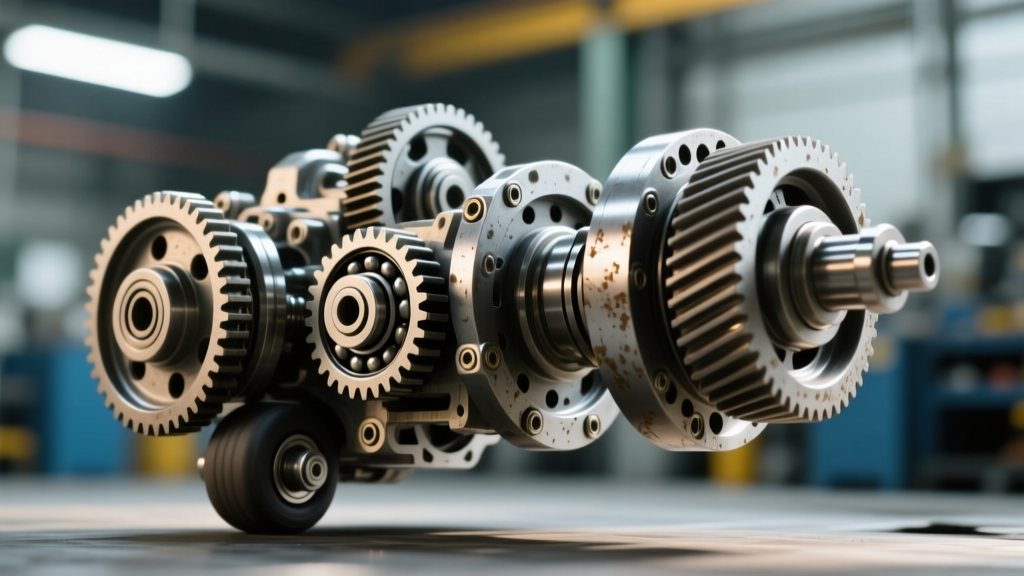
Most heavy-duty mecanum platforms utilize high-torque planetary gearboxes, such as the SEW-Eurodrive CMP series or Neugart PLE variants, mounted directly to the hub motor. These gearboxes reduce motor speed while multiplying torque, but they are highly susceptible to lubrication starvation and backlash misalignment.
Identifying Gear Mesh Frequencies
If your wireless chassis ears pick up a high-frequency whine (typically between 1,000 Hz and 4,000 Hz), you are likely dealing with planetary gear wear.
- Continuous Whine: Indicates worn sun gear teeth or improper gear backlash. Standard backlash for these industrial automotive hubs should be between 3 to 8 arcminutes. Anything exceeding 12 arcminutes will cause harmonic resonance and whine.
- Rhythmic Grinding or Clicking: Suggests a chipped planet gear or a failing planet carrier needle bearing.
- Low-Pitch Growling: Points to main output shaft bearing brinelling, often caused by the severe lateral side-loads unique to mecanum strafing maneuvers.
Teardown and Inspection Protocol
- Drain the gearbox fluid. Mecanum hub gearboxes typically require ISO VG 220 synthetic gear oil (e.g., Mobilgear SHC XMP 220). Capacity is usually between 0.8L and 1.5L depending on the housing size.
- Inspect the magnetic drain plug. Fine, glitter-like ferrous dust is normal wear; however, distinct metallic flakes or chunks indicate catastrophic sun gear or ring gear spalling.
- Measure the output shaft axial and radial play using a dial indicator. Radial play must not exceed 0.05 mm. If it does, the main taper roller bearings must be pressed out and replaced.
Step 3: Inspecting the Mecanum Roller Assemblies
The defining feature of a mecanum drivetrain is the array of free-spinning, 45-degree angled rollers mounted to the main wheel hub. Each roller relies on internal needle bearings to spin independently while the main hub is driven by the gearbox. When these needle bearings fail, they produce a distinct low-frequency rumble or a 'crunching' sound during lateral movement.
According to engineering data from SKF needle roller bearing specifications, the drawn cup needle bearings (such as the HK2520 series commonly used in mid-sized AGV rollers) are highly sensitive to moisture ingress and particulate contamination. Because mecanum wheels operate close to the ground, seal degradation is a primary failure mode.
Roller Bearing Replacement Procedure
- Remove the roller from the main hub. This typically requires removing two 12-point M8 or M10 mounting bolts. Torque Spec for reassembly: M10x1.25 bolts must be torqued to exactly 45 Nm (33 lb-ft) with medium-strength threadlocker.
- Press the roller assembly apart using a hydraulic arbor press. Do not hammer the roller, as this will brinell the internal raceway.
- Extract the failed needle bearing. Inspect the inner shaft race for spalling. If the shaft shows wear grooves deeper than 0.02 mm, the entire roller shaft must be replaced, not just the bearing.
- Pack the new needle bearing with a high-load, water-resistant lithium complex grease (NLGI Grade 2) before pressing it into the roller housing.
Step 4: CV Axle and Spline Coupling Verification
On centralized mecanum drivetrains—where a single inboard motor drives the wheel hub via a short CV axle or spline shaft—directional changes often produce a sharp 'clunk' or rhythmic clicking. This is frequently misdiagnosed as a gearbox fault when it is actually a spline coupling or CV joint issue.
Because mecanum wheels constantly shift between forward, reverse, and lateral vectoring, the CV joints experience rapid torque reversals. Inspect the CV joint boots for tears. If the joint is dry, clean and repack it with a high-molybdenum CV grease. If the clicking persists under manual rotation, the internal ball bearings and spider gears have exceeded their wear limits. Furthermore, check the splined connection between the drive shaft and the hub. Spline backlash should be minimal; if you can rotate the shaft more than 2 degrees by hand before the hub engages, the splines are stripped, requiring a complete shaft and hub coupling replacement (typically costing between $450 and $850 per corner).
Diagnostic Summary and Cost Matrix
Use the following matrix to cross-reference acoustic symptoms with likely component failures and estimated repair costs for heavy-duty automotive AGV platforms.
| Acoustic Symptom | Operating Condition | Probable Component Failure | Estimated Repair Cost (Parts/Labor) |
|---|---|---|---|
| High-Frequency Whine | Scales with Motor RPM | Planetary Sun/Ring Gear Wear | $1,800 - $3,200 (Gearbox Rebuild) |
| Low-Frequency Rumble | Lateral Strafing / Cornering | Mecanum Roller Needle Bearing | $85 - $150 per roller |
| Sharp Clunk / Click | Direction Reversal | CV Joint / Spline Coupling Backlash | $450 - $850 per axle assembly |
| Grinding / Scraping | Continuous under load | Main Hub Taper Roller Bearing | $300 - $600 per hub |
Preventative Maintenance for Longevity
To prevent acoustic degradation and catastrophic failure in a mecanum drivetrain, strict adherence to maintenance intervals is non-negotiable. Gearbox fluid (ISO VG 220) must be sampled and analyzed for ferrous particulate every 1,000 operating hours, with a complete flush every 3,000 hours. Roller assemblies should be manually rotated and checked for axial play every 500 hours. Finally, ensure that all hub retaining nuts are re-torqued to 250 Nm (184 lb-ft) during every major service interval, as the harmonic vibrations inherent to omnidirectional movement can gradually back out improperly secured hardware.