Decoding the BMW F30 Drivetrain Malfunction Warning
When the iDrive screen of your BMW F30 (2012-2018 3 Series) flashes the dreaded "Drivetrain Malfunction: Drive Moderately" warning, it is easy to panic. As of 2026, the F30 platform is aging gracefully, but its complex powertrain electronics and high-stress mechanical components are entering their prime failure window. While BMW uses the term "drivetrain" as a catch-all for both engine management (like N20/N55 boost leaks or charge pipe failures) and actual mechanical driveline faults, true drivetrain failures require a deep understanding of your specific vehicle layout.
To properly diagnose and repair an F30, you must understand how its longitudinal Rear-Wheel Drive (sDrive) and All-Wheel Drive (xDrive) architectures differ fundamentally from the transverse Front-Wheel Drive (FWD) layouts found in competitors. This model-specific repair guide breaks down the FWD vs. RWD vs. AWD comparison to explain exactly why your F30 fails, where to look, and how to fix it using exact OEM part numbers and torque specifications.
Layout Anatomy: FWD vs. RWD vs. AWD Stress Points
Many DIY mechanics approach the F30 with experience from FWD-based platforms (like the Audi A3 or Mercedes CLA). In a FWD or FWD-based AWD vehicle, the transmission and differential are housed in a single transverse transaxle. Power is routed directly to the front wheels via half-shafts, and a PTO (Power Take-Off) unit sends power rearward if AWD is equipped. When a FWD transaxle throws a fault code, the repair usually involves dropping the entire front subframe or replacing integrated CV axles.
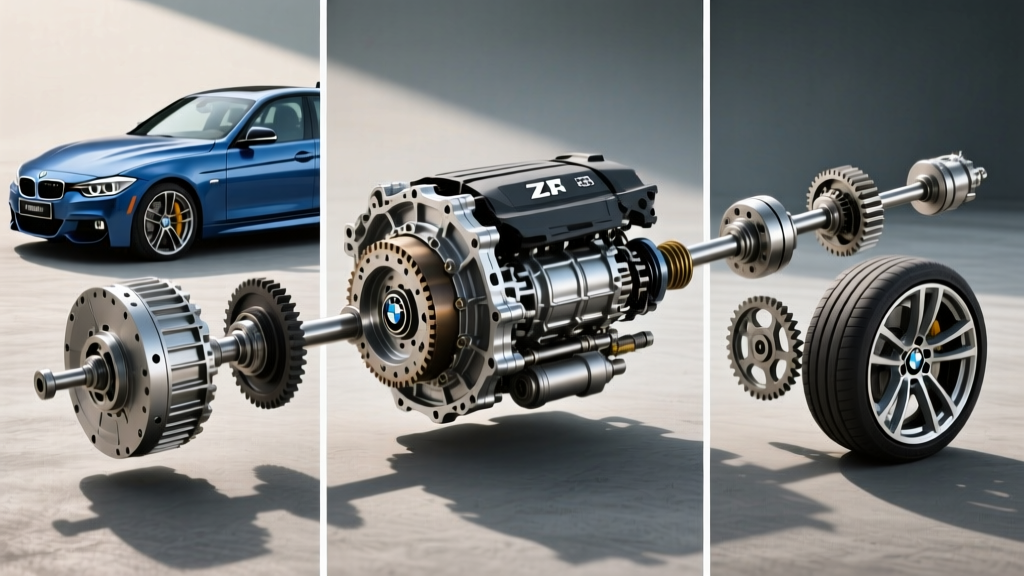
The BMW F30, however, utilizes a strictly longitudinal layout. Whether you have the RWD sDrive or the AWD xDrive, the transmission (the legendary ZF 8HP) is mounted north-south, bolted directly to the engine block. Power is sent rearward via a multi-piece propshaft. In xDrive models, a transfer case splits torque to the front wheels via a separate front differential and axles. This separation of components means the F30 has unique failure points that FWD vehicles simply do not possess.
| Feature | FWD / Transverse AWD (Competitors) | BMW F30 RWD (sDrive) | BMW F30 AWD (xDrive) |
|---|---|---|---|
| Primary Transmission | Transverse Transaxle (e.g., Aisin, DSG) | ZF 8HP45 / 8HP50 (Longitudinal) | ZF 8HP45X / 8HP50X (Longitudinal) |
| Common Fault Trigger | Mechatronic sleeve leaks, CV joint binding | ZF Mechatronic unit failure, Flex disc (Guibo) tear | Transfer Case Actuator Gear stripping, Front Diff starvation |
| Repair Complexity | High (Requires subframe drop for transaxle removal) | Moderate (Mechatronic can be dropped via transmission pan) | High (Transfer case servo accessible, but front diff requires subframe work) |
Diagnosing the F30 sDrive (RWD) Drivetrain Malfunction
If you are driving an F30 sDrive (320i, 328i, or 335i RWD), your drivetrain consists of the ZF 8-speed automatic, a propshaft with a rubber flex disc (guibo), and a rear limited-slip or open differential. When the drivetrain malfunction warning appears and is accompanied by harsh 3-2 downshifts, hesitation upon acceleration, or a complete refusal to shift out of Park, the culprit is almost always the ZF 8HP Mechatronic Unit.
The ZF 8HP Mechatronic Failure
The mechatronic unit houses the Transmission Control Module (TCM) and the solenoid valve body. Over time, the internal solder joints on the TCM circuit board crack due to thermal cycling, or the plastic accumulator pistons wear out, causing pressure drops. Because the F30 uses a longitudinal layout, you do not need to remove the entire transmission to fix this. You can drop the integrated ZF plastic transmission pan (which contains the filter) and unbolt the mechatronic unit from underneath the vehicle.
- OEM Part Number: ZF 24347588725 (Mechatronic Unit - verify with VIN)
- Fluid Required: ZF LifeguardFluid 8 (Approx. 4.5L for a pan drop)
- Estimated 2026 Repair Cost: $1,800 - $2,400 at an independent specialist.
Note: Always inspect the rubber flex disc (Part # 26117511454). While a torn guibo causes vibration rather than an iDrive warning, it is a critical longitudinal RWD maintenance item that FWD cars do not have.
Diagnosing the F30 xDrive (AWD) Drivetrain Malfunction
The xDrive system is where the FWD vs. AWD comparison becomes vital for repair strategy. Unlike FWD-based AWD systems that use an electronically controlled clutch pack at the rear differential (like Haldex), the F30 xDrive utilizes a dedicated Transfer Case (ATC35L or ATC45L) bolted to the side/rear of the ZF transmission. This transfer case uses a chain and a servo motor to actuate a clutch pack, sending up to 50% of torque to the front wheels.
The Notorious Transfer Case Actuator Gear
The most common mechanical cause for an xDrive F30 drivetrain malfunction is the stripping of the plastic drive gear inside the transfer case actuator motor. When this gear strips, the transfer case cannot modulate torque to the front axle. The vehicle detects the discrepancy between wheel speeds and transmission output, triggering the iDrive warning and often locking the car into a RWD-only limp mode.
According to extensive community documentation on BimmerFest F30 Forums, this issue is incredibly prevalent on F30 xDrive models between 70,000 and 110,000 miles. Fortunately, because of the longitudinal layout, the actuator motor is accessible from the passenger side of the transmission tunnel without removing the exhaust or dropping the transfer case.
Step-by-Step Repair: xDrive Transfer Case Actuator Gear
Instead of replacing the entire $2,500 transfer case, you can replace just the internal plastic gear. Here is the model-specific repair procedure for the F30 xDrive.
- Safety & Lifting: Raise the vehicle on a two-post lift or secure jack stands. Ensure the transmission is in Neutral and the wheels are chocked to relieve tension on the transfer case clutch.
- Access the Actuator: Locate the black plastic actuator motor bolted to the side of the ATC transfer case. Disconnect the electrical connector by pressing the release tab.
- Removal: Remove the three T30 Torx bolts securing the motor to the transfer case housing. Gently pull the motor straight out. Be prepared for a small amount of DTF-1 fluid to seep out.
- Disassembly: Remove the T15 Torx screws on the plastic motor cover. Inside, you will find the stripped white or black plastic gear. Remove the C-clip and slide the old gear off the metal shaft.
- Reassembly: Slide the new reinforced gear onto the shaft and secure the C-clip. Pack the housing with high-temp dielectric grease to protect the internal electronics from moisture.
- Installation & Torque: Reinstall the motor onto the transfer case. Torque the three T30 mounting bolts to exactly 10 Nm (7.4 lb-ft). Reconnect the electrical harness.
- Calibration: Use a BMW-compatible diagnostic tool (like BimmerCode, ISTA+, or Foxwell NT510) to perform a Transfer Case Calibration / End-Stop Adaptation. This resets the clutch bite point and clears the drivetrain malfunction code.
F30 Drivetrain Fluid Capacities and OEM Specifications
Maintaining the correct fluid is paramount for longitudinal drivetrains. Using generic ATF in a ZF 8HP or the wrong fluid in an xDrive transfer case will result in immediate clutch pack failure. Below are the exact specifications for the F30 platform.
| Component | Fluid Type | Capacity (Service Fill) | Fill Plug Torque |
|---|---|---|---|
| ZF 8HP45/50 Transmission | ZF LifeguardFluid 8 | 4.0L - 5.0L (Level check at 30-50°C) | 12 Nm (Plastic Pan Bolts) |
| xDrive Transfer Case (ATC) | BMW DTF-1 | 0.65L (Fill until it weeps from plug) | 30 Nm |
| Front Differential (xDrive) | BMW SAF-XO 75W-85 | 0.45L | 30 Nm |
| Rear Differential (All Models) | BMW SAF-XO 75W-85 | 0.9L - 1.1L | 40 Nm |
Why the FWD Comparison Matters for Your Repair Strategy
Understanding the FWD vs. RWD vs. AWD paradigm prevents costly misdiagnoses. If a mechanic approaches your F30 xDrive assuming it operates like a FWD transverse system, they might misdiagnose a transfer case shudder as a failing front transaxle or CV axle, leading to unnecessary parts replacement. The F30's longitudinal architecture isolates the transmission, the transfer case, and the final drives into distinct, serviceable modules.
As ZF Aftermarket documentation confirms, the 8HP series is designed to be serviced in-car for mechatronic and valve body issues, a massive advantage over transverse FWD transmissions that often require complete removal for internal solenoid access. Furthermore, sourcing parts from dedicated European specialists like FCP Euro ensures you receive the updated, reinforced actuator gears and genuine DTF-1 fluids required to keep the xDrive system functioning flawlessly.
Final Thoughts on the F30 Drivetrain
The "Drivetrain Malfunction" warning on the BMW F30 is a gateway to a complex, highly engineered longitudinal system. By recognizing that your F30 does not share the transverse limitations of FWD competitors, you can target the exact failure points—whether it is the ZF 8HP mechatronic unit in your sDrive or the transfer case actuator gear in your xDrive. Armed with the correct torque specs, OEM fluid requirements, and a clear understanding of your drivetrain layout, you can confidently tackle these repairs and keep your 3 Series on the road for years to come.