The Dreaded iDrive Warning: Understanding BMW Hybrid Drivetrain Faults
When the iDrive screen in your BMW plug-in hybrid electric vehicle (PHEV) suddenly flashes the yellow "Drivetrain Malfunction" warning, the immediate instinct is to blame the transmission or the high-voltage battery. But can low battery cause drivetrain malfunction BMW owners frequently experience? The short answer is an emphatic yes. In modern BMW hybrid architectures—such as those found in the G20 330e, G30 530e, and G05 X5 xDrive45e—the 12-volt auxiliary battery and the high-voltage (HV) traction battery are inextricably linked to the mechanical operation of the drivetrain.
Unlike traditional internal combustion engine (ICE) vehicles where a weak 12V battery merely results in a slow crank, BMW's hybrid drivetrains rely on precise electrical voltage to modulate transmission clutches, manage torque handoff, and operate the integrated electric motor. This preventive maintenance guide explores the electromechanical relationship between your BMW's batteries and its hybrid drivetrain, providing actionable diagnostics and maintenance protocols to keep your vehicle out of limp mode.
Anatomy of the BMW Hybrid Drivetrain: The ZF 8HP Integration
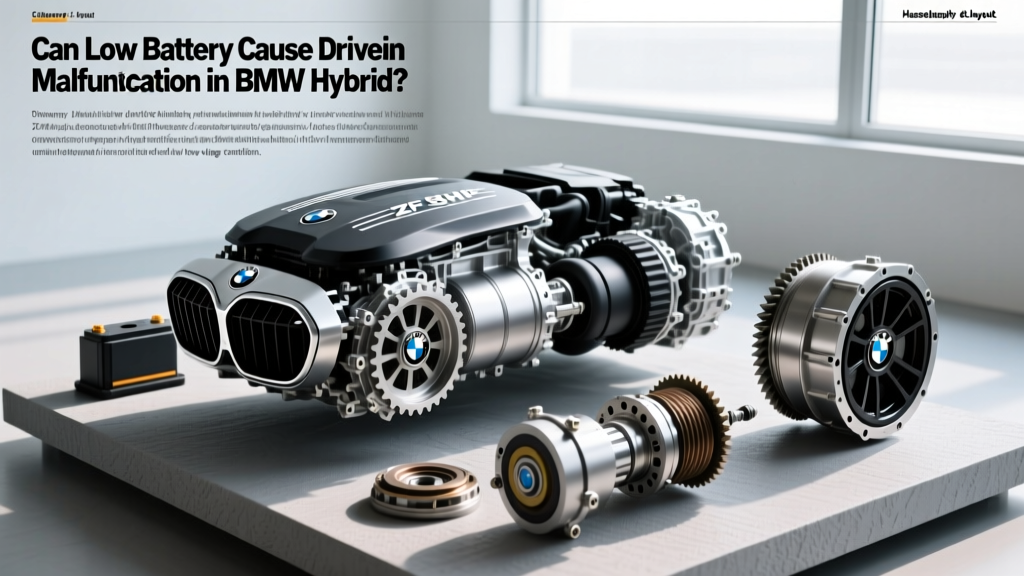
To understand why voltage anomalies trigger drivetrain faults, we must examine the transmission at the heart of BMW's PHEV lineup: the ZF 8HP Gen 3 and Gen 4 (specifically the 8HP75 and 8HP76 hybrid variants). In these transmissions, the traditional hydraulic torque converter has been entirely eliminated. Instead, BMW and ZF integrated an Electric Machine (E-Motor) directly into the transmission bell housing.
This E-Motor serves a triple duty:
- Propulsion: Provides pure electric torque to the drivetrain.
- Regeneration: Acts as a generator during deceleration to recharge the HV battery.
- Engine Starting: Replaces the traditional 12V starter motor, using the HV system to spin the engine to life seamlessly.
The brain controlling this complex ballet of torque is the Mechatronic unit, which houses the Transmission Control Module (TCM) and the electrohydraulic solenoids. Crucially, the Mechatronic unit operates on the vehicle's 12V electrical architecture. If the 12V system experiences a voltage drop—often caused by a degrading Absorbent Glass Mat (AGM) auxiliary battery—the TCM cannot maintain the precise hydraulic line pressures required to hold the transmission clutches engaged. The result? The TCM detects a slip fault, defaults to protective limp mode, and triggers the Drivetrain Malfunction warning.
12V Auxiliary vs. High-Voltage Traction: Diagnosing the Culprit
When troubleshooting the query "can low battery cause drivetrain malfunction BMW," technicians must differentiate between a 12V auxiliary failure and a High-Voltage (HV) battery degradation issue. Both will limit drivetrain output, but their failure modes and diagnostic codes differ significantly.
Scenario A: The 12V AGM Battery Brownout
BMW PHEVs use an Intelligent Battery Sensor (IBS) to manage charging. As the 12V AGM battery ages, its internal resistance increases. During high-load events—such as the E-Motor cranking the ICE engine or the climate control compressor drawing heavy current—system voltage can temporarily sag below 11.5V. The Mechatronic unit requires a minimum of 11.8V for reliable solenoid operation. A micro-second brownout causes the TCM to reboot mid-drive, resulting in a sudden loss of propulsion and fault codes like 222904 (Transmission control module, internal fault) or 1F0214.
Scenario B: High-Voltage Battery Thermal Derating
The HV battery (typically ranging from 9.2 kWh in older F30 330e models to 24.0 kWh in newer LCI G05 X5 models) powers the E-Motor. If the HV battery's dedicated low-temperature cooling circuit is neglected, the battery cells overheat during aggressive acceleration or fast DC charging. The Battery Management Electronics (BME) will intentionally derate the E-Motor's torque output to prevent thermal runaway, triggering a drivetrain warning that limits RPMs and disables electric-only driving modes.
Diagnostic Thresholds: Voltage and Fault Code Matrix
Use a digital multimeter and a BMW-compatible OBD2 scanner (such as ISTA+, Foxwell NT510, or Carly) to cross-reference resting voltages with stored fault codes.
| 12V System State | Resting Voltage | Drivetrain Symptom | Common ISTA+ Fault Code |
|---|---|---|---|
| Optimal (Registered) | 12.6V - 12.8V | Normal operation, seamless torque handoff. | None |
| Marginal / Aging | 12.1V - 12.4V | Harsh shifts, occasional start-stop failure. | 1F0214 (TCM Internal) |
| Critical Brownout | Below 11.8V | Drivetrain Malfunction, Limp Mode (locked in 3rd/4th gear). | 222904, 51A214 |
| HV Thermal Derate | N/A (HV System) | Loss of E-Drive, reduced combined torque output. | 103314 (HV Cooling Circuit) |
Preventive Maintenance Protocol for BMW Hybrid Drivetrains
Preventing electromechanical drivetrain failures requires a strict adherence to BMW's specialized maintenance schedules for PHEV vehicles. Follow this protocol to safeguard your transmission and battery systems.
Step 1: 12V AGM Load Testing and Registration
Do not wait for the 12V battery to fail. Test the AGM battery annually using a conductance tester capable of reading EN/CCA ratings. If the health drops below 60%, replace it immediately. Critical Step: You must register the new battery to the vehicle's Body Domain Controller (BDC). Failing to register the battery resets the IBS charging profile, which will overcharge and destroy a new AGM battery within months due to incorrect alternator/DC-DC converter mapping.
- Part Number: 61216910798 (12V 80Ah AGM - verify via your specific VIN ETK).
- Torque Spec: Battery terminal clamps must be tightened to exactly 10 Nm. Overtightening damages the internal lead posts; undertightening causes micro-arcing and voltage drops.
Step 2: Mechatronic Sealing Sleeve Inspection
Voltage spikes from a failing 12V system or improper jump-starting can damage the electrical contacts passing through the transmission casing. During a ZF 8HP fluid service (recommended every 60,000 miles for PHEVs due to the E-Motor's thermal load), inspect the Mechatronic sealing sleeve for micro-cracks or fluid weeping.
- Part Number: 24347588725 (Mechatronic Sealing Sleeve).
- Cost: ~$45 for the OEM ZF sleeve.
- Fluid Spec: ZF LifeguardFluid 8 (Part # 83222152426). Capacity is typically 8.5 to 9.0 liters for a dry fill, but expect 5.5 liters for a drain-and-fill.
Step 3: HV Battery Cooling Circuit Bleed
The HV battery relies on an independent, electrically conductive coolant to manage cell temperatures. BMW mandates the use of a specific low-conductivity coolant to prevent high-voltage short circuits within the cooling plates.
- Fluid Spec: BMW Electric Vehicle Coolant (Part # 83192468468).
- Maintenance Interval: Flush and bleed every 4 years or 50,000 miles.
- Bleed Procedure: Requires ISTA+ to run the electric coolant pumps at varying RPMs to purge air pockets. Trapped air leads to localized hot spots on the HV cells, resulting in permanent capacity loss and torque-derating drivetrain faults.
Real-World Costs and Sourcing
Addressing a battery-induced drivetrain malfunction is significantly cheaper than replacing a hybrid transmission. A complete ZF 8HP76 hybrid transmission replacement at a BMW dealership can exceed $12,000 to $15,000. In contrast, proactive maintenance costs are highly manageable:
- 12V AGM Battery & Registration: $280 - $380 (Parts + Independent Shop Labor).
- ZF 8HP Hybrid Fluid Service: $450 - $650 (Includes ZF pan/filter kit and Lifeguard 8 fluid).
- ISTA+ Diagnostic & Coding Session: $150 - $250 at an independent BMW specialist.
For DIY enthusiasts, investing in a dedicated BMW coding cable (such as an ENET cable for ISTA/INPA) and a high-quality digital multimeter is essential. Resources like Bimmerpost offer extensive community-driven wiring diagrams and ISTA+ troubleshooting threads for specific PHEV fault codes. Furthermore, reviewing ZF Aftermarket technical bulletins provides vital insights into the exact hydraulic pressures and solenoid PWM (Pulse Width Modulation) curves required for the 8HP hybrid variants.
Final Thoughts: Voltage is the Lifeblood of Hybrid Drivetrains
So, can low battery cause drivetrain malfunction BMW owners dread? Absolutely. In a BMW PHEV, the 12V auxiliary battery is not just an accessory; it is the neurological power source for the transmission's Mechatronic brain. Simultaneously, the HV battery's thermal health dictates the mechanical torque limits of the drivetrain. By treating your battery systems as critical drivetrain components—adhering to strict registration protocols, utilizing exact OEM fluid specifications, and monitoring voltage thresholds—you can entirely prevent the majority of electromechanical limp-mode failures. Stay proactive, keep your software coded, and your BMW's hybrid drivetrain will deliver seamless, fault-free torque for hundreds of thousands of miles.