The Complexity of FWD-Biased Off-Road Platforms
When evaluating an off-road vehicle drivetrain, enthusiasts and mechanics often fixate on solid axles, heavy-duty transfer cases, and low-range gearing. However, the modern off-road landscape is heavily populated by unibody crossovers, midsize pickup trucks, and side-by-side UTVs that utilize front-wheel drive (FWD) or FWD-biased transverse powertrains. Vehicles like the Honda Ridgeline, Subaru Outback Wilderness, Ford Bronco Sport, and the Polaris Ranger rely on sophisticated front-wheel drive system operation to navigate mud, rocks, and deep sand. Diagnosing drivetrain faults in these platforms requires a fundamental understanding of transverse torque management, constant velocity (CV) joint articulation limits, and Power Transfer Unit (PTU) thermal dynamics.
As of the 2026 model year, the integration of electronic torque-vectoring and selectable front-differential locks has made FWD-based off-road systems more capable than ever. Yet, the core mechanical vulnerabilities of the front-wheel drive system remain when subjected to extreme off-road articulation and high-load, low-speed traction scenarios. This guide provides a deep-dive diagnostic framework for troubleshooting front-wheel drive operation failures specific to off-road applications.
Transverse Torque Management and Intermediate Shafts
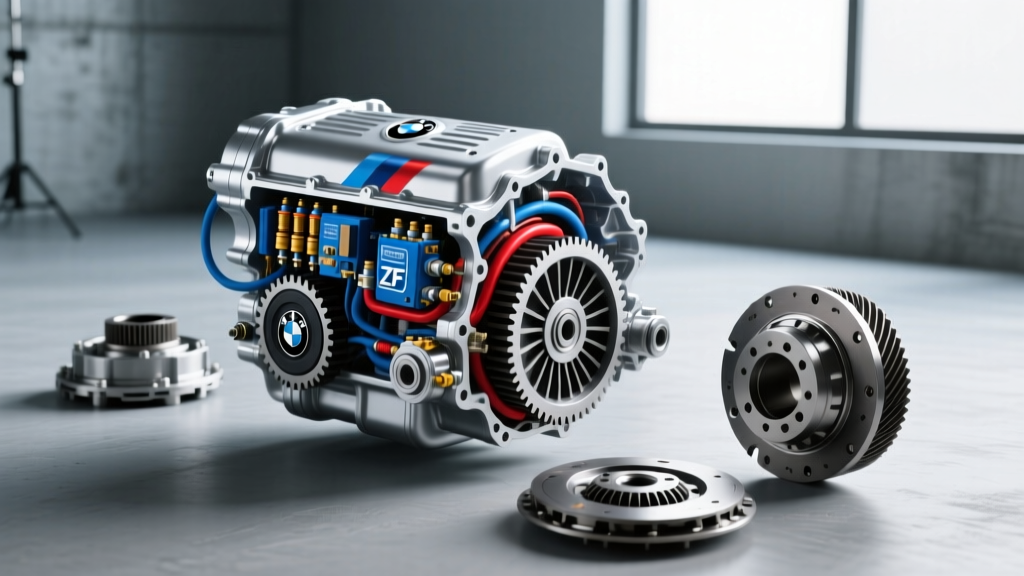
In transverse FWD-biased off-road vehicles, the transmission and front differential are housed in a single transaxle casing. Because the engine is mounted sideways, the distance from the differential to the left front wheel is significantly shorter than to the right front wheel. This unequal half-shaft length creates severe torque steer and uneven joint loading when climbing over off-road obstacles.
To mitigate this, engineers utilize an intermediate shaft (or jackshaft) supported by a carrier bearing, which equalizes the length and torsional twist of both front axles. When diagnosing front-wheel drive system operation issues—specifically a rhythmic clunking or vibration under heavy throttle in 4-Low or mud modes—the intermediate shaft carrier bearing is a prime suspect. Off-road impacts frequently misalign the carrier bearing bracket, causing the intermediate shaft to wobble and prematurely destroy the inner tripod CV joint on the passenger side.
CV Joint Articulation and Plunge Depth Limitations
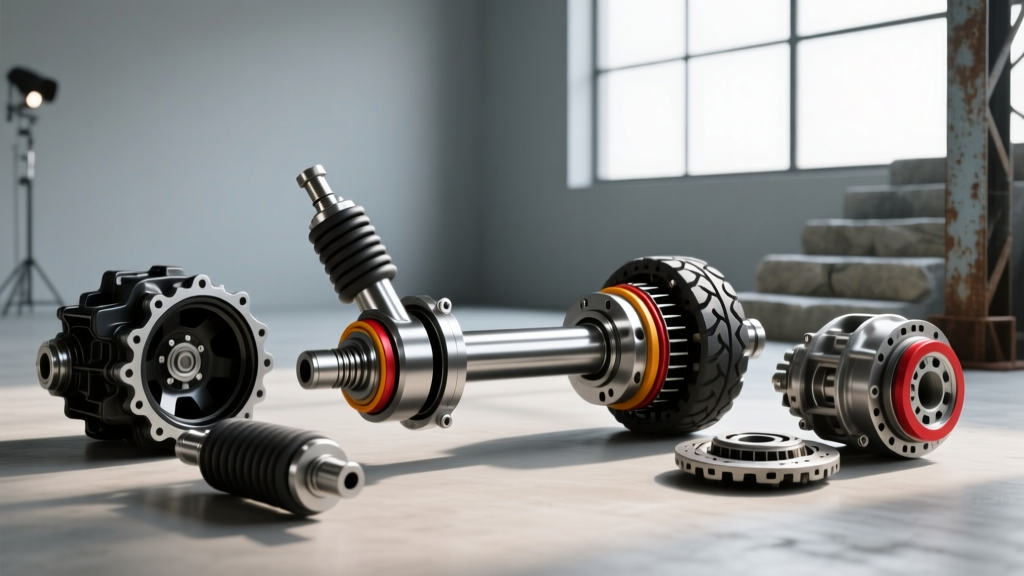
The most catastrophic mechanical failures in a FWD-based off-road vehicle drivetrain occur at the CV axles. Standard automotive FWD systems utilize a Rzeppa outer joint (for steering angle) and a tripod inner joint (for plunge depth and axial movement). Off-road suspension modifications, such as 2-inch lift kits and extended-travel control arms, drastically alter the static ride height and maximum droop of the suspension.
When the suspension reaches full droop (e.g., when a front wheel drops into a deep rut or ditch), the inner tripod joint must extend to its maximum plunge depth. If the lift kit exceeds the factory CV axle's plunge tolerance, the tripod spider gears will physically pull out of the inner housing cup under torque. This results in a violent snapping noise, immediate loss of front-wheel drive operation, and grease contaminating the undercarriage.
Diagnostic Torque Specs and Upgrade Paths
When servicing or diagnosing these components, adhering to precise torque specifications is non-negotiable to prevent hub bearing failure or axle nut back-off on the trail. Furthermore, upgrading to heavy-duty aftermarket axles is often required for dedicated off-roaders.
- Honda Ridgeline / Passport (i-VTM4 Platform): Front axle hub nut torque specification is 134 lb-ft (182 Nm). OEM replacement CV axles cost between $350 and $450. For severe off-roading, RCV Performance heavy-duty axles (Part # 300HD) are recommended, costing approximately $1,200 to $1,400 per pair, featuring a 300M chromoly inner and outer stub.
- Subaru Outback Wilderness (Symmetrical AWD): Front axle nut torque is 140 lb-ft (190 Nm). Subaru's FWD-biased CVT relies heavily on front traction. Lifted Subarus frequently suffer from inner boot tearing due to increased operating angles. Always use OEM Subaru boots (Part # 28323AG010) as aftermarket clamps often fail under high-torque off-road loads.
- Polaris Ranger / General (Selectable FWD): Front gearcase drain plug torque is 120 in-lbs (10 lb-ft). Over-torquing cracks the magnesium/aluminum casing. Fluid capacity is typically 9.5 oz of Polaris AGL (All Gear Lubricant).
Diagnostic Matrix: Front-Wheel Drive Operation Failures
Use the following troubleshooting matrix to isolate front-wheel drive system operation faults in FWD-biased off-road vehicles and UTVs.
| Symptom | Probable Cause | Diagnostic Step | Est. Repair Cost |
|---|---|---|---|
| Grinding/Clicking only during tight, low-speed off-road turns | Outer Rzeppa CV joint cage wear or lack of lubrication | Inspect outer boot for tears; check for radial play in the joint while suspended | $350 - $1,200 (Axle replacement) |
| Loud 'pop' followed by FWD disengagement under heavy load | Inner tripod joint exceeded plunge depth and separated | Verify suspension droop limits; inspect inner housing for spider gear exit marks | $1,100+ (Upgraded Long-Travel Axles) |
| FWD fails to engage electronically (UTV / Crossover) | Front differential actuator motor or armature air-gap failure | Test 12V draw at actuator connector; measure armature clearance (Spec: 0.010' - 0.020') | $180 - $300 (Actuator/Rebuild Kit) |
| Whining noise from front transaxle during sustained sand/mud driving | PTU (Power Transfer Unit) fluid thermal degradation | Extract PTU fluid via syringe; inspect for metallic glitter and burnt odor | $150 - $250 (PTU Flush & Fluid) |
UTV Front Gearcase Engagement: The DemandDrive System
In the off-road UTV segment, front-wheel drive system operation is rarely full-time. Vehicles like the Polaris Ranger utilize a selectable system (often branded as DemandDrive or similar electromagnetic clutch systems). The front differential remains disconnected from the front axles until the rear wheels lose traction, at which point an electronic or mechanical sprague clutch engages the front axle hubs.
A common diagnostic failure in this off-road vehicle drivetrain configuration is the failure of the front gearcase armature. When the operator selects 'AWD', an electromagnet pulls an armature plate against a clutch pack, locking the front ring gear to the axle output shafts. If the air gap between the armature and the clutch coil exceeds 0.025 inches due to wear or debris ingestion, the magnetic field cannot overcome the gap, resulting in a failure to engage the front wheels. Diagnosing this requires removing the front gearcase cover, cleaning the mating surfaces with isopropyl alcohol, and measuring the gap with a feeler gauge before adjusting the shim stack.
Power Transfer Unit (PTU) Thermal Degradation
For FWD-biased crossovers and unibody trucks (like the Ford Bronco Sport or Honda Ridgeline), the PTU is the critical junction that splits torque from the front transaxle to the rear driveshaft. The PTU is essentially a right-angle gearset bathed in a small volume of fluid (typically 12 to 14 ounces of 75W-85 or 75W-140 gear oil). Because it is mounted directly to the hot exhaust side of the transverse engine and subjected to the immense friction of off-road crawling, the PTU is a massive thermal bottleneck.
When diagnosing a shuddering sensation or a distinct sulfur/burnt smell after a day on the trails, the PTU fluid has likely sheared and lost its extreme-pressure (EP) additive integrity. Unlike a traditional longitudinal transfer case that holds 2 to 3 quarts of fluid, the PTU's tiny sump boils rapidly under low-speed, high-torque off-road conditions. Diagnostic protocol: Use a fluid extraction pump to pull the PTU fluid via the fill plug (as most FWD-biased PTUs lack a drain plug). If the fluid is black and contains fine metallic paste, the hypoid gear bearings are scoring. Preventative maintenance for off-road use dictates flushing the PTU every 15,000 miles using high-synthetic fluid like Motorcraft XT-11-QDC or Amsoil Severe Gear 75W-90.
Authoritative References and Further Reading
Accurate diagnosis of any off-road vehicle drivetrain requires adherence to OEM engineering standards and continuous education on driveline kinematics. The following resources provide foundational data on transverse drivetrain operation and CV joint mechanics:
- AA1Car Drivetrain and Axle Diagnostics - Comprehensive guides on CV joint failure modes, intermediate shaft alignment, and transaxle noise isolation.
- SAE International Technical Papers - In-depth engineering analyses on torque-vectoring differentials, PTU thermal management, and FWD-biased AWD system kinematics.
By understanding the precise mechanical limits of front-wheel drive system operation—from tripod joint plunge depths to PTU thermal capacities—technicians and off-road enthusiasts can accurately diagnose failures, select the correct heavy-duty replacement components, and keep modern FWD-based off-roaders crawling reliably through the most punishing terrain.