The Paradigm Shift: From Multi-Speed Transmissions to Integrated E-Axles
The automotive landscape has undergone a seismic shift, and nowhere is this more apparent than beneath the chassis of modern electric vehicles. For decades, the internal combustion engine (ICE) relied on complex, multi-speed automatic or manual transmissions to keep the engine within its narrow power band. Today, the EV drivetrain has largely abandoned this approach in favor of the integrated e-axle—a compact, unified assembly housing the electric motor, power inverter, and single-speed reduction gearbox. For owners navigating the EV drivetrain Denver service landscape, finding a shop that understands the intersection of high-voltage (HV) safety, precision gear machining, and dielectric fluid dynamics is absolutely paramount.
Unlike traditional powertrains where the engine and transmission are distinct entities bolted together via a flexplate and torque converter, an e-axle operates as a single, cohesive ecosystem. The inverter converts DC battery power into AC current, the motor generates rotational force, and the reduction gear multiplies that torque to the wheels. This integration drastically reduces weight and improves efficiency, but it also means that a failure in the cooling loop or a degraded bearing can compromise the entire high-voltage system. As we move through 2026, the complexity of these systems has only increased, demanding a new tier of specialized automotive expertise.
Anatomy of the Modern E-Axle: What Denver Shops Must Master
To properly service an EV drivetrain, technicians must possess a deep understanding of its three core pillars. General mechanics accustomed to swapping 4L60E or ZF 8HP transmissions are often entirely unequipped for the following EV-specific architectures:
1. The Traction Motor and Hairpin Stators
Most modern EVs utilize Permanent Magnet Synchronous Motors (PMSM). To maximize efficiency and power density, manufacturers have moved to 'hairpin' stator winding techniques. Instead of traditional round wire wrapped hundreds of times, flat copper pins are inserted into the stator slots and laser-welded. This increases the copper fill factor from roughly 45% to over 70%, drastically reducing resistance and heat. However, if an e-axle housing is breached or requires internal inspection, the epoxy potting that protects these windings is easily compromised. Proper reassembly requires clean-room environments and specialized vacuum-potting equipment that standard Denver garages simply do not possess.
2. Silicon Carbide (SiC) Inverters
The inverter is the brain of the drivetrain. By 2026, the industry standard has shifted heavily toward Silicon Carbide (SiC) MOSFETs rather than traditional silicon IGBTs. SiC switches operate at much higher frequencies with significantly lower switching losses, which translates to better range and faster charging. The trade-off is immense thermal density. The inverter is bolted directly to a liquid-cooled cold plate. If the low-conductivity coolant degrades or experiences galvanic corrosion, it can eat through the cold plate, allowing fluid to contact the 800V bus bars, resulting in catastrophic dielectric failure and a totalled vehicle.
3. High-RPM Reduction Gearboxes
While ICE engines redline around 6,500 RPM, modern EV motors routinely spin past 18,000 RPM (with some prototypes and hypercars exceeding 25,000 RPM). The single-speed reduction gearbox must handle extreme input shaft velocities. This requires aerospace-grade helical gear cutting, specialized surface treatments like superfinishing, and highly specific synthetic fluids designed to prevent micro-pitting and foaming at extreme shear rates.
The Colorado Factor: Altitude, Cold-Soaks, and the I-70 Corridor
Operating an EV in Colorado presents unique drivetrain challenges that do not exist in sea-level, temperate climates. According to research from the National Renewable Energy Laboratory (NREL) located in Golden, CO, high-altitude and extreme temperature gradients heavily influence EV thermal management systems.
- The I-70 Mountain Descent: Driving down from the Eisenhower Tunnel places immense regenerative braking loads on the drivetrain. The motor acts as a massive generator, sending hundreds of kilowatts of energy back through the inverter and battery. This generates intense heat in the stator windings and the inverter cold plate. Shops must know how to flush and degas the integrated cooling loops to prevent localized boiling and vapor lock.
- Sub-Zero Cold Soaks: Denver winters routinely drop below freezing. When an EV cold-soaks, the reduction gearbox fluid thickens significantly. If a driver demands maximum torque immediately upon departure, the sheer shear-force on the gear teeth and the oil pump cavitation can cause premature bearing wear. Specialists must verify that the correct OEM-spec fluid is in the housing, as aftermarket 'universal' fluids often fail to maintain the necessary viscosity index at 0°F.
2026 EV Drivetrain Configuration Comparison
Not all e-axles are created equal. Below is a technical comparison of three dominant drivetrain layouts currently navigating Colorado roads, highlighting the distinct engineering philosophies behind them.
| Vehicle Platform | Drivetrain Layout | Gear Ratio(s) | Fluid Capacity & Spec | Unique Engineering Feature |
|---|---|---|---|---|
| Tesla Model Y (Rear) | Single-Speed PMSM | 9.73:1 | ~1.5L (Castrol BOT 341 / Tesla 1092755-00-A) | Oil-cooled rotor with internal cooling channels for sustained track/mountain use. |
| Porsche Taycan (Rear) | 2-Speed PMSM | 1st: 15:1 / 2nd: 8.05:1 | ~3.2L (Pentosin FFL-4) | Electromechanical dog-clutch engagement for seamless high-speed highway efficiency. |
| Rivian R1T (Quad-Motor) | 4x Independent E-Axles | 13.7:1 (per unit) | ~1.0L per gearbox (Specific OAT Dielectric) | Tank-turn capable; individual torque vectoring requires complex half-shaft NVH tuning. |
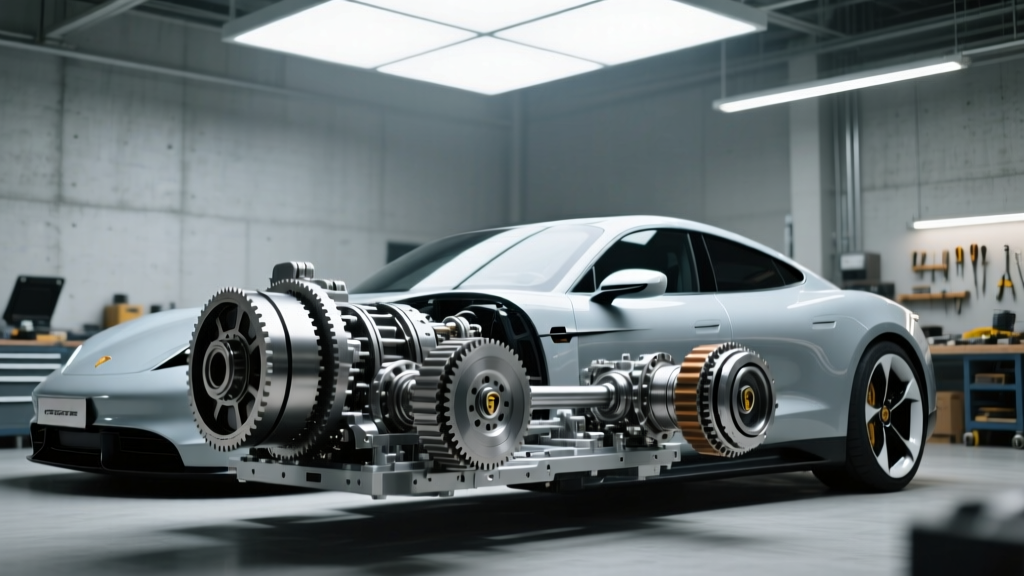
The Porsche Taycan’s rear 2-speed transmission is a marvel of modern engineering, utilizing a planetary gearset and a dog clutch rather than friction clutches to shift gears. This requires highly specialized diagnostic software to calibrate the shift actuator fork positions—a task far beyond the reach of generic OBD2 scanners.
Evaluating EV Drivetrain Specialists in Denver: A Buyer's Checklist
When your vehicle throws an isolation fault or exhibits high-frequency whine from the rear subframe, choosing the right facility is critical. The U.S. Department of Energy EV Guidelines emphasize the severe risks associated with improper high-voltage handling. Use this checklist to vet potential drivetrain specialists in the Denver metro area:
- High-Voltage PPE and Tooling: The shop must possess ASTM-rated Class 0 (1000V) insulated gloves, insulated rescue hooks, and fully insulated hand tools. Bare steel wrenches near an exposed 800V bus bar are a lethal liability.
- Megahmmeter (Insulation) Testing: Before and after any drivetrain removal, technicians must perform an insulation resistance test (Megger test) applying 500V to 1000V DC to the motor phases to ensure the stator windings have not shorted to the aluminum housing.
- Clean-Room Teardown Capabilities: If an e-axle is being rebuilt rather than replaced, the shop must have a positive-pressure clean room. A single grain of Colorado dust or sand trapped between the rotor and stator can scrape the magnetic laminations and destroy the motor upon startup.
- OEM Software Access: Post-repair, the drivetrain requires software commissioning. This includes rotor position offset calibration, resolver alignment, and active damper tuning to eliminate driveline shunt.
Precision Maintenance: Torque Specs and Dielectric Fluids
EV maintenance is less about frequent oil changes and more about extreme precision and chemical compatibility. Below are critical specifications that separate true experts from generalists:
Low-Conductivity Coolant Requirements
The liquid cooling loop that manages the inverter and motor stator requires specialized low-conductivity coolant. Standard ethylene glycol antifreeze contains ionic corrosion inhibitors that make it electrically conductive. EV-specific coolants must maintain a conductivity level of less than 5 µS/cm (microsiemens per centimeter). If a Denver shop tops off your EV cooling loop with standard green or orange antifreeze, the fluid will eventually conduct electricity, arc through the inverter's cooling jacket, and trigger a catastrophic high-voltage isolation fault, potentially bricking the drive unit.
Critical Fastener Torque Specifications
Because EVs produce instant, massive torque from 0 RPM, drivetrain fasteners are subjected to severe shock loads. Adhering to exact torque-to-yield specifications is non-negotiable.
- Tesla Model 3/Y Rear Half-Shaft Axle Nut: Initial torque to 180 Nm, followed by a precise 90-degree angle turn. Reusing the old stretch nut is strictly prohibited; it will back out under regenerative braking loads.
- Stator-to-Housing Bolts: Typically torqued to 12 Nm with a specific medium-strength threadlocker (e.g., Loctite 243). Over-torquing can warp the housing and misalign the rotor air-gap, causing severe NVH (Noise, Vibration, and Harshness) and efficiency loss.
- Inverter High-Voltage Terminal Nuts: Usually capped at 10 Nm to 12 Nm. Over-tightening these soft copper/aluminum bus bar connections will crack the terminal, leading to localized arcing and thermal runaway under heavy load.
Cost Expectations and Warranty Considerations in 2026
Repairing or replacing an EV drivetrain is a significant financial undertaking. In the Denver market, a complete remanufactured Tesla Rear Drive Unit (RDU) swap, including fluid, axle nuts, and software commissioning, typically ranges from $3,800 to $5,500. For more complex architectures like the Porsche Taycan rear 2-speed e-axle, expect dealership or specialized independent invoices to range between $9,000 and $14,000 due to the intricate actuator calibration and proprietary fluid requirements.
Before paying out of pocket, always verify your powertrain warranty status. Federal law mandates that EV batteries and core drivetrain components are covered for a minimum of 8 years or 100,000 miles. However, if a third-party shop improperly services the reduction gearbox fluid and the e-axle subsequently fails due to lubrication starvation, the OEM will void the warranty. Always demand itemized receipts showing the exact OEM part numbers for the fluids and filters used.
Final Verdict: Securing Your EV's Future
The EV drivetrain is a masterpiece of electromechanical engineering, but it is not invincible. The extreme thermal cycling of Colorado winters and the grueling regenerative loads of mountain descents demand meticulous, specialized care. By prioritizing facilities that invest in HV safety, dielectric testing, and OEM-level software access, Denver EV owners can ensure their vehicles remain efficient, silent, and safe for hundreds of thousands of miles. Do not trust your 800V e-axle to a shop that still primarily relies on a transmission jack and a socket set built for a 1998 Chevy Silverado.