The Click of Doom: Understanding CV Axle and Joint Failures
If you have ever heard a rhythmic clicking noise while turning your front-wheel-drive or all-wheel-drive vehicle, you are already intimately familiar with the most common drivetrain failure point: the Constant Velocity (CV) joint. CV axles are the critical link between your transmission or differential and the wheel hubs, tasked with transmitting rotational power while accommodating the extreme vertical travel of the suspension and the sharp angles of steering.
Despite their robust engineering, CV axles are highly susceptible to environmental damage and mechanical wear. When a CV axle fails, the immediate question for most vehicle owners is whether their coverage will foot the bill. Specifically, consumers frequently ask if a lifetime drivetrain warranty will cover the replacement of a failed CV joint or axle assembly. The short answer is: it depends entirely on the fine print, and more often than not, warranty administrators use specific loopholes to deny these claims.
In this comprehensive cost analysis and technical breakdown, we will dissect the real-world pricing of CV axle replacements in 2026, explore the mechanical differences between inner and outer joint failures, and expose the common exclusions hidden inside lifetime drivetrain warranty contracts.
Diagnosing the Failure: Inner vs. Outer CV Joints
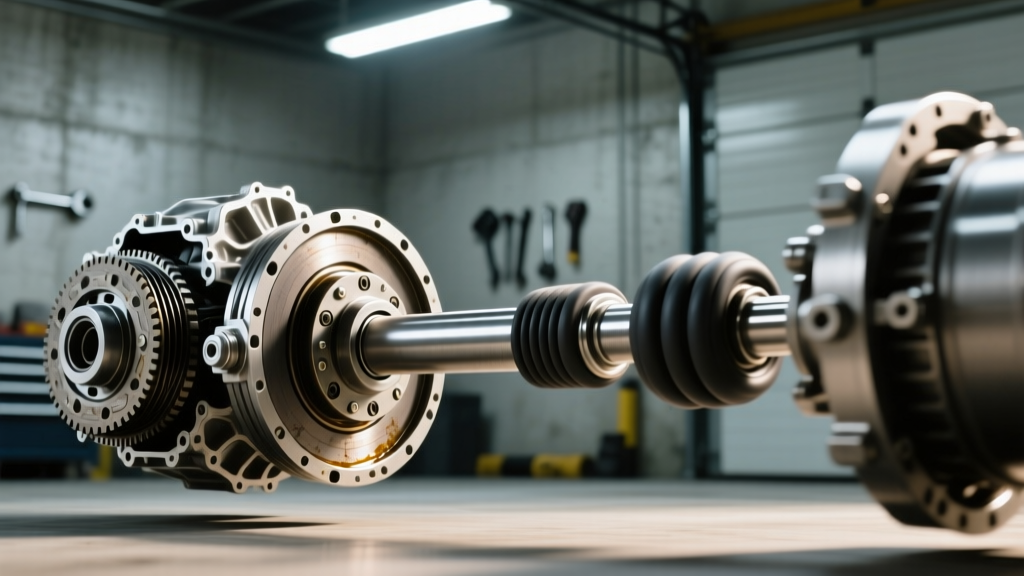
Before discussing repair costs, it is vital to understand which part of the drivetrain has actually failed. A standard CV axle assembly consists of a shaft, an outer CV joint, an inner CV joint, and two flexible elastomeric boots. According to engineering data from GKN Driveline, the global leader in OE CV joint manufacturing, the two joints serve entirely different kinematic purposes.
Outer CV Joint (Rzeppa Design)
The outer joint is typically a Rzeppa-style joint, designed to handle extreme steering angles (up to 47 degrees in modern platforms). It uses six precision-machined steel balls riding in a spherical cage and raceway. When the protective neoprene or thermoplastic boot tears, moisture and silica dust infiltrate the molybdenum disulfide grease. This causes pitting on the ball bearings, resulting in the infamous 'clicking' noise during tight turns. Outer joint failures are almost exclusively caused by boot degradation.
Inner CV Joint (Tripod or Double-Offset Design)
The inner joint connects to the transmission or differential and must accommodate the axial plunge (in-and-out movement) as the suspension cycles up and down. Most modern vehicles use a tripod-style inner joint featuring three roller bearings. Symptoms of a failing inner joint are vastly different from the outer joint: you will typically feel a pronounced vibration or shudder under hard acceleration, or hear a heavy 'clunk' when shifting from park to drive. Inner joints often fail due to excessive torque bind, a common issue in lifted 4WD vehicles or heavily modified AWD platforms like the Subaru WRX or Jeep Wrangler.
2026 Cost Breakdown: Dealership vs. Independent vs. DIY
The cost to replace a CV axle varies wildly depending on the vehicle platform, the source of the replacement part, and the labor rate of the repair facility. Data aggregated by RepairPal indicates that the national average for a CV axle replacement sits between $350 and $850 per side. However, luxury and performance AWD vehicles can push this figure well over $1,200.
Below is a detailed cost matrix comparing part tiers and labor scenarios for a standard mid-size AWD crossover (e.g., Toyota RAV4 or Honda CR-V) in 2026.
| Part Tier | Brand Examples | Part Cost (Per Axle) | Estimated Labor (Hours) | Total Installed Cost |
|---|---|---|---|---|
| OEM (Dealer) | Toyota, Honda, Subaru Genuine | $450 - $750 | 1.2 - 1.5 | $650 - $1,100 |
| Premium Aftermarket (New) | GKN, SKF, NTN | $180 - $300 | 1.2 - 1.5 | $350 - $650 |
| Remanufactured | Cardone Reman, A1 Cardone | $90 - $150 | 1.2 - 1.5 | $250 - $450 |
| Economy / Budget (New) | SurTrack, TrakMotive, Amazon Brands | $60 - $110 | 1.2 - 1.5 | $200 - $350 |
Expert Warning: Avoid budget 'economy' axles for high-torque or AWD applications. Economy axles frequently use inferior metallurgy in the tripod bearings and lack the precise spline tolerances required for smooth operation. This often leads to premature vibration and differential seal leaks within 15,000 miles.
The 'Lifetime Drivetrain Warranty' Loophole
Many consumers purchase vehicles advertising a lifetime drivetrain warranty, assuming that any component transferring power from the engine to the wheels is covered indefinitely. Unfortunately, when a CV axle fails, the warranty claim process often reveals a harsh reality. The Federal Trade Commission (FTC) allows warranty administrators to define 'drivetrain' and 'wear items' according to their specific contract language.
How Warranty Denials Happen
When you submit a claim for a clicking CV joint, the warranty adjuster will require the shop to tear down the assembly for inspection. If the adjuster notes that the CV boot is torn, cracked, or missing, the claim is almost universally denied. The denial code typically cites 'environmental damage,' 'road debris,' or 'lack of maintenance.' Because the boot is made of rubber or thermoplastic, administrators classify it as a 'wear item'—similar to brake pads or wiper blades—even though its failure directly destroys the internal steel drivetrain components.
Factory Powertrain vs. Dealer Lifetime Warranties
- Factory Powertrain Warranties (e.g., Hyundai 10yr/100k, Chrysler 5yr/60k): These manufacturer-backed warranties generally cover the internal transmission and differential components but explicitly list CV joints, CV boots, and axle shafts under 'excluded wear items' in the owner's manual warranty booklet.
- Dealer-Installed Lifetime Warranties: Often backed by third-party administrators like Fidelity or Zurich, these contracts define the 'drivetrain' as the transmission, transfer case, and drive axles. However, the 'Exclusions' section will specifically list 'boots, seals, and gaskets.' If a $5 rubber boot fails, it voids coverage for the $600 steel axle assembly.
If you are relying on a lifetime drivetrain warranty to protect your wallet from CV axle repairs, you must perform documented visual inspections of your CV boots every 5,000 miles. Catching a torn boot early and replacing it (a $150 repair) can save the joint, but once the joint clicks, the warranty loophole will be used against you.
Precision Installation: Torque Specs and ABS Tone Ring Risks
Replacing a CV axle is not simply a matter of unbolting and swapping parts. Improper installation can lead to catastrophic drivetrain damage, wheel bearing failure, or ABS system faults. Professional technicians adhere to strict torque specifications and handling procedures.
Hub Nut Torque Specifications
The CV axle is secured to the wheel hub via a massive hub nut. Reusing old hub nuts or applying incorrect torque is a leading cause of premature wheel bearing failure and axle spline wear. Below are standard torque specifications for common platforms (always verify with factory service manuals):
- Honda / Acura (e.g., Civic, Accord, CR-V): Typically utilizes a 36mm hub nut. Standard torque is 134 lb-ft (180 Nm), followed by an additional 90-degree turn, or a flat 180 lb-ft depending on the generation. Honda requires the nut to be staked into the axle groove using a blunt punch.
- Subaru (e.g., WRX, Outback): Utilizes a 32mm hub nut. Torque specification is generally 140 lb-ft (190 Nm). Subaru explicitly states that the hub nut must be replaced every time it is removed; it is a prevailing-torque design and cannot be safely reused.
- GM Trucks / SUVs (e.g., Silverado, Tahoe): Utilizes a large 36mm hub nut. Torque specification is 155 lb-ft (210 Nm) for most modern 4WD applications.
- VW / Audi (MQB / MLB platforms): Many modern VW/Audi vehicles use a 12-point stretch bolt (e.g., M24 or M27) rather than a traditional nut. These are one-time-use torque-to-yield fasteners. The spec is usually 150 lb-ft plus a 180-degree turn. Reusing these bolts will result in the bolt snapping under load.
Protecting the ABS Tone Ring
Modern CV axles feature integrated ABS tone rings. Older vehicles used stamped steel toothed rings, but modern platforms use delicate magnetic encoder rings bonded to the inner CV joint housing. If a technician uses a pry bar or excessive force with a slide hammer (like the OTC 7256 CV axle puller) against the inner housing, the magnetic encoder can be cracked or demagnetized. This will trigger an ABS fault code (e.g., C0035) and disable the vehicle's stability control system, requiring the replacement of the entire axle assembly all over again.
Final Verdict: Managing Drivetrain Costs
While the concept of a lifetime drivetrain warranty provides peace of mind for internal transmission and differential failures, it is fundamentally inadequate for protecting against CV axle and joint problems. The inherent vulnerability of the elastomeric CV boots to road debris, heat cycling, and dry rot makes them an easy target for warranty claim denials.
For vehicle owners, the most cost-effective strategy is proactive maintenance. Inspect your CV boots during every oil change. If you notice grease slung on the inside of your wheel or lower control arms, address the torn boot immediately before the joint is compromised. When replacement is inevitable, bypass the cheap economy remanufactured axles and invest in premium aftermarket brands like GKN or SKF, which utilize OE-spec metallurgy and high-temperature thermoplastic boots, ensuring your drivetrain remains smooth, quiet, and reliable for the next 100,000 miles.