Decoding the iDrive Warning: What Does It Actually Mean?
When your BMW’s iDrive display suddenly illuminates with a yellow or red warning, panic is the natural response. The specific message—"Drivetrain malfunction. Drive moderately. Continued driving possible"—is one of the most misunderstood alerts in modern German engineering. Unlike the catastrophic "Stop vehicle carefully" warning, which indicates immediate engine or transmission failure, the "continued driving possible" variant often points to a secondary drivetrain component struggling to manage torque delivery.
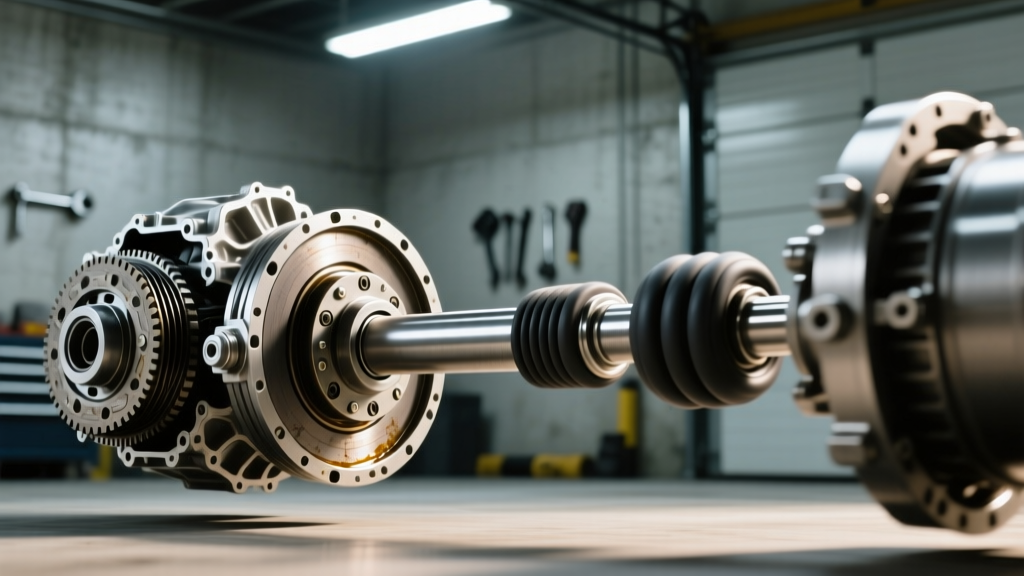
While many owners immediately suspect the ZF 8HP automatic transmission or the engine's mechatronic systems, a highly common, frequently misdiagnosed culprit is the CV axle and CV joint assembly. In xDrive models, a failing constant velocity joint doesn't just cause clicking or vibrations; it creates rotational speed discrepancies that trick the vehicle's dynamic stability and transfer case modules into throwing a drivetrain fault code.
In this 2026 cost analysis, we break down exactly why CV axle failures trigger these specific BMW warnings, the real-world repair costs across different service channels, and the precise torque specifications required to fix it correctly.
The xDrive Connection: How CV Joints Trigger Drivetrain Codes
To understand the cost, you must understand the failure mode. BMW’s xDrive system relies on the ATC (Active Torque Coupling) transfer case to distribute power between the front and rear axles. The transfer case clutch pack is governed by wheel speed sensors located at each hub.
When the inner tripod CV joint wears out, it develops excessive play. Under heavy acceleration, this play causes micro-fluctuations in rotational speed—often a variance of just 2 to 5 km/h between the left and right front wheels. The ABS/DSC module detects this anomaly and assumes wheel slip. It commands the transfer case to compensate, rapidly cycling the clutch pack. This generates excessive heat and triggers transfer case fault codes (such as 5F39 or 54C6), resulting in the dreaded "Drivetrain Malfunction" iDrive message.
If you ignore this and continue driving, the transfer case clutch pack will physically burn out, turning a $400 CV axle repair into a $3,500+ transfer case replacement.
2026 Cost Breakdown: BMW CV Axle Replacement
Repair costs for European drivetrain components have shifted in 2026 due to supply chain adjustments and updated OEM pricing. Below is a realistic cost analysis for replacing a single front CV axle on common xDrive platforms (e.g., F30/F31 3-Series, G20, F25 X3).
| Repair Channel | Parts Cost (OEM/GKN) | Labor Cost (1.5 - 2.5 Hrs) | Estimated Total | Warranty Coverage |
|---|---|---|---|---|
| BMW Dealership | $450 - $650 | $800 - $1,100 ($220+/hr) | $1,250 - $1,750 | 2 Years / Unlimited Miles |
| Independent Euro Specialist | $280 - $350 (GKN/Löbro) | $350 - $500 ($150-$180/hr) | $630 - $850 | 1-2 Years / 12k-24k Miles |
| DIY (Driveway Mechanic) | $250 - $320 (GKN/Löbro) | $0 (Your Time) | $250 - $320 | Parts Only (Return Policy) |
Note: Prices reflect front axle replacement. Rear axles on xDrive models are generally cheaper ($180-$250 for parts) but require different hub-puller tooling.
OEM vs. Aftermarket: Part Numbers and Sourcing
When sourcing a CV axle for a BMW, the golden rule of drivetrain repair is to never buy budget remanufactured axles. Cheap aftermarket axles often use inferior greases and poorly machined tripod bearings that introduce harmonic vibrations right out of the box, immediately triggering the same xDrive fault codes you were trying to fix.
BMW does not manufacture their own CV axles. The OEM supplier is GKN Automotive (often branded as Löbro or Spidan). Buying the GKN box directly saves you the "BMW tax" while providing the exact same part.
Common GKN / OEM Part References (F-Series & G-Series xDrive)
- F30/F31 328i/330i xDrive (Front Left): BMW OE # 31607625542 | GKN # 304762 (Approx. $290)
- F30/F31 328i/330i xDrive (Front Right): BMW OE # 31607625541 | GKN # 304761 (Approx. $290)
- G05 X5 xDrive40i (Front Axle): BMW OE # 31607625544 | GKN # 305112 (Approx. $380)
Always verify the exact part number using your vehicle’s last 7 digits of the VIN, as BMW frequently updates drivetrain part numbers mid-production run.
Critical Torque Specs and Installation Protocol
Replacing a CV axle is not simply a matter of unbolting and rebolting. The drivetrain relies on precise clamping forces to prevent hub bearing failure and axle nut backing. The axle nut is a TTY (Torque-to-Yield) fastener. It stretches upon installation and must be replaced every single time it is removed.
Expert Drivetrain Tip: Never use an impact wrench to torque the axle nut. The shock loading can damage the internal raceways of the new CV joint and the wheel hub bearing. Always use a calibrated torque wrench and a pry bar to hold the brake rotor.
Standard BMW xDrive Front Axle Torque Specifications
- Axle Nut (M27x1.5): 210 Nm (155 lb-ft) + 90 degrees turn. (Must be torqued with the vehicle's weight on the ground to prevent binding the CV joint tripod).
- Lower Control Arm Ball Joint Nut: 56 Nm (41 lb-ft) + replace nut.
- Transfer Case Output Flange Bolt (if removing inner CV joint from flange): M10 bolts typically require 38 Nm (28 lb-ft) + Loctite 243.
Hidden Costs: When the Transfer Case Takes the Hit
If you have been driving with the "Drivetrain Malfunction" warning for several weeks, the transfer case may have already suffered internal damage. The ATC13 and ATC35L transfer cases use a specialized friction fluid (Shell TF0870 or equivalent BMW DT1). The micro-slipping caused by the bad CV axle degrades this fluid rapidly.
When performing a CV axle replacement to cure a drivetrain code, it is highly recommended to perform a Transfer Case Fluid Service and Calibration Reset using a bi-directional OBD2 scanner (like ISTA, BimmerCode, or an Autel MaxiSys). Failing to reset the clutch adaptation values after clearing the fault codes can result in the transfer case continuing to operate with aggressive clamping pressures, leading to premature failure.
A transfer case fluid service adds roughly $120-$180 to an independent shop bill, but it is a vital insurance policy for your xDrive system.
Diagnostic Checklist: Confirming the CV Axle
Before spending money on parts, confirm the CV axle is the root cause of the drivetrain warning:
- Visual Inspection: Check the inner and outer CV boots for tears. A torn boot means grease loss and contamination, guaranteeing joint failure.
- The "Shudder" Test: Drive the vehicle at 40-50 mph and apply moderate throttle. If you feel a rhythmic shudder or vibration through the floorpan that disappears when you lift off the throttle, the inner tripod joint is worn.
- Scanner Data: Use a scanner to view live ABS wheel speed data while driving in a straight line. If one front wheel shows erratic speed spikes compared to the other three, you have found your failing axle.
By understanding the mechanical link between your CV joints and the xDrive computer logic, you can confidently address a BMW drivetrain malfunction, avoid unnecessary transmission repairs, and keep your vehicle safely on the road.