The Convergence of Performance SUVs and Heavy-Duty Axles
As the automotive landscape shifts toward high-horsepower crossovers and heavy-duty towing rigs, the line between a sports car and a utility vehicle has blurred. The modern BMW X5 M or X6 M produces over 600 horsepower, placing immense stress on the final drive. Conversely, traditional trucks like the Ford F-150 or Chevrolet Silverado endure massive static and dynamic loads when towing. Whether you are performing a BMW differential fluid change on a G05 chassis or servicing the rear axle of a 3/4-ton truck, understanding the nuances of gear oil rheology, limited-slip friction modifiers, and precise torque specifications is non-negotiable for drivetrain longevity in 2026.
For enthusiasts who daily drive a performance SUV but spend weekends towing a track car or a boat, the differential is the unsung hero of the drivetrain. It multiplies torque from the ZF 8HP transmission or NVG transfer case and routes it to the wheels. Neglecting this component leads to catastrophic hypoid gear failure, bearing whine, and destroyed limited-slip clutch packs. This guide bridges the gap between European performance SUV maintenance and traditional truck axle service, providing a comprehensive upgrade path for both platforms.
Debunking the 'Lifetime' Gear Oil Myth
BMW, like many European manufacturers, often labels differential fluid as 'lifetime' under normal driving conditions. However, industry tribologists and used oil analysis (UOA) data from platforms like Bob Is The Oil Guy reveal that hypoid gear oils in high-load SUV applications suffer severe viscosity shear and additive depletion between 40,000 and 60,000 miles. The extreme sliding friction inherent in hypoid ring and pinion gear sets strips the zinc and phosphorus anti-wear additives from the basestock over time.
In contrast, traditional truck manufacturers (Ford, GM, Ram) typically recommend axle fluid intervals between 100,000 and 150,000 miles for normal use, but drop that requirement to 30,000 miles under severe towing conditions. Upgrading your fluid before the OEM interval is the most cost-effective performance and reliability modification you can make, regardless of whether you are driving an xDrive crossover or a solid-axle truck.
Platform Comparison: BMW SUVs vs. Traditional Trucks
When planning your differential maintenance for trucks and SUVs, you must account for varying capacities, hardware styles, and friction modifier requirements. Below is a technical breakdown comparing popular performance SUV and truck platforms.
| Vehicle Platform | Diff Type | OEM Fluid Spec | Capacity | Drain/Fill Torque |
|---|---|---|---|---|
| BMW G05 X5 (Rear) | M Sport / Open | SAF-XJ (75W-85) | 1.0L - 1.2L | 60 Nm (44 lb-ft) |
| BMW G05 X5 (Front) | Open xDrive | SAF-XO (75W-90) | 0.4L - 0.5L | 30 Nm (22 lb-ft) |
| Ford F-150 (9.75 in.) | E-Locker / LSD | 75W-140 Synthetic | 2.0L - 2.4L | 35 lb-ft |
| Chevy Silverado (9.5 in.) | G80 Locker | 75W-90 GL-5 | 2.1L - 2.5L | 25 lb-ft |
Fluid Viscosity and Additive Packages
BMW typically specifies SAF-XJ (75W-85) or SAF-XO (75W-90) GL-5 gear oil. For the front differential of an xDrive SUV, a 75W-85 is standard to minimize parasitic drag and optimize fuel economy. However, if you are tracking your X5 or towing near the 7,200 lb limit, upgrading to a high-shear 75W-90 synthetic like AMSOIL Severe Gear 75W-90 provides a thicker protective hydrodynamic film under extreme heat.
Trucks, on the other hand, often utilize 75W-140 in the rear axle when equipped with a factory towing package. Furthermore, trucks with clutch-type limited-slip differentials (like Ford's 9.75-inch axle or GM's G80 locker) require a specific friction modifier (e.g., Motorcraft XL-3 or ACDelco 10-4016) to prevent chatter during low-speed cornering. BMW's M Sport differentials and ZF-based rear drives rarely require aftermarket friction modifiers, as their synthetic basestocks and proprietary additive packs handle the locking clutch packs natively.
Thermal Dynamics and Fluid Shear
The operating temperature of a differential dictates the necessary viscosity index (VI). In a heavy-duty truck towing a 10,000 lb trailer up a 6% grade, rear axle fluid temperatures can easily exceed 250°F (121°C). At these temperatures, conventional 75W-90 oils thin out, allowing metal-on-metal contact between the ring and pinion gears. This is why truck owners frequently upgrade to 75W-140 or specialized heavy-duty fluids like Red Line 75W140, which maintain their film strength in extreme thermal environments.
Conversely, a BMW X5 M generating 600 horsepower on a road course experiences rapid, cyclical temperature spikes rather than sustained thermal loads. For this application, a high-quality 75W-90 with robust anti-foaming agents is preferred. Foam acts as an insulator and reduces the oil's ability to transfer heat away from the gear teeth, leading to rapid oxidation and varnish buildup inside the differential housing.
Hardware Realities: Plugs, Washers, and Torque Specs
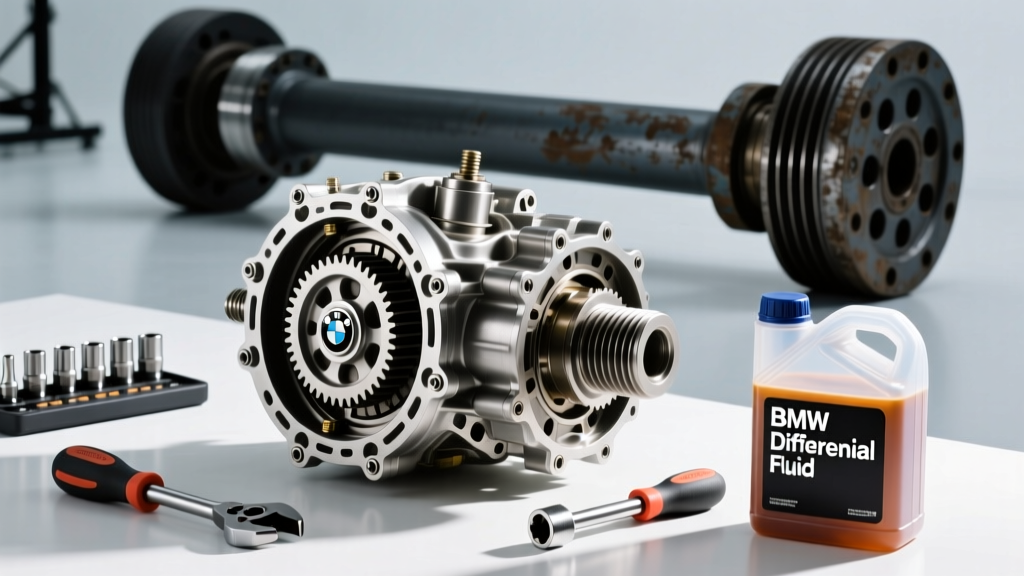
A failed differential is often traced back to improper drain and fill plug torques or reused crush washers. BMW utilizes metric hex (Allen) or Torx plugs, while American trucks typically use standard SAE square-drive or metric hex bolts. Always replace aluminum or copper crush washers to prevent slow leaks that will eventually starve the pinion bearing of lubrication.
- BMW Rear Diff Plug (M14x1.5): Requires a 14mm Hex bit. Torque to 60 Nm (44 lb-ft). OEM Crush Washer Part # 07119963200.
- BMW Front Diff Plug (M12x1.5): Requires a 14mm or 17mm Hex bit depending on the exact ZF/Getrag housing. Torque to 30 Nm (22 lb-ft).
- Ford F-150 9.75 in. Axle: Uses a 3/8-inch drive square plug for the fill hole (no drain plug on many modern Ford axles; requires a fluid extraction pump). Torque to 35 lb-ft.
- Chevy Silverado 9.5 in. Axle: Uses a 15mm hex for both drain and fill. Torque to 25 lb-ft (34 Nm).
The Upgrade Execution: Step-by-Step
1. Preparation and Thermal Cycling
Before draining, drive the vehicle for 15-20 minutes to bring the differential fluid up to operating temperature (approx. 104°F / 40°C). Warm fluid flows faster and suspends metallic particulates, allowing them to drain out completely. This is especially critical for BMW SUVs, as the OEM fluid level check procedure mandates the fluid be at operating temperature to account for thermal expansion.
2. Extraction and Draining
For BMWs equipped with drain plugs, remove the fill plug first. This is a golden rule of differential service; if the fill plug is seized and you drain the fluid first, the vehicle is immobilized. Use a high-quality manual fluid pump to extract the remaining fluid from truck axles that lack a dedicated drain plug, such as the Ford 9.75-inch rear end. Inspect the magnetic drain plug (if equipped) for metallic shavings. A fine, glitter-like paste is normal wear; chunky metal shards indicate bearing or gear failure requiring a full rebuild.
3. Flushing and Refilling
If the OEM fluid is heavily degraded or you are switching from a conventional to a synthetic ester-based oil, consider running a dedicated gear oil flush. When refilling, use a flexible hose pump to inject the new fluid. For BMW xDrive systems, ensure the transfer case and front differential fluids are matched in viscosity to prevent binding in the center clutch pack. Fill until the fluid reaches the exact bottom lip of the fill hole for trucks, or until it begins to weep out of the fill hole on level ground for BMWs.
4. Torque and Verification
Install new crush washers and torque the plugs to the manufacturer's specifications listed above. Wipe the differential housing clean with brake parts cleaner. After driving for 100 miles, re-inspect the area around the fill and drain plugs for any signs of weeping or seepage.
Final Thoughts on Drivetrain Preservation
Whether you are optimizing a BMW X5 for track duty or prepping a Silverado for cross-country towing, differential maintenance is the cornerstone of drivetrain reliability. By ignoring the 'lifetime' fluid myth, selecting the correct viscosity and additive package, and adhering to strict torque specifications, you ensure that your ring and pinion gears remain quiet, cool, and fully engaged for hundreds of thousands of miles.