The Thermal Bottleneck in Modern Heavy-Duty Drivetrains
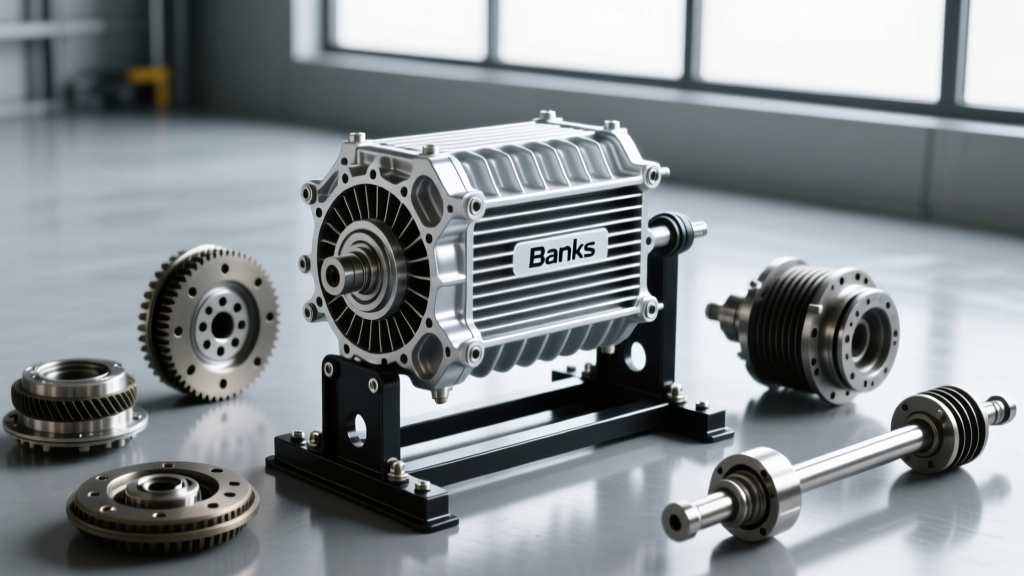
As heavy-duty diesel trucks have evolved to meet stringent emissions standards and tow ratings exceeding 35,000 pounds, the thermal load placed on the drivetrain has increased exponentially. Modern powertrains like the GM L5P Duramax paired with the Allison 1000 10-speed, or the Ford 6.7L Powerstroke mated to the 10R140, generate massive amounts of parasitic heat within the torque converter during heavy hauling. When transmission fluid temperatures exceed 220°F, automatic transmission fluid (ATF) begins to oxidize, forming varnish and sludge that degrades clutch pack friction materials and compromises valve body hydraulics. For operators demanding maximum reliability, the factory in-tank radiator coolers or undersized OEM front-mount units are often insufficient. This technical deep-dive explores the engineering, fluid dynamics, and vehicle-specific integration of the Banks transmission cooler systems designed for the Big Three diesel platforms.
Engineering the Banks Transmission Cooler: Core Architecture
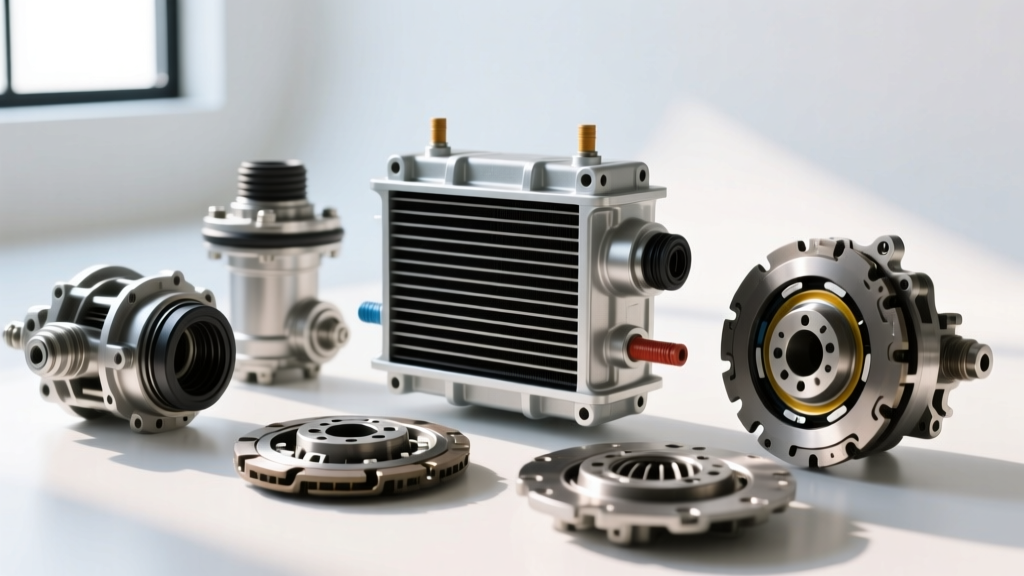
The primary differentiator in the heavy-duty aftermarket cooling sector is the physical architecture of the heat exchanger core. While legacy systems relied on tube-and-fin designs, modern high-performance applications demand higher surface-area-to-volume ratios without introducing excessive fluid restriction. Banks Power engineers their premium transmission coolers utilizing a micro-extruded stacked-plate architecture. This design forces the ATF through a series of narrow, turbulated micro-channels, effectively breaking up the boundary layer of fluid that typically insulates the inner walls of standard cooler tubes and impedes heat transfer.
Micro-Extruded Stacked-Plate vs. Traditional Tube-and-Fin
In a traditional tube-and-fin cooler, fluid travels through smooth, relatively large-diameter tubes. The fluid in the center of the tube moves faster than the fluid near the walls, creating a thermal boundary layer that acts as an insulator. The stacked-plate design utilized in the Banks transmission cooler forces the fluid through flat, dimpled plates. These dimples act as turbulators, constantly mixing the fluid and exposing the core temperature of the fluid stream to the aluminum cooling fins. The result is a thermal transfer efficiency increase of up to 30% over comparable tube-and-fin units, while simultaneously requiring less physical frontal area, which preserves critical airflow to the engine radiator and intercooler.
Vehicle-Specific Integration: Fitment and Part Numbers
Universal coolers often lead to compromised mounting solutions and poorly routed lines that kink under suspension articulation. The Banks transmission cooler lineup is engineered for direct, chassis-specific integration, utilizing factory mounting points and CNC-bent brackets. Below is a breakdown of the primary applications, part numbers, and core specifications for the most common heavy-duty diesel platforms.
| Vehicle Application | Transmission Model | Banks Part # | Core Volume | Hose ID / Fitting | Est. Price Range |
|---|---|---|---|---|---|
| 2011-2016 GM Duramax | Allison 1000 (6-spd) | 49034 | 225 cu in | 1/2" / -8 AN | $450 - $520 |
| 2017-2023 GM Duramax | Allison 1000 (10-spd) | 49038 | 280 cu in | 5/8" / -10 AN | $550 - $630 |
| 2011-2019 Ford Powerstroke | 6R140 TorqShift | 49042 | 250 cu in | 1/2" / -8 AN | $480 - $560 |
| 2013-2018 Ram Cummins | Aisin AS69RC / 68RFE | 49046 | 265 cu in | 5/8" / -10 AN | $510 - $590 |
Technical Installation Protocol: Allison 1000 and 6R140
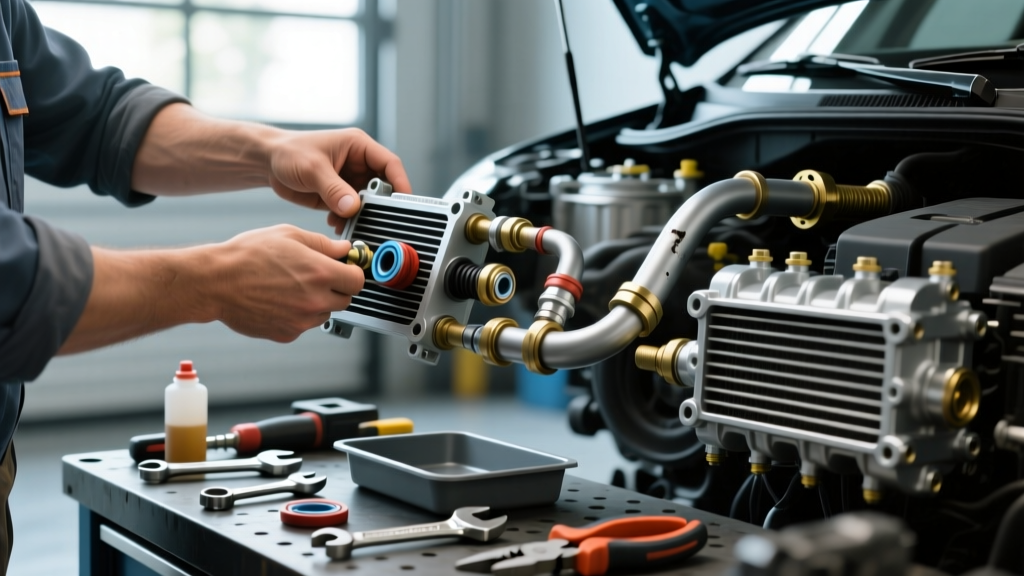
Proper installation of a high-capacity auxiliary cooler is just as critical as the hardware itself. Incorrect plumbing can lead to aeration, pressure drops, or catastrophic line failure. When installing a Banks transmission cooler on an Allison 1000 or Ford 6R140, technicians must adhere to strict hydraulic protocols.
Line Pressure Dynamics and Burst Ratings
The Allison 1000 is notorious for generating immense mainline pressure, particularly when operating in Tow/Haul mode or utilizing aftermarket tuning. Under heavy load, mainline pressure can spike between 230 psi and 310 psi. Standard barbed fittings and low-grade clamps will fail under these conditions, leading to rapid fluid loss and transmission burnout. The Banks kits utilize high-pressure synthetic rubber hoses (equivalent to Gates C5D specifications) rated for continuous operation at 400 psi, with a burst pressure exceeding 800 psi. Furthermore, the cooler core itself is hydrostatically tested to withstand internal pressures well beyond the OEM transmission pump's maximum output.
Fitting Torque Specs and Hose Clamping
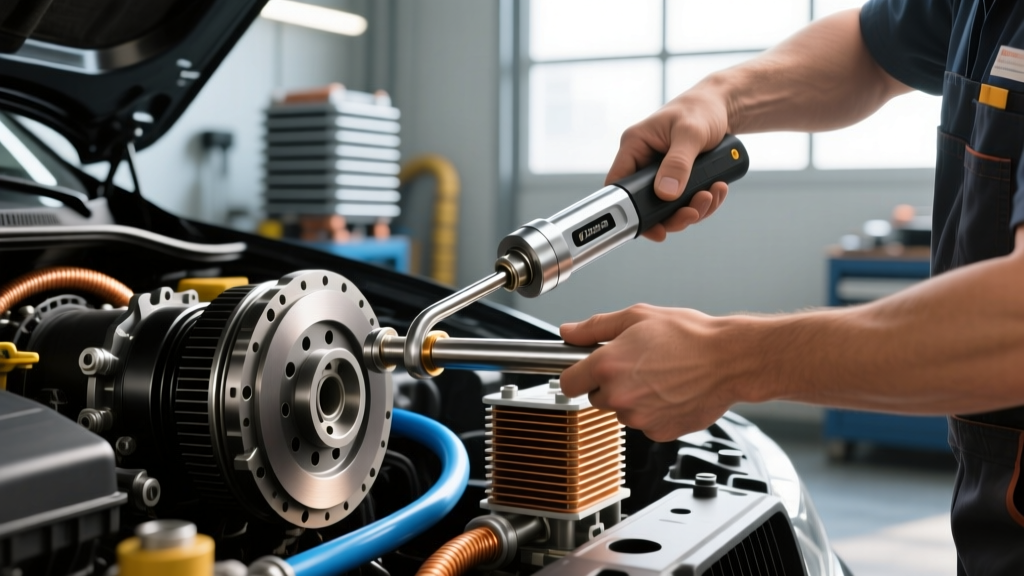
When adapting the cooler lines to the transmission case or the OEM cooler block, precise torque specifications must be followed to prevent stripping aluminum threads or crushing O-rings.
- -8 AN O-Ring Boss (ORB) Fittings: Torque to 18-22 lb-ft using a crowfoot wrench. Always lubricate the O-ring with fresh ATF prior to installation to prevent binding and tearing.
- -10 AN ORB Fittings: Torque to 28-32 lb-ft.
- High-Pressure Hose Clamps: Use constant-tension T-bolt clamps or heavy-duty fuel injection style clamps. Torque the clamp screws to 45-55 in-lbs. Do not exceed 60 in-lbs, as over-torquing can cut into the synthetic hose jacket and compromise the inner wire braid.
Pro-Tip for 6R140 Installations: The Ford 6R140 utilizes a complex thermal management system with an internal bypass valve. When tapping into the return line for the Banks transmission cooler, ensure you are routing the fluid after the OEM thermal bypass valve. This ensures that cold fluid bypasses the auxiliary cooler during winter warm-up cycles, allowing the 6R140 to reach its optimal 185°F operating temperature faster, which reduces clutch drag and improves fuel economy.
Real-World Thermal Delta: Before and After Data
To quantify the efficacy of the Banks transmission cooler, we analyze thermal delta data collected during controlled grade testing (simulating an 8-mile pull up a 6% grade at 60 MPH with a 12,000 lb trailer). According to engineering data validated by Allison Transmission, maintaining ATF temperatures below 200°F is critical for preserving the structural integrity of the synthetic friction materials used in modern clutch packs.
- Stock OEM In-Tank Cooler (LML Duramax): Peak fluid temperature reached 232°F. At this temperature, Mobil Delvac 1 ATF begins to experience accelerated shear thinning and oxidation.
- Banks Ram-Air Front-Mount (Part #49034): Peak fluid temperature stabilized at 178°F. This represents a 54°F thermal reduction, effectively increasing the fluid's operational lifespan by a factor of three, based on the Arrhenius equation for chemical degradation rates.
The 10-speed Allison 1000 and Ford 10R140 feature even smaller, low-viscosity fluids (like TES 295 or MERCON ULV) designed to reduce parasitic drag. These thinner fluids are exceptionally sensitive to thermal breakdown. Upgrading to the higher-capacity 280 cu in Banks core (Part #49038) is highly recommended for 2017+ GM HD trucks used in commercial towing applications.
Cold-Weather Bypass Considerations
While mitigating heat is the primary goal, overcooling a transmission in sub-freezing ambient temperatures can be equally detrimental. ATF must reach at least 150°F to properly atomize and lubricate the valve body solenoids and clutch apply pistons. If an auxiliary cooler is too efficient, the transmission will remain in a cold-state high-pressure mode, causing harsh shifts and accelerated wear. Banks addresses this by engineering their heavy-duty kits to integrate seamlessly with the factory thermal bypass circuits. For extreme northern climates, installing an inline inline-thermostatic bypass valve (set to open at 160°F) in conjunction with the Banks transmission cooler is the ultimate setup, ensuring rapid warm-up in the winter and maximum thermal rejection in the summer.
Conclusion: Is the Premium Justified?
When evaluating the cost of a Banks transmission cooler kit—typically ranging from $450 to $650—it must be weighed against the cost of an out-of-warranty transmission rebuild, which easily exceeds $5,500 for a modern 10-speed automatic. The micro-extruded stacked-plate core, chassis-specific brackets, and high-pressure ORB fittings provide a level of engineering that generic universal coolers simply cannot match. For Duramax, Powerstroke, and Cummins owners who subject their trucks to heavy towing, mountain passes, or competitive sled pulling, the Banks transmission cooler is not just an accessory; it is a critical, data-backed insurance policy for the drivetrain.