The Acoustic Fingerprint of Drivetrain Failure
Proactive differential maintenance extends far beyond simply draining and refilling 75W-90 gear oil at arbitrary intervals. For automotive technicians and serious enthusiasts, the differential is a high-stress mechanical symphony, and when a component begins to fail, it broadcasts its distress through specific acoustic frequencies. Diagnosing axle noise requires a trained ear, an understanding of hypoid gear geometry, and a methodical approach to isolation.
In the modern era of high-output turbocharged engines and heavy-duty towing packages, differentials—such as the GM AAM 11.5-inch or the Dana Super 60—endure immense rotational mass and torque spikes. Ignoring early auditory warnings inevitably leads to catastrophic ring and pinion failure, turning a $150 fluid service into a $2,500 axle rebuild. This guide provides an expert-level framework for differential noise diagnosis, precise teardown specifications, and fluid tribology best practices.
Categorizing the Noise: Drive, Coast, and Constant
The hypoid ring and pinion gear set operates with a sliding and rolling action, creating distinct contact patterns on the drive (concave) and coast (convex) sides of the ring gear teeth. Where and when the noise occurs dictates your diagnostic path.
1. The Drive Whine (Acceleration)
A high-pitched whine that manifests only under throttle application indicates wear or improper setup on the drive side of the gear teeth. This is often caused by insufficient pinion depth, leading to the contact pattern riding too high on the tooth face. If left uncorrected, the gear will eventually strip under heavy load.
2. The Coast Howl (Deceleration)
Noise that appears when you lift off the throttle (engine braking) points to the coast side of the teeth. This typically results from excessive pinion depth or excessive backlash. In high-mileage differentials, coast-side wear is common because the coast side is rarely the primary load-bearing surface during normal driving, meaning it receives less consistent boundary lubrication.
3. The Constant Howl (Bearing Failure)
If the noise is present regardless of throttle position and changes pitch strictly in correlation with vehicle speed (not RPM), you are likely listening to a failing bearing. Pinion bearing failures often sound like a rhythmic hum or howl that peaks around 45-55 mph. Carrier bearings tend to emit a lower-pitched rumble that can be felt through the floorpan.
Diagnostic Matrix: Road Test & Isolation
Before pulling the differential cover, conduct a structured road test. Use the following matrix to isolate the failing component.
| Acoustic Symptom | Driving Condition | Probable Failure Point | Next Diagnostic Step |
|---|---|---|---|
| High-pitch whine | Under acceleration (load) | Ring & Pinion (Drive side wear / shallow pinion depth) | Check gear oil for brass/steel glitter; inspect contact pattern. |
| Low-pitch howl | Deceleration (coast) | Ring & Pinion (Coast side wear / deep pinion depth) | Measure backlash with dial indicator (spec: 0.006"-0.010"). |
| Rhythmic clicking | Turning corners (tight radius) | Limited Slip Differential (LSD) clutch pack degradation | Verify friction modifier dosage; perform figure-8 test. |
| Constant hum/growl | Speed-dependent (40-60 mph) | Pinion or Carrier Bearing spalling | Check pinion nut torque and rotating preload (inch-pounds). |
| Metallic clunk | Shifting from Reverse to Drive | Excessive backlash or worn cross-pin shafts | Inspect spider gears and ring gear bolt torque. |
Deep Dive: Teardown Specifications & Edge Cases
When diagnosis dictates a teardown, precision is non-negotiable. According to engineering data from Dana Spicer, improper setup tolerances are the leading cause of premature gear failure post-rebuild. Here are the critical specifications you must adhere to during differential maintenance and rebuilds.
Ring Gear Runout and Backlash
Mount a magnetic dial indicator to the axle housing and rest the probe on the back face of the ring gear. Rotate the carrier 360 degrees. Total Indicated Runout (TIR) must not exceed 0.003 inches. If runout exceeds this, the ring gear is warped, the carrier is damaged, or debris is trapped between the ring gear and carrier mating surface.
Backlash must be measured at a minimum of three equidistant points around the ring gear. For most passenger and light-truck applications (e.g., Ford 8.8, GM 8.5-inch 10-bolt), target backlash is between 0.006" and 0.010". Backlash that varies wildly around the gear indicates a warped ring gear or improper ring gear bolt torque.
Expert Tip: When installing ring gear bolts on a Ford 8.8 or Dana 44, always use a high-strength threadlocker (e.g., Loctite 271) and torque them in a star pattern to 70-85 lb-ft. For GM 10-bolt 8.5" axles, ring gear bolts require a massive 120 lb-ft of torque. Never reuse stretched ring gear bolts.
Pinion Bearing Preload
Pinion preload is the most common stumbling block for novice builders. Preload is the rolling resistance of the pinion bearings, measured in inch-pounds using a beam-style or digital inch-pound torque wrench.
- New Bearings: Target 25-30 in-lbs of rotating torque.
- Used Bearings: Target 15-20 in-lbs of rotating torque.
On crush-sleeve axles, achieving this requires tightening the pinion nut to extreme torque values (often 250+ lb-ft) while holding the yoke with a specialized tool like the OTC 8682. If you over-crush the sleeve, you must discard it and install a new one; never back off the pinion nut to reduce preload, as this will compromise the crush sleeve's structural integrity.
Fluid Tribology: The Role of Viscosity and Additives
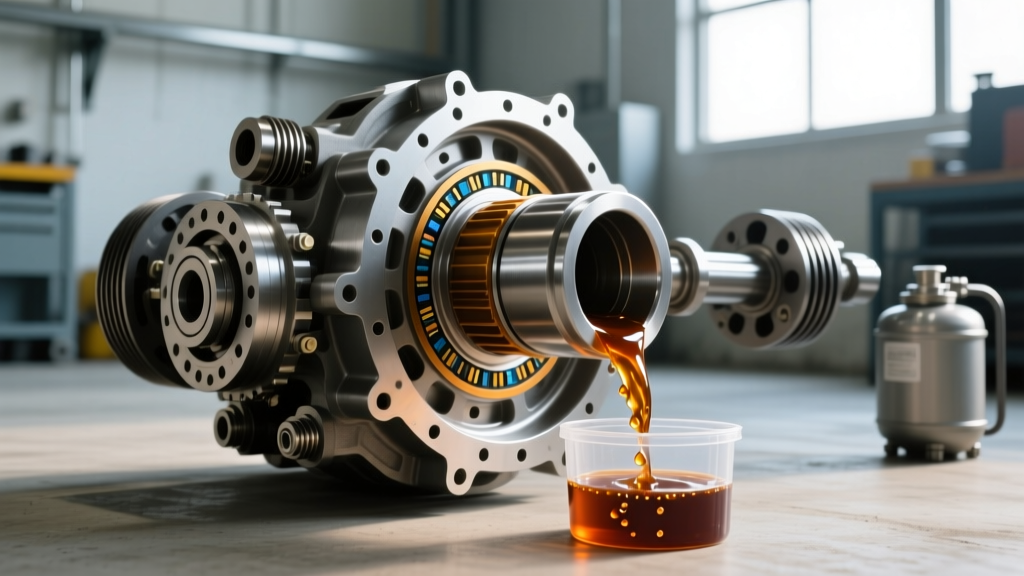
A critical, often overlooked aspect of differential maintenance is fluid selection and additive chemistry. Modern synthetic gear oils, such as Royal Purple Max Gear or Amsoil Severe Gear 75W-90, utilize polyalphaolefin (PAO) and ester base stocks that resist thermal shear far better than conventional petroleum oils. However, viscosity alone does not protect clutch-type Limited Slip Differentials (LSDs).
The Friction Modifier Dilemma
Clutch-type LSDs (like the Auburn or Eaton Truetrac predecessors) rely on specific friction modifiers to prevent stick-slip chatter during low-speed cornering. If your differential chatters during tight turns immediately after a fluid change, the modifier has either been omitted or has oxidized.
Always use OEM-specified modifiers. For Ford 8.8 and 9.75-inch axles, use Motorcraft XL-3 Friction Modifier. For GM applications, use ACDelco EOS (part #88900338). The standard dosage is typically 4 oz per axle, but for severe chatter, an additional 2 oz can be added without compromising the base oil's extreme pressure (EP) sulfur-phosphorus additive package.
When to Rebuild vs. Replace: A Cost-Benefit Analysis
As detailed in technical guides from Yukon Gear & Axle, the decision to rebuild a differential or swap in a remanufactured unit depends on housing integrity and parts availability.
| Service Type | Estimated Cost (Parts + Labor) | Best Application Scenario |
|---|---|---|
| Fluid & Additive Service | $80 - $150 | Routine 60k-mile maintenance; mild chatter diagnosis. |
| Bearing & Seal Reseal | $400 - $700 | Pinion seal leaks; early-stage bearing howl; gears are pristine. |
| Master Rebuild (Gears + Bearings) | $1,200 - $2,200 | Catastrophic gear wear; changing gear ratios (e.g., 3.73 to 4.56). |
| Crate Axle Assembly Swap | $2,500 - $4,500+ | Bent axle tubes; stripped differential case threads; fleet downtime. |
Final Diagnostic Directives
Never ignore a changing acoustic profile in your drivetrain. A faint whine at 70 mph is an invitation to inspect the differential cover for ferrous debris before the pinion bearing cages disintegrate and score the differential case. True differential maintenance requires combining auditory diagnostics with rigorous adherence to micrometer-level assembly tolerances and advanced fluid chemistry. By treating the axle as a precision instrument rather than a sealed forgotton component, you ensure maximum longevity and optimal power delivery to the pavement.