The Symbiosis of the Transmission and Drivetrain in AWD Architectures
Modern all-wheel drive (AWD) systems represent one of the most complex mechanical and electronic intersections in automotive engineering. Unlike traditional part-time four-wheel drive (4WD) systems that rely on a rigid, driver-selected mechanical lock, contemporary AWD relies on the seamless integration of the transmission and drivetrain to dynamically apportion torque across multiple axles. As of 2026, with the proliferation of hybridized powertrains and ultra-high-torque turbocharged engines, the mechanical handshake between the transmission's output shaft and the drivetrain's torque-biasing differentials has never been more critical.
To understand AWD operation, one must abandon the notion that the transmission merely 'sends power to the wheels.' Instead, the transmission acts as the primary torque modulator, while the drivetrain components—specifically the Power Transfer Unit (PTU), driveshafts, and active rear couplings—act as the spatial distributors. Whether the vehicle is built on a front-wheel-drive-biased transverse platform (like the VW Group MQB) or a rear-wheel-drive-biased longitudinal architecture (like BMW's CLAR), the fundamental physics of torque vectoring remain rooted in hydraulic clutches, helical gearsets, and advanced mechatronics.
Longitudinal vs. Transverse: Power Flow and PTU Dynamics
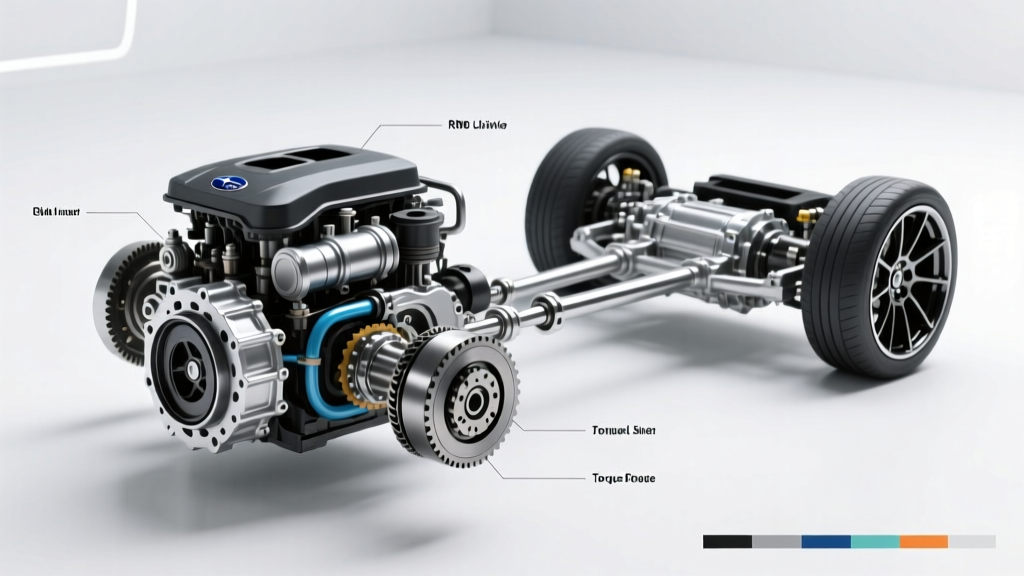
The physical orientation of the transmission dictates the complexity of the AWD drivetrain. In longitudinal applications, such as those utilizing the ZF 8HP eight-speed automatic transmission, the transfer case is typically bolted directly to the rear of the transmission housing. The center differential (often a Torsen or multi-plate clutch pack) sits concentrically within the transfer case, splitting torque front-to-rear via a dedicated output shaft that feeds the front driveshaft.
Conversely, transverse platforms require a Power Transfer Unit (PTU). The PTU is a right-angle gear reduction box bolted directly to the transaxle. It intercepts torque from the transmission's ring gear or a dedicated PTO (Power Take-Off) gear and redirects it 90 degrees down the propeller shaft to the rear axle.
The Thermal Vulnerability of the PTU
Because the PTU is mounted in close proximity to the transmission's exhaust routing and torque converter, thermal degradation is a primary failure point. For example, in Ford's 3.5L EcoBoost AWD applications, the PTU holds a mere 18 ounces (0.53 liters) of 75W-140 synthetic gear oil. This low volume, combined with high parasitic heat, frequently leads to bearing failure and gear whine. Upgrading to an aftermarket billet PTU cover with integrated cooling fins or an external fluid cooler is a common preventative measure in the enthusiast community, extending the lifespan of the hypoid gearsets significantly.
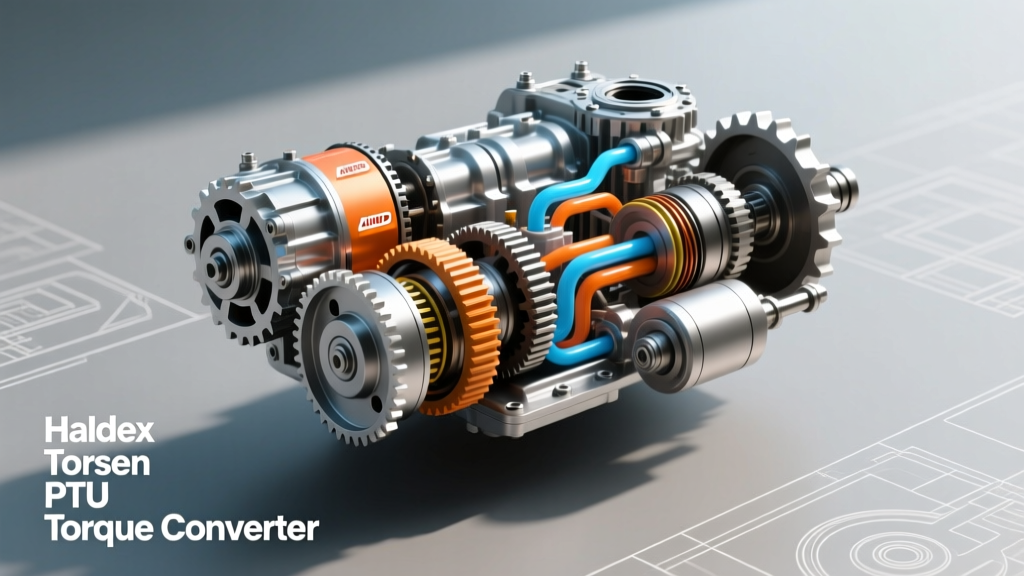
Torque Biasing Mechanisms: Haldex, Torsen, and SH-AWD
The true magic of the transmission and drivetrain relationship lies in how the system reacts to slip. The industry relies on three primary mechanisms to achieve this, each with distinct mechanical behaviors and maintenance requirements.
Haldex Generation V (FWD-Biased Active Clutch)
Widely used across Volkswagen, Audi (Quattro Ultra/Haldex), and Volvo platforms, the Haldex Gen V coupling is located at the rear differential. Unlike previous generations that utilized an engine-driven mechanical pump and an accumulator, Gen V relies entirely on a centrifugal hydraulic valve actuated by an electric pump. When the Haldex control module detects slip via wheel speed sensors or steering angle inputs, it energizes the pump, clamping the multi-plate friction discs to send up to 50% of available torque to the rear axle. The response time is measured in milliseconds, but the system requires meticulous fluid maintenance to prevent the micro-filter screen from clogging with clutch material.
Torsen (Torque-Sensing) Helical Differentials
Found in longitudinal applications like older Audi Quattro systems and the Toyota GR Yaris, the Torsen center differential utilizes complex helical worm gears. It operates purely on mechanical torque bias without the need for electronic clutch packs. If the front axle loses traction, the internal gear geometry creates friction and binds, automatically multiplying torque to the rear axle based on a fixed Torque Bias Ratio (TBR), typically 40:60 or 50:50. Because it is a purely mechanical device integrated into the drivetrain, it requires zero specialized electronic calibration, though it cannot send 100% of torque to a single axle if one axle has zero traction (unless equipped with locking brake interventions).
Active Twin-Clutch Rear Differentials (SH-AWD)
Honda's Super Handling All-Wheel Drive (SH-AWD) takes the transmission and drivetrain concept a step further by incorporating a rear axle that can actually over-speed the outside rear wheel during cornering. Using twin electromagnetic clutch packs mounted on either side of the rear differential, SH-AWD can route up to 70% of total engine torque to the rear, and 100% of that rear torque to a single wheel. By accelerating the outside rear wheel 1.7% faster than the front wheels, the system induces a yaw moment that physically pushes the car through the apex, effectively eliminating understeer.
Comparative Data: AWD Drivetrain Configurations
| System Type | Primary Architecture | Max Rear Torque Bias | Response Mechanism | Fluid Capacity & Spec |
|---|---|---|---|---|
| Haldex Gen V | Transverse (FWD-biased) | 50% (Dynamic) | Electric Pump / Centrifugal Valve | ~650ml (G 060 175 A2) |
| Torsen T-3 | Longitudinal (RWD-biased) | 60-80% (Mechanical TBR) | Helical Worm Gears | Integrated in Trans/Transfer Case |
| SH-AWD (Gen 4) | Transverse (FWD-biased) | 70% Total / 100% Lateral | Electromagnetic Twin-Clutch | ~2.8L Rear (DPSF-II) |
| BMW xDrive | Longitudinal (RWD-biased) | 100% (Dynamic) | Wet Multi-plate Chain Drive | ~1.2L (TF 0870) |
Drivetrain Maintenance: Fluids, Intervals, and Torque Specifications
The intersection of the transmission and drivetrain is fraught with high-stress fasteners and specialized lubricants. Neglecting these specific parameters is the leading cause of catastrophic AWD failure. Below are critical service specifications for common AWD architectures.
- Haldex Fluid Service: The factory specification for Gen V is typically G 060 175 A2. Capacity is roughly 650ml to 800ml depending on the housing. Critical Step: You must drop the pump and clean the brass micro-filter screen. Failing to clean this screen results in pump cavitation and a complete loss of rear-drive engagement. Interval: Every 40,000 miles.
- Propeller Shaft Flex Disc (Giubo): The rubber flex disc connecting the transmission output to the front half of the driveshaft absorbs torsional shock. When replacing the M10 or M12 flange bolts, they are almost universally Torque-To-Yield (TTY). A standard specification is 65 Nm + 90 degrees of rotation. Reusing old TTY bolts will result in driveline clunk and eventual flange separation.
- CV Axle Nut Torque: The front CV axles on AWD vehicles endure massive torsional loads. For modern MQB-platform vehicles, the 12-point M24 axle nut requires a staggering 200 Nm + 180 degrees. This requires a heavy-duty torque wrench and a breaker bar; impact guns cannot accurately achieve the yield stretch required to keep the wheel bearing preloaded.
- Rear Differential Drain/Fill Plugs: Typically M14 or M16 hex bolts. Torque specification is generally 35 Nm to 45 Nm. Always replace the crush washer to prevent hypoid gear oil leaks, which will destroy the ring and pinion within a few thousand miles.
Diagnostic Protocols for AWD Malfunctions
When a driver experiences a 'Drivetrain Malfunction' warning or a loss of rear-wheel traction, mechanical diagnosis must be paired with electronic verification. Modern AWD systems do not simply 'break'; they are commanded into safe modes by the ECU or TCM.
Bi-Directional Clutch Testing
Using a bi-directional OBD2 scanner (such as VCDS for VW/Audi or FORScan for Ford), a technician can access the AWD control module and manually command the clutch pack duty cycle. By raising the vehicle on a lift, placing it in gear, and commanding the Haldex or PTU clutch to 100% lock, the technician can observe the rear driveshaft. If the front wheels spin but the rear driveshaft remains stationary despite a 100% commanded duty cycle, the fault is mechanical (sheared splines, stripped driveshaft U-joint, or burnt clutch friction material). If the rear driveshaft engages, the fault lies upstream in the wheel speed sensors, steering angle sensor, or CAN-bus communication network.
Transmission Slip and Drivetrain Binding
In vehicles equipped with active transfer cases (like BMW xDrive), mismatched tire tread depths or incorrect rolling diameters will cause the transfer case clutch pack to drag continuously. The Torsen or multi-plate clutch will interpret the differing wheel speeds as continuous slip, leading to rapid thermal degradation of the transfer case fluid. Always verify that the rolling circumference of all four tires is within 2mm to 4mm of each other to protect the transmission and drivetrain from catastrophic binding.
Conclusion
The operation of an all-wheel-drive system is a masterclass in mechanical and electronic synergy. The transmission and drivetrain do not operate in isolation; they are in a constant state of data exchange and physical torque negotiation. Whether relying on the brute mechanical force of a Torsen differential or the micro-second hydraulic clamping of a Haldex Gen V coupling, understanding the precise fluid requirements, torque specifications, and diagnostic pathways is essential for any automotive professional or dedicated enthusiast navigating the complex landscape of modern AWD platforms.