The Evolution of AWD: From Viscous Couplings to Active Transfer Cases
The modern All-Wheel Drive (AWD) landscape has shifted dramatically from the purely mechanical, viscous-coupling-based systems of the 1990s to highly sophisticated, computer-controlled Active Transfer Cases (ATC). Today, torque distribution is managed in milliseconds, relying on complex electromagnetics, pulse-width modulation (PWM), and real-time CAN bus data. For automotive technicians targeting specialized ATC drivetrain OKC jobs in the expanding Oklahoma City commercial fleet and advanced diagnostic sectors, mastering these electromechanical systems is no longer optional—it is a prerequisite for senior-level drivetrain roles.
Unlike traditional part-time 4WD systems that require driver intervention and mechanical locking hubs, modern AWD systems operate seamlessly. The Transfer Case Control Module (TCCM) monitors wheel speed sensors, steering angle, throttle position, and yaw rate to preemptively route torque to the axle with the most traction. Understanding the exact mechanical and electrical operation of the ATC is the dividing line between a parts-swapper and a true drivetrain diagnostician.
Inside the ATC: Electromagnetic Clutch Pack Operation
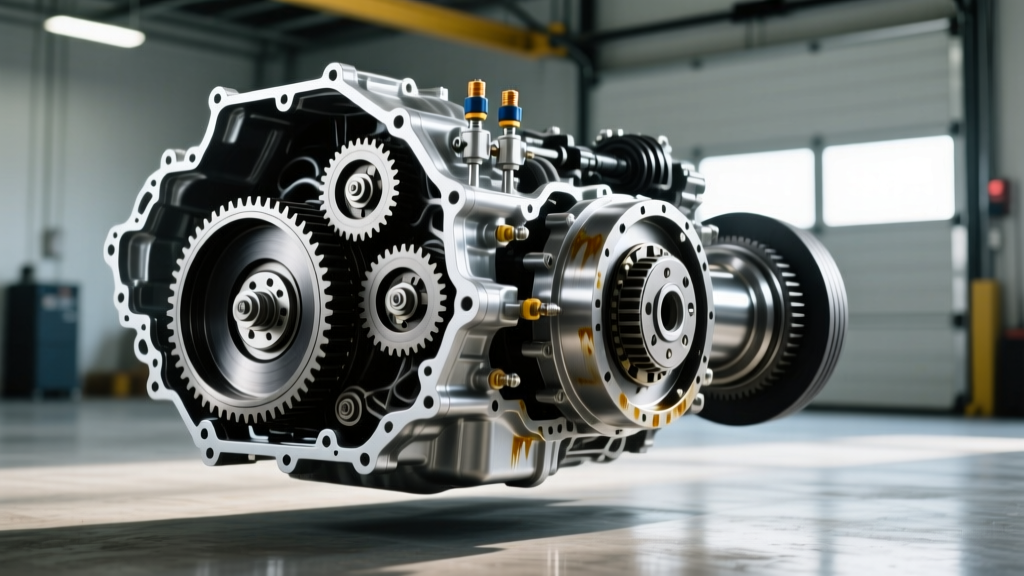
At the heart of most contemporary AWD systems (such as those found in GM, Ford, and various Stellantis platforms) is an electromagnetic clutch pack housed within the transfer case. This assembly is responsible for biasing torque from the primary driven axle (usually the rear) to the secondary axle (the front).
The Physics of PWM Torque Biasing
The TCCM does not simply turn the clutch pack "on" or "off." Instead, it utilizes a 12-volt Pulse Width Modulated (PWM) signal to an electromagnetic coil. When the coil is energized, it generates a magnetic field that pulls an armature plate. This plate acts as a cam, forcing a series of alternating friction and steel clutch plates together.
- 0% to 10% Duty Cycle: The clutch pack remains largely disengaged. The vehicle operates in RWD or FWD mode to maximize fuel economy and reduce parasitic drivetrain loss.
- 15% to 60% Duty Cycle: The TCCM detects slip or anticipates loss of traction (e.g., aggressive throttle tip-in). The PWM signal increases, progressively compressing the clutch pack to transfer 10% to 40% of available torque to the secondary axle.
- 80% to 100% Duty Cycle: Maximum magnetic saturation. The clutch pack is fully locked, providing a rigid 50/50 torque split for severe low-traction environments.
According to engineering white papers published by the Society of Automotive Engineers (SAE), the response time of these modern electromagnetic actuators is typically under 150 milliseconds, vastly outperforming the fluid-shear delay inherent in older viscous couplings.
Critical Specifications: Fluids, Torques, and Clearances
Diagnosing AWD chatter, binding, or failure to engage requires strict adherence to manufacturer specifications. Using the incorrect fluid in an ATC will alter the coefficient of friction on the clutch plates, leading to immediate shudder during low-speed turns or catastrophic thermal degradation under load.
| Transfer Case Model | Common Application | Fluid Specification | Fill Capacity | Drain/Fill Plug Torque |
|---|---|---|---|---|
| NVG 246 (GM Auto-Trak) | GM 1500/2500 Trucks & SUVs | Auto-Trak II (GM P/N 88900402) | 2.0 Quarts | 18 lb-ft |
| BorgWarner 4484 | Ford/GM AWD Crossovers | Dexron VI / BW Specific | 1.5 Quarts | 22 lb-ft |
| Magna Powertrain DD1 | Modern FWD-based AWD | Specific CVTF / AWF | 1.2 Quarts | 25 lb-ft |
| NVG 263XHD | Heavy Duty GM Trucks | Dexron VI | 2.7 Quarts | 18 lb-ft |
Note: Always verify the exact RPO code or OEM part number before servicing. As highlighted in technical service bulletins from BorgWarner, mixing Auto-Trak II with standard Dexron VI in an NVG 246 will cause immediate clutch pack glazing due to the lack of specialized friction modifiers.
Diagnostic Edge Cases: Mismatched Tires and Thermal Protection
When interviewing for advanced ATC drivetrain OKC jobs, hiring managers will frequently test your knowledge on edge-case failures that mimic internal mechanical breakdowns but are actually external or logic-based faults.
The Mismatched Tire Catastrophe
AWD systems are exquisitely sensitive to rolling radius discrepancies. If a vehicle requires a new tire due to a sidewall blowout, replacing only one tire creates a difference in overall diameter. A mere 4mm difference in tread depth between the front and rear axles can result in a 10 to 15 RPM speed delta at highway speeds. The TCCM interprets this delta as continuous wheelslip. Consequently, the TCCM commands a constant 20-30% PWM duty cycle to the clutch pack. This continuous micro-slip generates immense heat, eventually boiling the transfer case fluid, glazing the friction plates, and destroying the ATC from the inside out. Rule of thumb: If tread depth variance exceeds 3/32" across all four corners, the tires must be shaved or replaced as a complete set.
Thermal Deration and "AWD Unavailable" Faults
Modern TCCMs feature inferred thermal models. Because placing a physical temperature sensor inside a spinning clutch pack is mechanically unfeasible, the TCCM calculates clutch temperature based on ambient air temp, fluid viscosity estimates, and the cumulative time spent in high-slip PWM states. If the calculated temperature exceeds 140°C (284°F), the module initiates a thermal protection strategy. It will aggressively derate torque transfer, often triggering an "AWD Unavailable" or "Service 4WD" message on the instrument cluster. Technicians must use a bidirectional scan tool to view the Clutch Temp PID to differentiate between a true mechanical failure and a thermal deration event.
Oscilloscope Diagnostics: Testing the Encoder Motor
The encoder motor (or shift motor) is responsible for moving the mode fork and range collar, as well as providing positional feedback to the TCCM. Older systems used potentiometers, which are prone to internal resistive track wear. Modern systems utilize Hall-effect sensors.
When diagnosing a "Service 4WD" code accompanied by a P0836 (Four Wheel Drive Switch Circuit), do not immediately condemn the motor. Connect a digital storage oscilloscope (DSO) to the feedback circuit.
- Verify the 5V Reference: Ensure the TCCM is providing a clean 5.0V reference and a sub-0.05V ground.
- Monitor the Signal Trace: As the motor sweeps through its range (from 2WD to Auto to 4HI), the voltage should ramp smoothly from roughly 0.5V to 4.5V.
- Identify Dropouts: Any sudden vertical drop to 0V or spike to 5V during the sweep indicates a dead spot on the potentiometer track or a failing Hall-effect magnet. This precise data capture is the gold standard for professional drivetrain diagnostics and prevents unnecessary $400+ encoder motor replacements.
Bridging Theory and Practice: The Modern Drivetrain Technician
The transition from a general repair technician to a drivetrain specialist requires a deep, systemic understanding of how mechanical hardware and software logic intersect. Securing highly competitive ATC drivetrain OKC jobs requires more than just knowing how to drain and fill a transfer case; it demands the ability to interpret PWM duty cycles, calculate rolling radius tolerances, and perform oscilloscope sweeps on encoder circuits.
As automakers continue to integrate AWD systems with hybrid and electric powertrains—utilizing electric motors on the secondary axle rather than mechanical driveshafts—the foundational logic of torque biasing, thermal management, and traction prediction remains identical. Master the Active Transfer Case today, and you secure your diagnostic relevance for the electrified drivetrains of tomorrow.