The Thermal Crisis in Heavy-Duty and Off-Road Axles
In the realm of high-performance off-road racing and heavy-duty commercial towing, differential thermal management is a critical frontier for 2026 powertrain engineering. When pushing a fully loaded Ford F-450 Super Duty equipped with an AAM 11.5-inch ring gear, or a Baja 1000 trophy truck running a Dana 60 front and Dana S135 rear, differential fluid temperatures can rapidly exceed 260°F (126°C). At these extreme thresholds, even premium 75W-140 synthetic gear oils—such as Amsoil Severe Gear or Mobil 1 Synthetic Gear Lubricant—begin to experience accelerated oxidation, viscosity shear, and additive depletion.
While liquid-to-liquid heat exchangers are common in packaged OEM setups, they add significant weight, plumbing complexity, and vulnerability to rock damage in off-road environments. Consequently, advanced fabricators and motorsport engineers frequently turn to high-capacity finned differential covers paired with active or passive ram-air ducting. However, designing an aerodynamically efficient cooling duct requires precise data. This is where the integration of an air differential pressure transmitter becomes an indispensable tool for validating convective heat transfer without incurring severe parasitic drag penalties.
Forced-Air Differential Covers vs. Liquid Coolers
Finned differential covers, manufactured by companies like Mag-Hytec, PML, and AFE Power, increase the surface area of the differential housing by up to 300%. Constructed from cast A356-T6 aluminum, these covers act as massive heat sinks. However, their effectiveness is entirely dependent on the convective heat transfer coefficient ($h$), which is dictated by airflow velocity across the fins.
At highway speeds (65+ mph), ambient airflow provides sufficient cooling. But in low-speed, high-torque scenarios—such as rock crawling, steep grade towing, or desert silt beds—boundary layer separation occurs, and airflow stagnates. To combat this, engineers fabricate ram-air scoops that route high-pressure air from the vehicle's grille or roof directly to the differential cover. To measure the efficiency of this ductwork, telemetry systems rely on an air differential pressure transmitter to monitor the pressure drop ($\Delta P$) across the cooling matrix.
Enter the Air Differential Pressure Transmitter
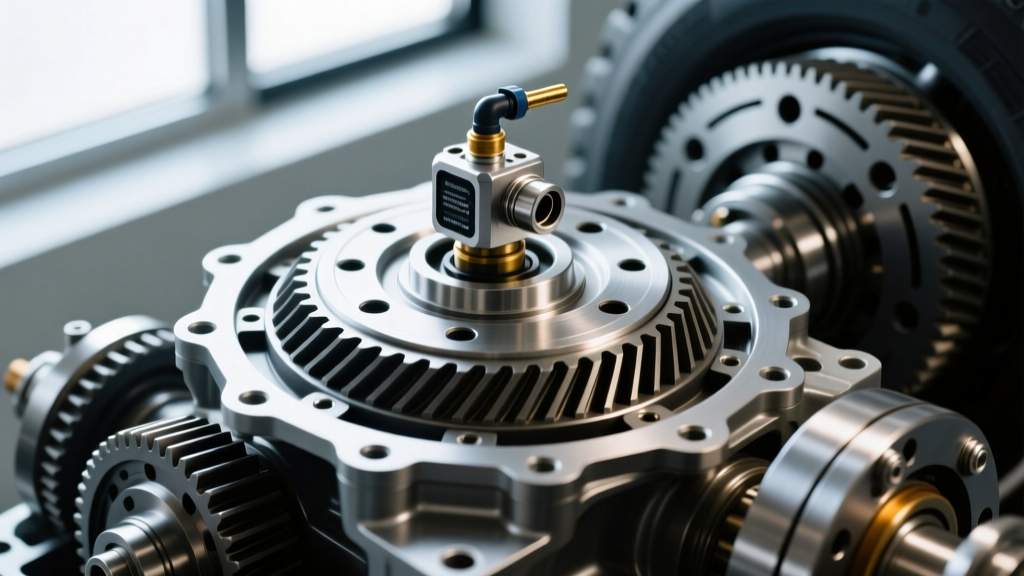
An air differential pressure transmitter is an industrial-grade sensor designed to measure the difference in pressure between two points. In an automotive cooling application, one port of the transmitter is connected to a pitot tube facing the oncoming airstream (stagnation pressure), while the other port is routed to the low-pressure wake zone behind the finned differential cover or cooling duct.
Key Specifications for Automotive Integration
- Measurement Range: 0 to 2.0 inches of water column (in. w.c.), sufficient for capturing automotive ram-air pressures up to 150 mph.
- Output Signal: 4-20mA or 0-5V analog, compatible with motorsport ECUs and data loggers like the MoTeC M150 or Holley Terminator X.
- Accuracy: $\pm$1% of full scale, ensuring precise aerodynamic mapping.
- Environmental Rating: IP65 or higher, with conformal potted circuitry to survive water fording, mud, and extreme underbody vibration.
By logging this $\Delta P$ data alongside differential fluid temperature (via a threaded PT100 RTD sensor in the diff cover), engineers can mathematically correlate airflow velocity with thermal dissipation, allowing them to reshape ducting for maximum cooling efficiency.
Telemetry Data: Cooling Efficiency & Pressure Drop Metrics
The following data table illustrates the relationship between vehicle speed, measured differential pressure, and the resulting temperature delta across a heavily loaded AAM 11.5 axle equipped with a custom ram-air duct and finned cover. Data was logged using a Dwyer MS2 Magnesense transmitter.
| Vehicle Speed (MPH) | Ram Air Velocity (m/s) | Measured $\Delta P$ (in. w.c.) | Diff Fluid Temp (°F) | Thermal State |
|---|---|---|---|---|
| 15 (Crawling/Towing) | 6.7 | 0.05 | 235°F | Critical / Active Fan Required |
| 35 (Trail/Grade) | 15.6 | 0.28 | 210°F | Stabilizing |
| 55 (Highway) | 24.5 | 0.65 | 185°F | Optimal Convective Cooling |
| 75 (Interstate) | 33.5 | 1.22 | 165°F | Over-cooled / High Drag |
As the table demonstrates, monitoring the air differential pressure allows the driver or automated ECU to deploy active aero flaps or auxiliary cooling fans when the $\Delta P$ drops below 0.15 in. w.c., indicating insufficient airflow for the current thermal load.
Installation and Calibration on an AAM 11.5 Axle
Integrating a pressure transmitter and finned cover requires meticulous attention to sealing and torque specifications to prevent gear oil contamination and sensor failure.
Step 1: Differential Cover Swap
Drain the factory 75W-140 gear oil (the AAM 11.5 holds approximately 3.8 quarts). Clean the mating surface on the axle housing using a non-abrasive brake cleaner. Install the new finned aluminum cover using the supplied Viton O-ring—do not use RTV silicone, as it can break off and clog the oil pickup. Torque the M10x1.5 cover bolts in a crisscross pattern to 26 lb-ft (35 Nm).
Step 2: Sensor and Pitot Tube Mounting
Mount the air differential pressure transmitter in a protected location, such as inside the frame rail or a sealed underbody enclosure. Route the high-pressure silicone tubing to a forward-facing pitot tube mounted on the diff guard or skid plate. Route the low-pressure tube to a static port located directly behind the trailing edge of the differential cover. Ensure all tubing is secured with UV-resistant zip ties and shielded from exhaust heat using fiberglass sleeving.
Step 3: Telemetry Wiring
Wire the 4-20mA output loop to an analog input channel on your data acquisition system. In the MoTeC M150 software, configure the channel scaling: 4mA = 0.0 in. w.c. and 20mA = 2.0 in. w.c. Overlay this channel with your differential fluid temperature channel to create a real-time thermal-aerodynamic efficiency map on your digital dash.
Cost Analysis and Sourcing
Building a telemetry-enabled active cooling system requires investment in both mechanical and electronic components. Below is a realistic 2026 pricing breakdown for a professional-grade setup:
- Finned Differential Cover (e.g., Mag-Hytec AAM 11.5): $220 - $280
- Air Differential Pressure Transmitter (e.g., Dwyer MS2-121): $160 - $195
- Custom Fabricated Ram-Air Scoop & Tubing: $150 - $300
- PT100 RTD Fluid Temp Sensor & Fitting: $85 - $120
- Total Hardware Cost: $615 - $895 (Excluding ECU/Data Logger)
For sourcing, industrial suppliers like Dwyer Instruments offer the most reliable transmitters for harsh environments. For axle-specific engineering data and torque specifications, fabricators should consult the Dana Spicer or AAM technical service bulletins.
Conclusion: The Future of Drivetrain Thermal Management
As vehicles continue to produce immense torque—evidenced by the latest generation of heavy-duty diesel and EV truck platforms—the thermal loads placed on the ring and pinion gears are reaching unprecedented levels. Relying solely on passive aluminum fins is no longer sufficient for extreme applications. By leveraging an air differential pressure transmitter to quantify and optimize underbody aerodynamics, engineers can ensure that differential fluid remains within its optimal viscosity window, preventing catastrophic gear failure and extending the service life of the entire drivetrain.
For further reading on drivetrain thermal dynamics and fluid shear limits, refer to the latest technical papers published by SAE International on heavy-duty axle thermal management.