The Local Search Dilemma: Layout Dictates the Repair Bill
When your vehicle shudders under acceleration, emits a high-pitched whine at highway speeds, or binds during tight parking lot turns, your immediate reflex is to pull out your phone and search for drivetrain mechanics near me. However, not all local transmission and driveline shops are equipped to handle every architecture. The fundamental layout of your vehicle—Front-Wheel Drive (FWD), Rear-Wheel Drive (RWD), or All-Wheel Drive (AWD)—dictates not only the complexity of the repair but the specialized tooling required and the final 2026 labor bill.
To provide a concrete, model-specific comparison, this guide dissects three benchmark vehicles representing each layout: the Honda Accord (FWD), the Ford Mustang S550 (RWD), and the Subaru Outback (AWD). By understanding the exact failure points, part costs, and labor hours associated with these platforms, you can accurately vet local mechanics and avoid inflated diagnostic fees.
FWD Architecture: Honda Accord (10th Gen) Transaxle & CV Axles
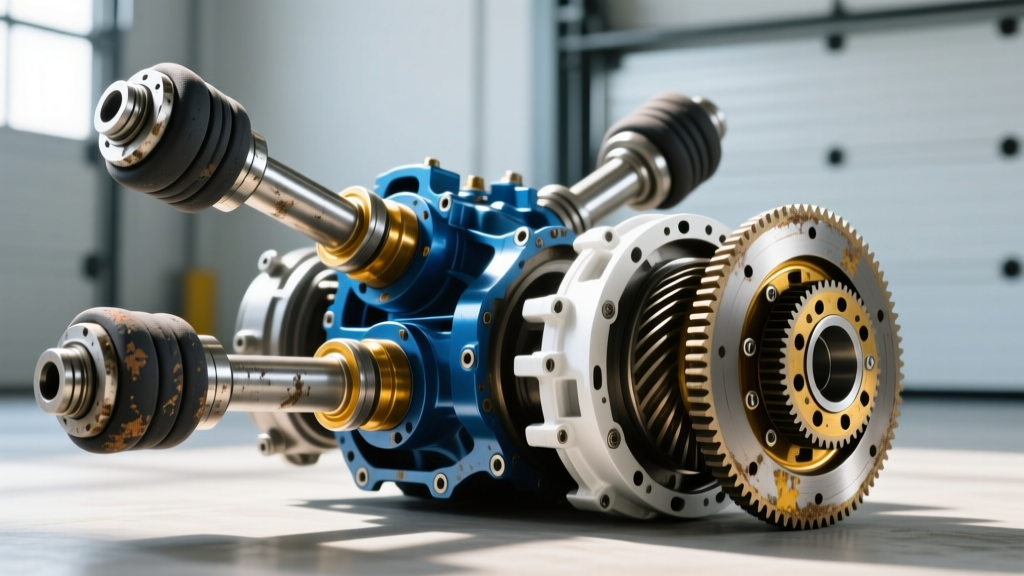
In a Front-Wheel Drive layout, the transmission and differential are integrated into a single housing known as a transaxle. Power is routed directly to the front wheels via Constant Velocity (CV) half-shafts. While this packaging is space-efficient, it concentrates immense torque and heat into a compact area.
Common Failure: Inner Tripod Joint & Differential Bearings
On the 10th-generation Honda Accord (specifically the 1.5T with the Honda CF1 CVT), a frequent drivetrain complaint is a pronounced vibration under load between 40 and 60 mph. This is rarely a tire balance issue; it is typically caused by wear in the inner CV joint's tripod housing. The needle bearings inside the tripod joint develop flat spots, causing the axle to bind and vibrate as the suspension cycles.
Another FWD-specific issue is differential bearing whine. Because the FWD differential shares fluid with the transmission (or relies on a small, isolated sump), delayed fluid changes lead to starved pinion bearings, resulting in a $3,000+ transaxle teardown.
2026 Repair Realities & Torque Specs
- Part Focus: Front CV Axle Assembly (OEM Honda 44372-TVA-A01 or aftermarket equivalent like GSP NCV36041).
- Labor Time: 1.2 to 1.5 hours per side.
- Crucial Torque Spec: The 36mm front axle nut must be torqued to 180 lb-ft (verify specific year/trim, as 2.0T models may require up to 254 lb-ft) and subsequently staked with a blunt chisel to prevent backing off.
- Mechanic Vetting Tip: Ask the shop if they use a hub-puller tool (like an OTC Hub Tamer). If a local mechanic plans to use a sledgehammer on the CV joint stub to free it from the wheel bearing hub, walk away. Hammering destroys the internal CV joint raceways.
RWD Architecture: Ford Mustang (S550) Driveshaft & IRS Differential
Rear-Wheel Drive separates the transmission from the differential, requiring a driveshaft to bridge the gap. The S550 Ford Mustang (2015-2023) utilizes a longitudinal 10R80 10-speed automatic transmission and an Independent Rear Suspension (IRS) with a rear-mounted differential.
Common Failure: Pinion Seal Leaks & Driveshaft Clunk
The 10R80 transmission produces aggressive torque multiplication, which puts immense stress on the rear differential's pinion seal. A leaking pinion seal on the Mustang's 8.8-inch IRS differential is a common failure. Additionally, the two-piece aluminum/steel driveshaft utilizes a Center Support Bearing (CSB). When the CSB rubber degrades, owners experience a harsh 'clunk' during the 1-2 shift or when transitioning from reverse to drive.
The IRS Penalty: Labor Over Parts
According to ATSG (Automatic Transmission Service Group) guidelines, working on modern IRS differentials is vastly more labor-intensive than older solid-axle setups. To replace a $15 pinion seal, the mechanic must either drop the entire rear subframe or work in extremely confined spaces above the axle, often requiring the removal of the exhaust system and rear half-shafts to access the pinion flange.
- Part Focus: Rear Pinion Seal (Motorcraft) or Complete Driveshaft Assembly (Dorman 934-series).
- Labor Time: 3.5 to 5.0 hours for a pinion seal; 2.5 hours for a driveshaft swap.
- Crucial Torque Spec: The pinion flange nut does not use a standard static torque. It requires measuring rotational drag torque (typically 8-14 in-lbs of drag) using a dial inch-pound torque wrench to properly seat the solid spacer or crush sleeve without over-preloading the bearings.
AWD Architecture: Subaru Outback Symmetrical AWD & Transfer Clutch
All-Wheel Drive introduces a transfer mechanism that splits torque between the front and rear axles. The Subaru Outback utilizes the TR690 Lineartronic CVT with a Symmetrical AWD system. The AWD transfer clutch pack is housed in the transmission's rear extension housing, making it a highly complex, integrated unit.
Common Failure: Torque Bind & Solenoid Degradation
If you search for 'drivetrain mechanics near me' because your Outback is hopping or binding during tight, low-speed turns, you are likely experiencing AWD torque bind. This occurs when the transfer clutch packs wear out, the AWD solenoid fails, or the rear differential fluid degrades, causing the front and rear axles to fight each other. As noted by Sonnax Industries, failing to address solenoid degradation early can lead to catastrophic clutch pack burnout, contaminating the entire CVT fluid system.
Extension Housing Removal: A Major Undertaking
Unlike FWD axles or RWD driveshafts, repairing the AWD transfer clutch on a Subaru requires removing the transmission extension housing. On the TR690, this generally necessitates dropping the entire transmission from the vehicle to access the rear housing safely and prevent damage to the valve body harness.
- Part Focus: AWD Transfer Clutch Pack & Solenoid (OEM Subaru 31363AA030).
- Labor Time: 8.0 to 11.0 hours (Transmission removal, teardown, and reinstallation).
- Crucial Torque Spec: Extension housing to main case bolts require precisely 25 Nm (18 lb-ft). Over-torquing can warp the case and bind the transfer clutch drum.
- Mechanic Vetting Tip: AWD systems require dynamic fluid temperature checks and electronic clutch calibration via a bidirectional scan tool (like Subaru Select Monitor). If a local shop only has generic OBD2 scanners, they cannot properly calibrate the new AWD clutch pack.
2026 Cost & Labor Comparison Matrix
The table below illustrates how drivetrain layout directly impacts your wallet, based on average 2026 independent shop labor rates ($140 - $180 per hour).
| Component / Failure | Layout / Model | Avg. Part Cost (OEM/Premium) | Est. Labor Hours | Specialty Tools Required |
|---|---|---|---|---|
| CV Axle (Inner Joint Wear) | FWD / Honda Accord | $250 - $450 | 1.2 - 1.5 | Hub puller, 36mm socket, torque wrench |
| Pinion Seal Leak | RWD / Ford Mustang (IRS) | $15 - $35 | 3.5 - 5.0 | Dial inch-pound torque wrench, subframe jacks |
| Driveshaft Center Support | RWD / Ford Mustang | $800 - $1,400 (Full Shaft) | 2.0 - 2.5 | Driveline angle gauge, strap wrenches |
| AWD Transfer Clutch Pack | AWD / Subaru Outback | $350 - $600 | 8.0 - 11.0 | Transmission jack, OEM bidirectional scanner |
Vetting Drivetrain Mechanics Near You: What to Ask
When you finally call the shops that popped up in your local search, use these layout-specific questions to separate the generalists from the drivetrain specialists:
- For FWD Owners: 'Do you press the wheel bearings in-house, and do you use a slide-hammer/hub-puller for CV axle removal?' (Prevents collateral damage to your wheel bearing).
- For RWD Owners: 'How do you measure pinion bearing preload on an IRS differential?' (If they don't mention rotational drag or inch-pound measurements, they will likely destroy your rear end gears).
- For AWD Owners: 'Do you have the factory software to perform an AWD clutch learning procedure and CVT fluid temperature lock?' (Essential for modern electronic AWD systems).
Final Verdict: Which Layout is Cheapest to Maintain?
When comparing FWD vs RWD vs AWD from a pure repair-cost perspective, FWD remains the most economical. Components like CV axles are modular, easily accessible, and require minimal labor to replace. RWD introduces the 'IRS penalty', where cheap parts (like seals) require massive labor due to packaging constraints. AWD is undeniably the most expensive to repair; because the torque-splitting mechanisms are buried deep inside the transmission casing, minor electronic or clutch failures often require complete powertrain removal. Armed with this model-specific data, you can confidently hire the right local mechanic and negotiate a fair, accurate repair bill.