The True Cost of a BMW Drivetrain Check Up: Diagnosing CV Axle Failures
When BMW owners experience vibrations under acceleration, clicking noises during tight turns, or shudders upon take-off, the immediate instinct is to schedule a comprehensive inspection. However, the search term drivetrain check up BMW often leads to confusion between electronic 'Drivetrain Malfunction' warnings (which typically relate to engine or transmission mapping) and physical NVH (Noise, Vibration, and Harshness) inspections. A physical drivetrain inspection focusing on the constant velocity (CV) joints and half-shafts is a critical, yet frequently misunderstood, expense.
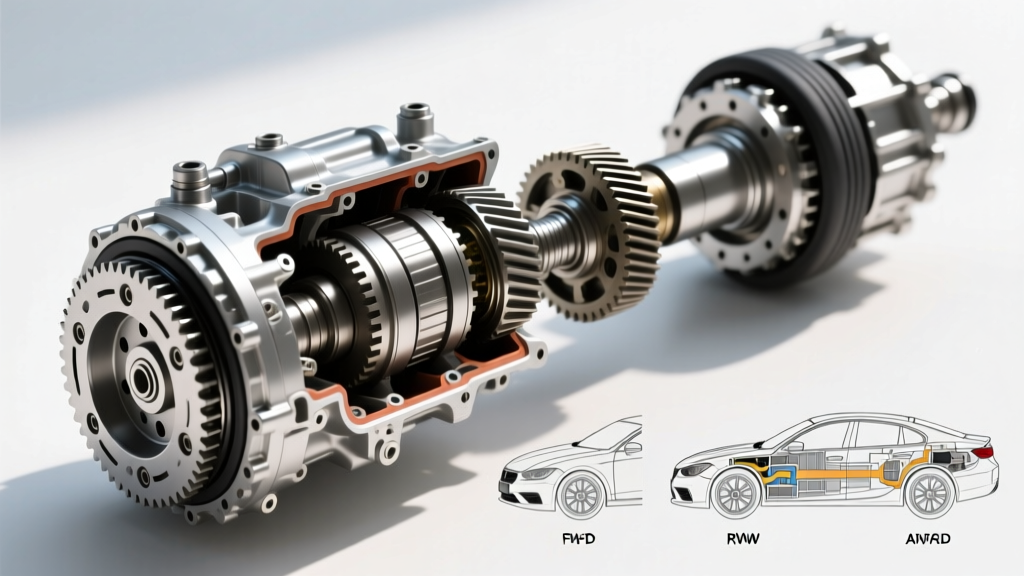
As of 2026, the cost of diagnosing and replacing BMW CV axles varies wildly depending on whether your vehicle is a rear-wheel-drive (sDrive) or all-wheel-drive (xDrive) model. While sDrive models only utilize rear CV axles, xDrive models feature a complex network of front and rear half-shafts connected to the transfer case and front differential. This guide breaks down the exact costs, OEM part numbers, and labor realities of BMW CV axle repairs.
Baseline Diagnostic Fees: What Does a Physical Check-Up Cost?
Before any parts are ordered, a proper diagnosis is required. Independent BMW specialists typically charge between $160 and $220 for a physical drivetrain NVH inspection. This involves lifting the vehicle on a hoist, running the car in gear (using a specialized lift with free-spinning wheels or a chassis dyno), and using a stethoscope and chassis ear to isolate worn inner tripod joints or failing outer ball-type CV joints.
Dealerships often bundle this into a broader 'Vehicle Check' package, which can push the initial diagnostic fee up to $285. According to data aggregated by the RepairPal BMW Estimator, diagnostic fees are generally waived or credited toward the final repair bill if you proceed with the axle replacement at the same facility.
Front vs. Rear xDrive CV Axle Price Breakdown
The most significant cost variable in a BMW drivetrain check up is the physical location of the failing axle. Front xDrive half-shafts are inherently more expensive to replace due to labor intensity. Accessing the inner CV joint on the front differential often requires unbolting the front sway bar links, disconnecting the lower control arm ball joint, and in some G-chassis models, partially dropping the front subframe to clear the axle from the transfer case output flange.
Rear axles, conversely, are relatively straightforward. The inner joint bolts directly to the rear differential flange using six E-Torx bolts (typically E12 or E14), and the outer joint slides through the rear wheel bearing hub.
2026 BMW CV Axle Replacement Cost Matrix
| Model (Chassis) | Position | OEM GKN/Löbro Part # | Part Cost (2026) | Labor Time | Est. Total (Indy Shop) |
|---|---|---|---|---|---|
| F30 328i xDrive | Front | GKN 304444 | $385 | 1.8 hrs | $690 |
| F30 328i xDrive | Rear | GKN 304445 | $410 | 1.2 hrs | $615 |
| G20 M340i xDrive | Front | GKN 305112 | $560 | 2.5 hrs | $1,010 |
| E90 335i xDrive | Front | GKN 303111 | $320 | 1.6 hrs | $590 |
*Labor rates calculated at an average independent specialist rate of $170/hour for 2026.
OEM vs. Aftermarket: The GKN Löbro Monopoly
When your drivetrain check up confirms a torn CV boot or a pitted joint cage, the next decision is parts sourcing. BMW does not manufacture its own CV axles; they are supplied by GKN Automotive (often branded as Löbro or Spidan in the European aftermarket).
Buying a genuine BMW-branded box from the dealer will cost you a 40% to 60% premium, often pushing a single front axle past $750. Purchasing the exact same GKN Löbro axle in a brown cardboard box from an authorized European parts distributor yields identical metallurgy and grease specifications for roughly $350 to $450.
The Danger of Budget Remanufactured Axles
Enthusiasts on forums like BimmerPost frequently document the pitfalls of using $120 remanufactured axles from big-box auto parts stores. These budget units often suffer from:
- Incorrect Grease Viscosity: Using standard lithium grease instead of the required molybdenum disulfide (Moly) high-pressure grease, leading to rapid cage wear.
- Thermoplastic Boot Failures: OEM boots are engineered to withstand the extreme heat radiating from BMW's turbochargers and exhaust downpipes. Cheap neoprene boots crack within 15,000 miles.
- NVH Harmonics: Remanufactured shafts are rarely dynamically balanced to BMW's strict tolerances, causing a persistent 60-75 mph steering wheel shudder that mimics a bad wheel bearing or control arm bushing.
Hidden Costs: Collateral Damage from Neglected CV Boots
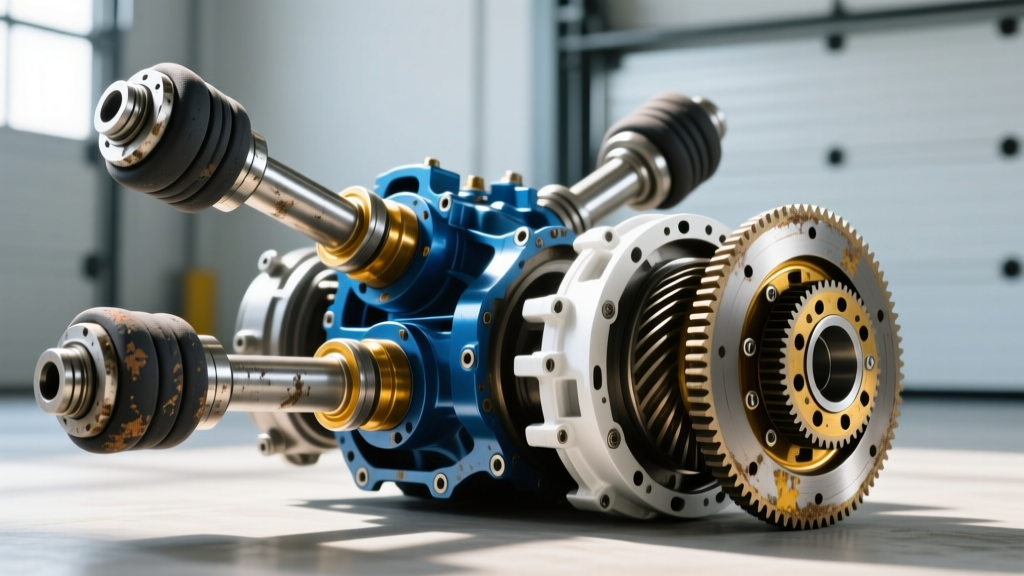
The most common failure point on any BMW CV axle is the inner or outer rubber boot. When a boot tears, centrifugal force slings the vital Moly grease out of the joint, while water and road grit infiltrate the precision-machined ball bearings and races. If caught early, a $45 boot kit and a $30 tube of CV grease can save the axle. If ignored, the collateral damage multiplies the cost of your drivetrain check up exponentially.
'We see it every week. A customer comes in for a drivetrain vibration, and we find a completely disintegrated inner CV joint. But because they ignored the clicking for six months, the shattered needle bearings and cage fragments migrated past the differential seal, contaminating the rear differential fluid and scoring the output flange. What was a $600 axle job turns into a $2,800 differential rebuild.'
— Master BMW Technician, Independent Euro Specialist (Chicago, IL)
Furthermore, on xDrive models, a failing front inner CV joint can cause excessive runout that damages the front differential output shaft seal. Replacing this seal requires draining the front differential fluid (approx. 0.4 liters of SAF-XO 75W-90) and using specialized seal drivers, adding roughly $180 in labor and fluid costs to the final invoice.
Torque Specs and Installation Nuances
A proper CV axle replacement is not just about unbolting and rebolting; it requires strict adherence to BMW Technical Information System (TIS) torque specifications. Reusing old hardware is a primary cause of post-repair drivetrain noise.
Critical Fastener Specifications (F-Series & G-Series)
- Outer Axle Nut (Front F30/G20): M27x1.5 self-locking nut. Torque to 210 Nm (155 lb-ft). Note: This nut must be replaced every time it is removed and staked into the groove on the CV joint stub shaft using a cold chisel.
- Outer Axle Nut (Rear F30/G20): M30x1.5 self-locking nut. Torque to 340 Nm (251 lb-ft). Requires a heavy-duty 1/2-inch drive torque wrench and a new staking nut.
- Inner Joint Flange Bolts (E-Torx): Typically M8 or M10 aluminum stretch bolts. Torque to 40 Nm (30 lb-ft) plus an additional 90-degree turn. These are one-time-use torque-to-yield bolts; reusing them risks snapping the bolt head off inside the differential flange.
Dealer vs. Independent Specialist: Where Should You Go?
For a physical drivetrain check up and subsequent CV axle replacement, an independent BMW specialist is almost always the superior financial choice. Dealerships operate on a flat-rate labor matrix that often pads CV axle jobs with unnecessary 'subframe alignment' checks or mandatory wheel alignments, pushing the out-the-door price for a single front axle on a G20 3-Series well over $1,400.
Independent shops, equipped with the same BMW ISTA diagnostic software and factory-grade torque wrenches, can perform the job using OEM GKN parts for 30% to 40% less. When scheduling your drivetrain inspection, explicitly ask the shop if they use OEM GKN/Löbro components and if their quoted labor includes the necessary fluid top-offs and new staking nuts. By understanding the true anatomy of these costs, you can navigate your BMW's drivetrain maintenance with confidence and avoid the markup traps of uninformed servicing.