Introduction to the Jeep Grand Cherokee Drivetrain Architecture
When analyzing the modern SUV landscape, the Jeep Grand Cherokee drivetrain remains a benchmark for seamlessly blending unibody on-road refinement with rugged, all-weather traction. As we navigate the 2026 automotive landscape, the engineering behind Jeep's All-Wheel Drive (AWD) and Four-Wheel Drive (4WD) systems continues to evolve, relying heavily on advanced mechatronics, precision clutch packs, and sophisticated torque-vectoring algorithms. Unlike traditional part-time 4WD systems that rely on a rigid mechanical lock, the Grand Cherokee's full-time AWD configurations utilize active torque management to distribute power dynamically.
This technical deep-dive explores the mechanical and electronic operation of the Grand Cherokee's AWD systems, specifically focusing on the Quadra-Trac II and Quadra-Drive II architectures found in the WK2 (2011-2021) and the current WL (2022-2026) generations. We will dissect the transfer case internals, the Electronic Limited-Slip Differential (ELSD) operation, and provide exact maintenance specifications required to keep these complex drivetrains functioning at peak efficiency.
Evolution of Full-Time AWD: Quadra-Trac vs. Quadra-Drive
To understand how the Jeep Grand Cherokee drivetrain manages slip, we must first differentiate between its primary full-time systems. Both systems utilize a chain-driven, two-speed transfer case, but their approach to axle torque distribution differs fundamentally.
Quadra-Trac II and the BorgWarner 44-44 Transfer Case
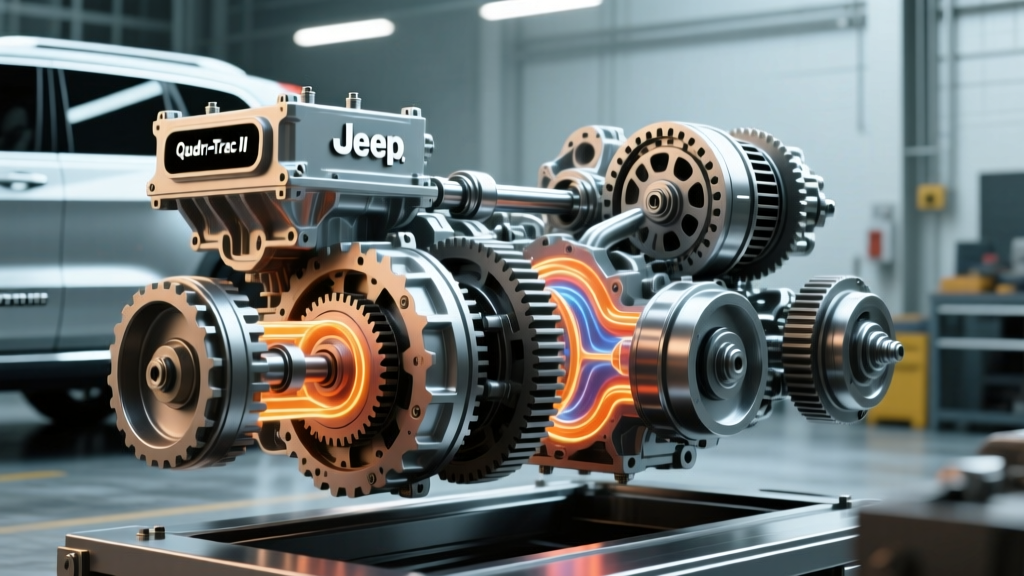
The Quadra-Trac II system is a single-path, full-time AWD setup. At the heart of this system is the BorgWarner 44-44 (or the updated BorgWarner 3028 in late WL models) transfer case. In standard driving conditions, the system routes torque primarily to the rear wheels to maintain a traditional rear-biased driving feel. However, the transfer case contains an electronically controlled multi-disc clutch pack.
When the vehicle's Anti-Lock Braking System (ABS) and Electronic Stability Control (ESC) modules detect a wheel speed differential—indicating slip—the Transfer Case Control Module (TCCM) commands a stepper motor to apply pressure to the clutch pack. This progressively binds the front and rear output shafts, transferring up to 100% of available torque to the front axle. According to BorgWarner's technical documentation, the response time of these modern electromagnetic actuator clutch packs is measured in milliseconds, allowing for preemptive torque transfer before the driver even perceives a loss of traction.
Quadra-Drive II and Electronic Limited-Slip Differentials (ELSD)
Quadra-Drive II elevates the Jeep Grand Cherokee drivetrain from a capable AWD system to a true torque-vectoring powerhouse. It utilizes the BorgWarner 44-48 transfer case (which adds a rear-biased clutch pack for quicker engagement) but the real magic lies at the axles. Quadra-Drive II is equipped with Electronic Limited-Slip Differentials (ELSDs) on both the front and rear axles.
Unlike traditional mechanical clutch-type LSDs that require specific break-in procedures and friction modifiers, the ELSD uses a gerotor pump and an electromagnetic actuator. When a wheel speed difference occurs across an axle, the gerotor pump generates hydraulic pressure. The TCCM then modulates a solenoid valve to apply this pressure to a multi-disc clutch pack inside the differential, locking the left and right wheels together. This allows the Grand Cherokee to transfer torque not just front-to-back, but side-to-side, effectively pulling the vehicle through diagonal off-road obstacles or high-G cornering scenarios.
Technical Specifications: Transfer Case and Drivetrain Data
Understanding the exact hardware is critical for diagnostics and maintenance. Below is a comprehensive breakdown of the primary transfer cases utilized in the modern Grand Cherokee lineup.
| System Name | Transfer Case Model | Low-Range Ratio | Clutch Type | Fluid Capacity (Approx.) |
|---|---|---|---|---|
| Quadra-Trac II (WK2) | BorgWarner 44-44 | 2.72:1 | Electromagnetic Multi-Disc | 1.9 Liters (2.0 qts) |
| Quadra-Drive II (WK2) | BorgWarner 44-48 | 2.72:1 | Electromagnetic Multi-Disc | 1.9 Liters (2.0 qts) |
| Active 4WD (WL Gen) | BorgWarner 3028 | 2.72:1 (if equipped) | Integrated Wet Clutch | 1.7 - 2.0 Liters |
Deep Dive: Gerotor Pump and ELSD Clutch Pack Operation
The ELSD is a marvel of hydraulic and electronic integration. Inside the differential carrier, a gerotor pump is driven by the speed differential between the axle shaft and the differential case. Under normal straight-line driving, both wheels turn at the same speed, and the pump generates minimal pressure.
However, when one wheel loses traction and begins to spin faster than the other, the gerotor elements move out of phase, rapidly generating hydraulic fluid pressure. The system's control module monitors wheel speeds via the ABS sensors and commands a proportional valve. This valve directs the pressurized fluid into the clutch pack cylinder, clamping the friction and steel plates together. This forces the spinning wheel to transfer torque to the wheel with grip.
Expert Note: The ELSD system in the Jeep Grand Cherokee drivetrain is entirely self-contained regarding its hydraulic pressure generation. It does not rely on the vehicle's main transmission fluid pump, meaning it remains active even in neutral or during specific towing scenarios, provided the vehicle's electrical system is awake.
Maintenance Realities: Fluids, Torque Specs, and Common Failures
The complexity of the Jeep Grand Cherokee drivetrain demands strict adherence to maintenance intervals. Neglecting transfer case and ELSD fluid changes is the leading cause of premature clutch pack degradation and actuator failure. As of 2026, aftermarket support and OEM documentation emphasize the critical nature of using exact fluid formulations.
Exact Fluid Specifications and Drain/Fill Torque
For the BorgWarner 44-44 and 44-48 transfer cases, Stellantis mandates the use of Mopar ATF+4 Automatic Transmission Fluid. Do not use generic CVT fluids or traditional gear oils, as the friction modifiers in ATF+4 are specifically calibrated for the BorgWarner wet clutch materials.
- Transfer Case Fluid: Mopar ATF+4 (Part # 05013458AA).
- ELSD Axle Fluid: Mopar Gear & Axle Lubricant 75W-85 (Part # 68218655AB) - Note: ELSD axles typically do not require the traditional Limited Slip Friction Modifier additive, as the electronic clutches are designed to operate with the base 75W-85 synthetic formulation. Always verify with your specific VIN build sheet.
- Transfer Case Drain/Fill Plug Torque: 20 Nm (15 lb-ft). The plugs are often 8mm or 10mm Allen/hex drive. Over-torquing can crack the magnesium or aluminum transfer case housing.
- ELSD Actuator Mounting Bolts: 25 Nm (18 lb-ft).
Sourcing genuine fluids is highly recommended to prevent shudder and clutch glazing. You can verify exact part numbers for your specific model year via the official Mopar parts catalog.
Diagnosing the "Service 4WD System" Message
One of the most common complaints among Grand Cherokee owners is the sudden illumination of the "Service 4WD System" warning on the dashboard. While this can indicate a severe internal failure, it is frequently triggered by peripheral electronic or mechanical components.
- Encoder Motor / Actuator Failure: The electric motor responsible for shifting the transfer case between 4-High, Neutral, and 4-Low is mounted externally. Water ingress through degraded O-ring seals can corrode the internal hall-effect sensors. Replacement parts (e.g., Mopar Part # 5143505AC) typically range from $180 to $350, and replacement requires dropping the rear driveshaft and unbolting the motor from the transfer case housing.
- Transfer Case Internal Chain Stretch: In high-mileage examples (120,000+ miles) that have been frequently driven in 4-Low or subjected to heavy towing, the Morse chain inside the BW44-44 can stretch. This results in a metallic "clunk" upon acceleration and eventual slipping. A complete remanufactured transfer case assembly costs between $2,200 and $3,800 installed.
- CAN Bus Communication Drops: The TCCM relies on high-speed CAN bus communication with the ABS and ECM modules. A failing wheel speed sensor or corroded chassis ground can cause the TCCM to default to a safe mode (usually locking the transfer case in 4-High or disabling the system entirely). Proper diagnosis requires a bi-directional scan tool capable of reading TCCM-specific network codes, not just generic OBD2 codes.
Conclusion
The Jeep Grand Cherokee drivetrain represents a highly sophisticated intersection of mechanical durability and electronic precision. Whether equipped with the reliable Quadra-Trac II or the highly capable Quadra-Drive II with ELSD, these AWD systems require a technician's understanding of fluid dynamics, clutch pack operation, and network topology. By adhering to strict fluid maintenance schedules, utilizing exact OEM torque specifications, and understanding the root causes of common electronic faults, owners and technicians can ensure these legendary AWD systems continue to perform flawlessly for hundreds of thousands of miles. For further historical and technical teardowns of Jeep drivetrain components, the Quadratec Jeep Library remains an excellent supplementary resource for drivetrain lineage and mechanical diagrams.