The Core Architectural Divide: AWD vs. 4WD Explained
When discussing off-road capability and inclement weather traction, the terms All-Wheel Drive (AWD) and Four-Wheel Drive (4WD) are frequently—and incorrectly—used interchangeably. As of 2026, the mechanical distinctions between these two drivetrain layouts remain absolute, and understanding them is critical for executing proper preventive maintenance. Traditional 4WD systems, found in body-on-frame trucks like the Jeep Wrangler or Toyota Tacoma, utilize a transfer case that physically locks the front and rear driveshafts together. This creates a 50/50 torque split but eliminates the ability for the front and rear axles to rotate at different speeds. Engaging a part-time 4WD system on dry pavement results in severe 'torque bind,' which can shatter transfer case chains and U-joints.
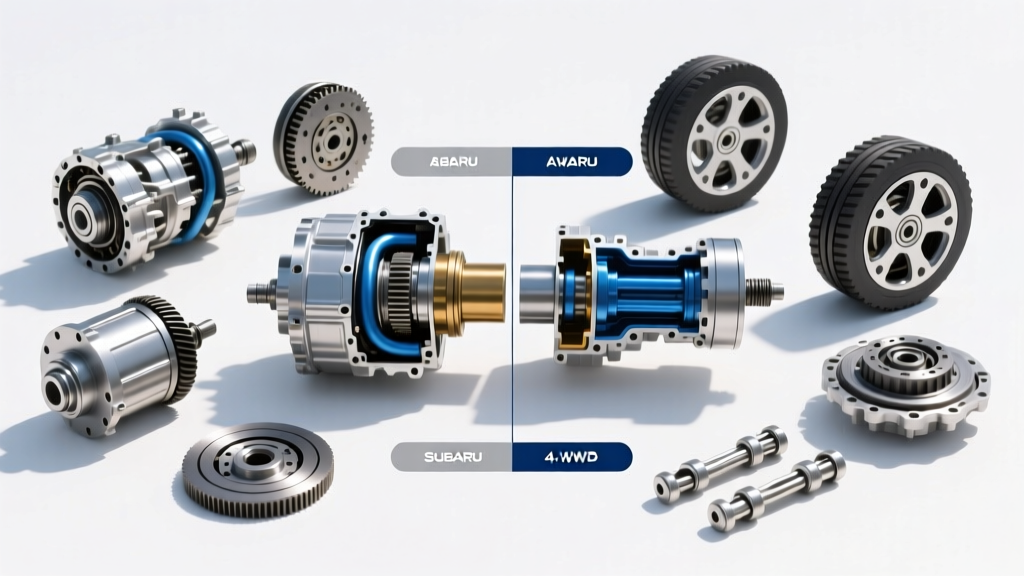
Conversely, AWD systems utilize a center differential, a viscous coupling, or an electronically controlled multi-plate clutch pack to allow front-to-rear rotational speed variance. This means AWD can be driven on dry pavement without mechanical binding. Subaru’s legendary Symmetrical AWD falls squarely into this category, utilizing sophisticated clutch packs and planetary gearsets to dynamically route torque. Because AWD systems rely heavily on friction modifiers and hydraulic pressure to manage torque transfer, their maintenance requirements are vastly more stringent than traditional 4WD systems—and failing to adhere to them is the fastest way to void your Subaru drivetrain warranty.
Subaru’s Symmetrical AWD Ecosystem: Active vs. Continuous
To maintain your vehicle correctly, you must first identify which Subaru AWD architecture is bolted to your engine. Subaru primarily utilizes two distinct layouts in modern vehicles:
- Active AWD (Lineartronic CVT): Found in the Outback, Legacy, Forester, and Ascent. This system uses an electronically controlled multi-plate transfer clutch located at the rear of the transmission. Under normal conditions, it sends 60% of torque to the front wheels and 40% to the rear. When front slip is detected, the Transmission Control Module (TCM) increases hydraulic pressure to the clutch pack, sending up to 50% of torque rearward.
- Continuous AWD (Manual Transmissions): Found in the WRX and base Impreza manuals. This system uses a mechanical center differential (often a limited-slip viscous coupling or a helical LSD) paired with a 50/50 default torque split. It is entirely mechanical and relies on gear oil rather than CVTF for the center differential's operation.
The Warranty Minefield: Protecting Your Subaru Drivetrain Warranty
Subaru offers a comprehensive 5-year/60,000-mile powertrain warranty. However, the Subaru Official Warranty Guide explicitly states that coverage is voided if a failure is traced back to improper maintenance, use of incorrect fluids, or failure to follow the 'Severe Driving' schedule. Because AWD systems are constantly managing micro-slip events, the fluid degrades much faster than in a traditional 2WD automatic or a part-time 4WD transfer case.
Expert Insight: Dealership warranty administrators frequently deny transfer clutch replacement claims on TR690 CVTs (used in 3.6R and 2.4T models) if the owner cannot produce receipts proving the CVTF was replaced using OEM-certified fluid at or before the 60,000-mile mark. Generic 'multi-vehicle' CVT fluids lack the specific friction modifiers required for Subaru's transfer clutch, leading to chatter, scoring of the clutch basket, and eventual torque transfer failure.
Preventive Maintenance Matrix: Fluids, Capacities, and Torque Specs
Preventive maintenance for Subaru AWD systems extends beyond the transmission. The front and rear differentials are separate gear-driven units that require their own service intervals. Below is the exact specification matrix for 2015-2026 Lineartronic CVT models (TR580 and TR690).
| Component | OEM Fluid Specification | Part Number | Drain & Fill Capacity | Plug Torque Spec | Service Interval |
|---|---|---|---|---|---|
| Lineartronic CVT (TR580/TR690) | Subaru High Torque CVTF | SOA635075 | ~10.5 Liters | 31.5 Nm (23.2 lb-ft) | 60k mi (Severe) / 100k mi (Normal) |
| Front Differential (Integrated) | 75W-90 GL-5 Gear Oil | SOA635079 | ~1.2 Liters | 44 Nm (32.5 lb-ft) | 60,000 miles |
| Rear Differential | 75W-90 GL-5 Gear Oil | SOA635079 | ~0.8 Liters | 39 Nm (28.8 lb-ft) | 60,000 miles |
Step-by-Step: TR690 Transfer Clutch and CVTF Service
Unlike a traditional 4WD transfer case where you simply drain and fill via a dipstick tube, Subaru’s Lineartronic CVTs require a precise temperature-dependent level check procedure. According to data from the Subaru Technical Information System (STIS), performing this incorrectly will result in either fluid starvation (destroying the transfer clutch) or overfilling (causing aeration and erratic hydraulic pressure).
- Preparation: Ensure the vehicle is perfectly level on a lift. The engine must be idling, and the parking brake engaged.
- Temperature Monitoring: Connect an OBD2 scanner capable of reading transmission data (such as Subaru's SSM4 or an advanced aftermarket tool). Monitor the 'CVTF Temperature' parameter. The fluid must be between 35°C and 45°C (95°F - 113°F) for an accurate level check.
- The Overflow Check: With the engine still idling and the fluid at the correct temperature, remove the overflow plug located on the side of the transmission case (not the main drain plug at the bottom).
- Fluid Adjustment: If fluid flows out and slows to a slow drip, the level is correct. If no fluid comes out, you must pump in OEM SOA635075 CVTF through the fill tube until it drips from the overflow hole.
- Final Torque: Reinstall the overflow plug with a new crush washer and torque to exactly 31.5 Nm (23.2 lb-ft).
Addressing Torque Bind and Differential Wear
If you experience 'torque bind' (a jerking or hopping sensation from the drivetrain during tight, low-speed parking lot turns), it is a primary indicator that your AWD system is failing to disengage the rear axle smoothly. In 4WD systems, this is normal on dry pavement. In a Subaru AWD, it indicates either degraded CVTF friction modifiers, a failing transfer clutch solenoid, or mismatched tire tread depths. Subaru mandates that all four tires must be within 1/4 inch of tread depth circumference. A single replaced tire with deeper tread will force the center differential and transfer clutch to constantly slip, generating immense heat and destroying the drivetrain long before the 60,000-mile warranty expires.
Real-World Costs: Dealership vs. Independent Specialists
Maintaining a Subaru AWD system is more expensive than servicing a traditional FWD crossover or a part-time 4WD truck. A dealership CVTF drain, fill, and level check typically costs between $350 and $450 in 2026, largely due to the high cost of OEM High Torque CVTF (roughly $15-$18 per liter) and the labor time required for the temperature-dependent overflow procedure. Independent Subaru specialists often perform this service for $250 to $300.
While saving money at an independent shop is appealing, you must ensure they document the exact OEM part numbers used on your invoice. If your transfer case fails at 55,000 miles and you file a Subaru drivetrain warranty claim, the corporate warranty auditors will request the maintenance invoices. An invoice listing 'Generic Multi-Vehicle CVT Fluid' is an automatic denial, leaving you with a $4,500+ replacement bill. Always demand OEM SOA635075 fluid and keep meticulous, time-stamped records to ensure your AWD system remains protected for the long haul.