The Thermal Threshold: Why the 4L80E Demands Better Cooling
The GM 4L80E remains a cornerstone of high-horsepower swaps, pro-touring builds, and heavy-duty towing rigs in 2026. Renowned for its robust planetary gearsets and ability to handle 800+ horsepower with basic internal modifications, it is arguably the most durable four-speed automatic ever produced by General Motors. However, behind this mechanical strength lies a critical vulnerability: thermal management. Selecting the correct 4L80E transmission cooler is not merely about picking the largest finned block you can fit behind the bumper; it is about matching thermal dissipation to your specific torque converter slip and horsepower output.
Modern synthetic automatic transmission fluids (ATF), such as AMSOIL Signature Series or Red Line D4, are engineered to withstand higher temperatures than legacy Dexron III fluids. Even so, the thermal threshold for catastrophic damage remains unforgiving. Normal operating temperatures should hover between 160°F and 185°F. Once fluid temperatures exceed 220°F, accelerated oxidation begins, leading to varnish buildup on the valve body. At 240°F, the friction material on the torque converter lockup clutch (TCC) and internal clutches begins to glaze and delaminate. For forced-induction or nitrous applications where torque converter slip is frequent, the fluid exiting the converter can easily spike above 280°F before it ever reaches the cooler lines.
Sizing Your 4L80E Transmission Cooler
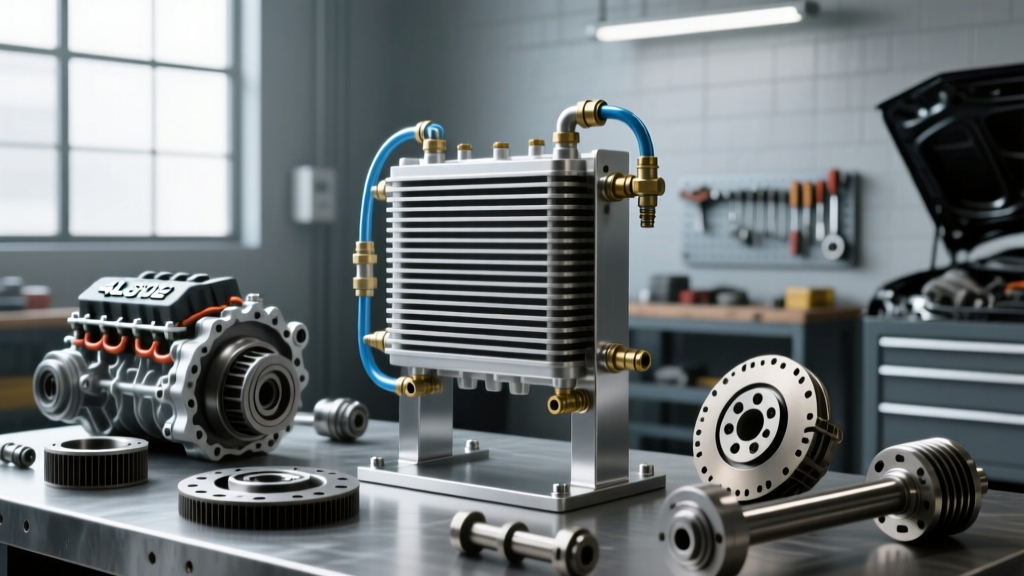
Transmission coolers are typically rated by Gross Vehicle Weight Rating (GVWR). While this metric is designed for OEM towing applications, performance builders must translate GVWR into horsepower and usage tiers. A stacked-plate design is mandatory for performance applications, as it offers superior heat transfer and significantly less flow restriction compared to traditional tube-and-fin coolers.
| Build Tier | Horsepower / Usage | Recommended GVWR | Core Type | Example Part Number & Cost |
|---|---|---|---|---|
| Street / Strip | 400 - 650 HP | 20,000 - 24,000 | Stacked-Plate | Derale 13950 (~$140) |
| Pro-Touring / Towing | 650 - 900 HP | 30,000 - 40,000 | Stacked-Plate | Tru-Cool 4544 (~$185) |
| Dedicated Drag / Track | 1,000+ HP | Dual 40,000+ w/ Fan | Stacked-Plate + Fan | Dual Derale 13960 (~$360) |
According to TCI Automotive engineering guidelines, a high-stall torque converter (3,000+ RPM) operating on the street will generate exponentially more heat than a stock lockup converter. If your build utilizes a non-lockup converter or a high-stall unit that slips through the lower gears, you must jump at least one tier up in cooler sizing to compensate for the continuous fluid shearing.
The 1/4-inch NPS vs. NPT Trap: A Costly Mistake
The most common mistake DIY builders make when installing an aftermarket 4L80E transmission cooler is destroying the transmission case during the plumbing phase. The 4L80E cooler line ports machined into the aluminum case and pump housing utilize a 1/4-inch NPS (National Pipe Straight) thread.
Many hardware stores and inexperienced builders mistakenly use 1/4-inch NPT (National Pipe Tapered) fittings. Because NPT threads are tapered, they act like a wedge as they are tightened. Forcing an NPT fitting into the 4L80E case will almost certainly crack the aluminum pump housing or the main case, resulting in a catastrophic fluid leak and a ruined core. To properly adapt the 4L80E to modern AN (Army-Navy) plumbing, you must use dedicated 1/4-inch NPS to -6 AN (or -8 AN) adapters, such as the Russell 640320 or specific adapters from Sonnax.
Because NPS threads do not seal via thread interference like NPT, they rely on an O-ring or a copper crush washer to seal against the machined face of the transmission case. The torque specification for these adapters is strictly 15 to 18 lb-ft. Over-torquing will strip the soft aluminum threads. Always use a calibrated inch-pound or low-range foot-pound torque wrench when installing these adapters.
Plumbing: Hose Selection and Flow Dynamics
Once the case adapters are installed, the next step is routing the lines to the front of the vehicle. For builds pushing under 700 horsepower, -6 AN (3/8-inch inner diameter) hoses are sufficient to maintain adequate flow velocity and pressure. However, for 1,000+ horsepower builds or vehicles utilizing high-volume aftermarket pumps (like those from Sonnax or TCI), stepping up to -8 AN (1/2-inch inner diameter) lines reduces the pressure drop across the cooler circuit, ensuring the lubrication circuit remains fully pressurized even when fluid viscosity drops at high temperatures.
Rubber transmission cooler hoses are unacceptable for performance engine bays due to radiant heat from exhaust headers and turbochargers. You must use PTFE-lined (Teflon), stainless-steel braided hoses. PTFE lining prevents the hose interior from degrading and shedding microscopic particles into the valve body, while the stainless braid protects against abrasion and radiant heat. When assembling PTFE hoses, use dedicated reusable socketless fittings or have them professionally crimped to prevent blow-offs under the 80-150 PSI of line pressure generated by a performance 4L80E.
Radiator Integration vs. Standalone Bypass
A frequent debate in the performance community is whether to route the transmission fluid through the vehicle's radiator internal cooler before sending it to the auxiliary front-mount cooler.
Pro-Tip: For dedicated track cars and high-horsepower street builds, bypassing the radiator's internal transmission cooler entirely is the safest route. This eliminates the risk of the 'strawberry milkshake' scenario, where a failed internal radiator barrier mixes coolant and ATF, instantly destroying the transmission's friction materials and requiring a complete teardown.
If you are building a dual-purpose street/strip car that sees cold-weather driving, routing the fluid through the radiator first can help the ATF reach its optimal 160°F operating temperature faster. In this setup, the fluid path should be: Transmission Outlet (Top Port) -> Radiator Cooler -> Auxiliary Stacked-Plate Cooler -> Transmission Return (Bottom Port). Always verify flow direction by briefly idling the engine with the return line disconnected and aimed into a catch pan before finalizing the plumbing.
Telemetry: Sensor Placement for Accurate Data
Installing an auxiliary cooler is useless if you cannot monitor its effectiveness. As of 2026, modern EFI systems from Holley Terminator X and Haltech Elite make it incredibly easy to log transmission temperatures alongside engine data. The placement of your ATF temperature sensor is critical for accurate telemetry.
Do not place the sensor in the transmission pan. The pan contains a mix of cooled return fluid and stagnant fluid, which will give you a delayed, artificially low reading. Instead, install a -6 AN sensor adapter bung in the hot pressure line exiting the transmission (before the cooler). This will allow your ECU or digital dash to read the exact peak temperature the fluid is experiencing as it leaves the torque converter. Pairing this data with a transmission output shaft speed sensor allows tuners to calculate real-time torque converter slip and dynamically adjust lockup clutch duty cycles to manage heat generation on the fly.
By respecting the thermal limits of the fluid, utilizing correct NPS threading, and sizing your stacked-plate cooler to your specific horsepower tier, your 4L80E will reliably handle the abuse of modern high-horsepower performance driving for years to come. For further reading on cooler flow dynamics and sizing charts, builders can reference the extensive testing data published by Derale Performance.