The Economics of Front Axle Maintenance in 2026
When owners search for a comprehensive 3rd gen Tacoma differential fluid change guide, the focus is overwhelmingly skewed toward the rear axle. However, the front differential on Toyota's 2016-2023 4x4 platforms is a highly stressed, often neglected component that requires precise maintenance. As we navigate the 2026 automotive service landscape, inflation and supply chain shifts have altered the cost baseline for drivetrain maintenance. Whether you are driving a base SR5 with an open front differential or a TRD Pro with a front E-Locker, understanding the true cost and mechanical nuances of the front axle service is critical for long-term drivetrain survival.
The 3rd generation Tacoma utilizes an 8-inch front ring gear housed in an aluminum drop-out assembly. This front differential operates under extreme shear stress, particularly when the front hubs are engaged in 4WD High or 4WD Low. Unlike the rear axle, which sees constant rotational duty, the front differential fluid experiences cyclical thermal shock and heavy shear loading only during 4WD operation. This unique duty cycle dictates specific service intervals and fluid requirements that directly impact your wallet.
2026 Service Cost Matrix: Dealer vs. Independent vs. DIY
To provide a transparent cost analysis, we have aggregated 2026 pricing data from dealerships, independent 4x4 specialty shops, and DIY material costs specifically for the front differential service. Note that these prices isolate the front axle and do not include the rear differential or transfer case.
| Service Provider | Estimated Labor Cost | Parts & Fluid Cost | Total 2026 Estimate | Warranty / Guarantee |
|---|---|---|---|---|
| Toyota Dealership | $85 - $130 | $45 - $65 | $130 - $195 | 12-month / 12k mile OEM |
| Independent 4x4 Shop | $60 - $95 | $35 - $55 | $95 - $150 | 6-month / 6k mile typical |
| DIY (Driveway Service) | $0 (25 mins labor) | $28 - $48 | $28 - $48 | None (Self-liability) |
As the table illustrates, the DIY route offers an immediate return on investment, saving up to $160 per service. However, the dealership route provides documented proof of maintenance, which is increasingly scrutinized by warranty adjusters if a front E-Locker actuator or internal clutch pack failure occurs under the 60,000-mile powertrain warranty.
Itemized DIY Bill of Materials (BOM)
If you opt to perform the service yourself, precision in part selection is non-negotiable. Using incorrect fluids or reusing crush washers are the two most common catalysts for front differential leaks and subsequent bearing failures.
Fluid Specifications and Brand Options
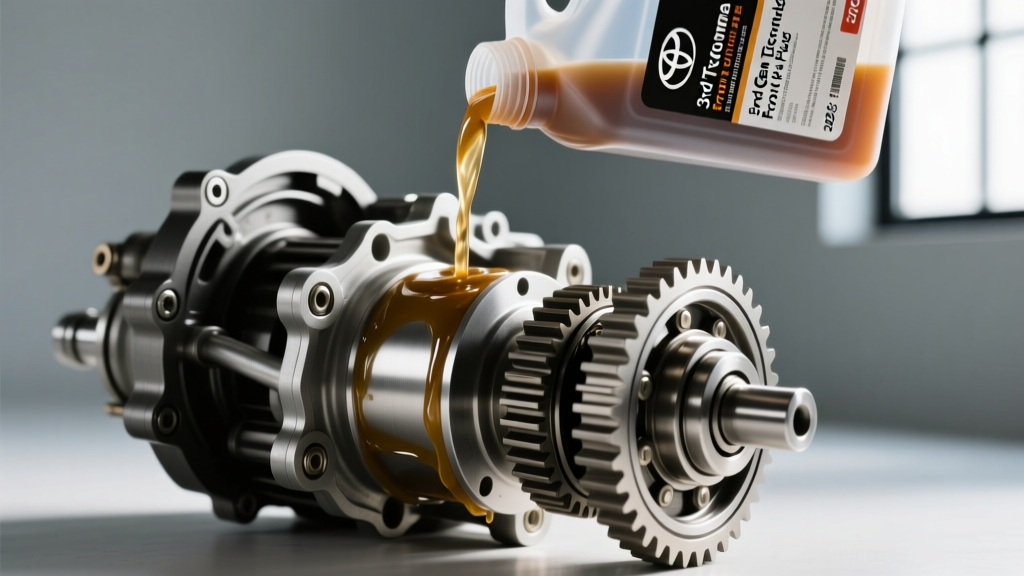
The factory fill specification for the 3rd gen Tacoma front differential is API GL-5, SAE 75W-85 or 75W-90. The front differential capacity is exactly 1.5 Liters (1.6 US Quarts). You will need to purchase two standard 1-quart bottles. Here is a breakdown of the top-tier options available in 2026:
- Toyota Genuine Differential Gear Oil LT 75W-85: Part # 08885-81080. Priced around $14-$18 per quart. This is the OEM baseline, offering excellent cold-weather engagement and fuel economy, though it lacks the high-temperature shear stability of synthetic aftermarket alternatives.
- Mobil 1 Synthetic Gear Lube 75W-90: Priced around $11-$14 per quart. A widely available, highly stable GL-5 fluid that provides robust protection for the hypoid gear set.
- Red Line 75W-90 GL-5 Gear Oil: Priced around $22-$26 per quart. The premium choice for TRD Off-Road and TRD Pro models that see heavy off-road use, rock crawling, or deep water crossings. Its polyol ester base resists thermal breakdown exceptionally well.
The Hidden Cost: Crush Washers and Tooling
Many DIYers budget for fluid but forget the sealing hardware. The front differential drain and fill plugs require 24mm ID Aluminum Crush Washers. The OEM Toyota part number is 90430-24003. You need exactly two washers for the front diff. They cost approximately $2.50 each at the dealer. Never use steel or copper washers on the Tacoma's aluminum front differential housing. Dissimilar metals in the presence of road salt and moisture will cause galvanic corrosion, eventually seizing the plug or stripping the housing threads.
Furthermore, you must account for tooling. The drain plug requires a standard 24mm socket. However, the fill plug on the 3rd gen front diff is typically a 10mm Hex (Allen) socket. Using a worn 10mm hex bit or an SAE 3/8-inch approximation will strip the soft metal of the fill plug, turning a $30 DIY job into a $400 dealership extraction nightmare.
Critical Engineering Specifications
For those executing the service, adhere strictly to the following factory engineering parameters. Deviating from these torque specs can lead to housing distortion or plug ejection under pressure.
- Fluid Capacity: 1.5 L (1.6 qt)
- Drain Plug Torque: 29 ft-lbf (39 N-m)
- Fill Plug Torque: 29 ft-lbf (39 N-m)
- Fill Level: Fluid should be level with the bottom of the fill plug threads.
Expert Pro-Tip: ALWAYS remove the fill plug before removing the drain plug. If your 10mm hex fill plug is seized or stripped, you do not want to discover this after you have already drained 1.5 liters of gear oil onto your driveway, leaving the truck immobile and requiring a flatbed tow to a shop.
The TRD E-Locker Factor and Fluid Shear
Owners of the TRD Off-Road, TRD Pro, and Trail Edition trims must consider the front E-Locker mechanism. According to drivetrain tribology data discussed by experts on Bob Is The Oil Guy, the sulfur-phosphorus extreme pressure (EP) additives in GL-5 fluids undergo mechanical shear when forced between the sliding surfaces of the locking collar and the side gears. Over 30,000 miles of mixed 4WD use, the fluid's viscosity index improvers break down, and the metallic particulate from the clutch pack engagement suspends in the oil.
If this metallic sludge is not flushed out via regular drain-and-fill services, it can foul the E-Locker actuator sensor and delay engagement. When the front locker fails to engage on the trail, it is rarely an electrical issue; it is almost always a mechanical binding issue caused by degraded, particle-heavy fluid. Replacing a front E-Locker assembly in 2026 costs upwards of $1,800 in parts alone, making a $35 fluid change the most cost-effective insurance policy available.
Diagnosing Emulsification and Breather Tube Failures
A critical variable in the cost analysis of front differential maintenance is environmental exposure. The 3rd gen Tacoma front differential features a breather tube to equalize pressure as the gear oil heats up and cools down. From the factory, this breather tube is routed relatively low, often terminating near the frame rail or radiator support.
If you perform deep water crossings, mud bogging, or drive through heavy snow slush, the sudden temperature drop of the aluminum housing creates a vacuum effect. If the breather tube is submerged or exposed to pressurized water, moisture is sucked directly into the differential. This results in fluid emulsification—commonly referred to as a 'chocolate milkshake' appearance. Emulsified fluid loses its hydrodynamic boundary layer, leading to catastrophic wear on the ring and pinion gear teeth and the carrier bearings. If you pull the drain plug and see milky fluid, an immediate service is required, regardless of the mileage on the odometer. Rerouting the breather tube higher into the engine bay is a mandatory $15 modification for any overlanding Tacoma.
Long-Term ROI and Final Verdict
When evaluating the cost of a 3rd gen Tacoma differential fluid change for the front axle, the DIY route is undeniably the most logical choice for mechanically inclined owners. By investing $35 in high-quality synthetic 75W-90 GL-5 fluid and $5 in OEM aluminum crush washers, you eliminate the $100+ labor markup charged by dealerships. More importantly, performing the service yourself allows you to visually inspect the drain plug magnet for excessive ferrous shavings and check the housing for impact damage from trail debris.
For those who prefer professional service, an independent 4x4 specialty shop offers the best middle ground in 2026, typically charging 30% less than a franchise dealership while utilizing technicians who actually understand the nuances of the Toyota 8-inch front clamshell. Whichever route you choose, adhering to a strict 15,000-mile service interval for severe 4WD use will ensure your front axle survives the lifespan of the truck.
Authoritative References
- Toyota Technical Information System (TIS) - Factory Service Manual Torque Specifications and Capacity Data.
- Bob Is The Oil Guy Forums - Tribology analysis on GL-5 Gear Oil shear stability and EP additive depletion.
- TacomaWorld Drivetrain Archives - Community teardown documentation of 3rd Gen front E-Locker wear patterns and breather tube routing.