Do 2WD Cars Have Differentials? The Short Answer
A frequent question from novice automotive enthusiasts and DIY mechanics is, do 2wd cars have differentials? The answer is an unequivocal yes. Whether your vehicle is Front-Wheel Drive (FWD) or Rear-Wheel Drive (RWD), a differential is mechanically mandatory. It allows the outer drive wheel to rotate faster than the inner wheel during cornering, preventing tire scrubbing, drivetrain binding, and axle snap. In FWD platforms, the differential is integrated directly into the transmission housing, forming a transaxle. In RWD platforms, it resides in a standalone housing at the rear, either as a solid axle or an Independent Rear Suspension (IRS) pumpkin.
However, as gearsets, bearings, and clutch packs endure tens of thousands of miles of torque loading, they begin to degrade. This degradation manifests as distinct acoustic signatures. For drivetrain specialists, diagnosing differential noise is a systematic process of isolating frequencies, loads, and fluid conditions. Below is our expert-level troubleshooting framework for 2WD differential noise diagnosis in 2026.
The Differential Noise Diagnostic Matrix
Before tearing into a housing, you must categorize the noise based on the vehicle's dynamic state. Use this matrix to narrow down the failing internal component.
| Noise Type | Driving Condition | Probable Culprit | Verification Method |
|---|---|---|---|
| High-pitch Whine | Acceleration (Under Load) | Ring & Pinion gear wear (Drive side), Pinion bearing preload loss | Check gear contact pattern with marking compound; measure pinion rotational drag. |
| Low-pitch Howl | Deceleration / Coast | Ring & Pinion gear wear (Coast side), Carrier bearing wear | Inspect backlash; check for side-to-side carrier play. |
| Metallic Clunk | Throttle tip-in / Reversing | Excessive backlash, worn spider gears, stripped axle splines | Dial indicator backlash test (Spec: >0.012" indicates failure). |
| Chatter / Bind | Low-speed tight turns | LSD clutch pack degradation, missing friction modifier | Drain fluid, inspect for clutch material; perform figure-8 test after adding modifier. |
RWD Solid Axle & IRS Diagnosis: Step-by-Step Protocol
Rear-wheel-drive 2WD vehicles (such as those utilizing the ubiquitous Ford 8.8-inch or GM 8.6-inch 10-bolt axles) offer the most straightforward diagnostic access. When a customer complains of rear-axle noise, follow this exact sequence:
1. Fluid Forensics
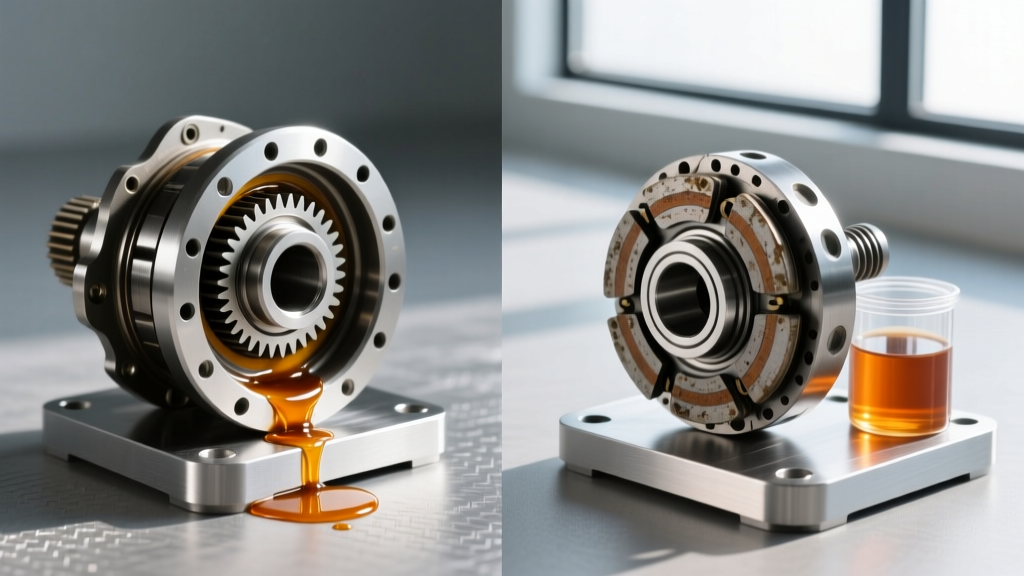
Remove the differential fill plug first, then the drain plug (or drop the cover if no drain plug exists). Inspect the 75W-90 GL-5 gear oil. A fine, silvery sheen on the fluid is normal wear from the break-in period of powdered metal gears. However, if you find ferrous chunks larger than 3mm or a burnt, acrid smell, the pinion or carrier bearings have suffered catastrophic thermal failure. According to Spicer Technical Manuals, bearing cage disintegration will immediately contaminate the ring and pinion, necessitating a full gearset replacement.
2. Backlash Measurement
Mount a magnetic-base dial indicator to the axle housing. Position the plunger perpendicular to the ring gear teeth. Hold the pinion yoke completely stationary and rotate the ring gear back and forth.
- OEM Specification: Typically 0.006" to 0.010" (0.15 - 0.25 mm).
- Failure Threshold: If backlash exceeds 0.015", the carrier bearings are worn, or the side adjusters have backed out. This excessive slop causes the 'clunk' on throttle tip-in.
3. Gear Contact Pattern Analysis
Apply yellow gear-marking compound to three teeth on the ring gear. Rotate the pinion to load the drive side, then the coast side.
- Ideal Pattern: Centered on the tooth face, slightly biased toward the heel under load.
- Toe/Heel Bias: Indicates incorrect pinion depth (shim thickness error).
- Face/Flank Bias: Indicates incorrect backlash.
FWD Transaxle Nuances: The Hidden Differential
Diagnosing the differential in a 2WD FWD car is vastly more complex because the final drive is submerged in the same housing as the transmission gearset. A whine from a Honda K-series manual transaxle or a VW DSG integrated final drive is often misdiagnosed as an input shaft bearing or helical gear whine.
Expert Tip: To isolate FWD transaxle differential noise, use a set of wireless chassis ears. Clamp the microphones to the transmission bell housing and the final drive cover (if applicable). Drive the vehicle at 45 MPH and lift off the throttle. If the howl shifts pitch exactly in correlation with road speed (not engine RPM), the final drive ring and pinion or the differential carrier bearings are failing. Unlike RWD axles, FWD transaxle differentials rarely have dedicated service intervals, and repairing them requires a complete transmission teardown and bench rebuild.
Best Practices: Fluids, Friction Modifiers, and Torque Specs
Proper reassembly and maintenance are critical to silencing a rebuilt 2WD differential. Using the wrong fluid or ignoring torque sequences will guarantee a comeback.
Limited Slip Differential (LSD) Chatter
If a 2WD car with a clutch-type LSD (like the Ford Traction-Lok or Eaton Posi) chatters during parking lot maneuvers, the fluid lacks the necessary friction modifier.
- The Fix: Drain the 75W-90 GL-5 fluid. Refill with a high-quality synthetic like Red Line 75W90 or AMSOIL Severe Gear. Crucially, add exactly 4 oz of OEM friction modifier (e.g., Ford XL-3 or GM EOS). Drive the car in 10 tight figure-8 patterns to work the modifier into the clutch friction surfaces.
Critical Torque Specifications
Never use an impact wrench on differential hardware. Use a calibrated torque wrench for the following common 2WD RWD applications:
- Ford 8.8" Differential Cover Bolts: 28 - 38 lb-ft (Use RTV silicone, no gasket).
- GM 8.6" (10-Bolt) Cover Bolts: 22 lb-ft (Use formed gasket or RTV).
- Drain/Fill Plugs (3/8" drive square): 25 - 30 lb-ft.
- Pinion Nut: DO NOT use a standard torque spec. The pinion nut is used to crush a new collapsible sleeve to achieve 15 to 25 inch-pounds of rotational drag on the pinion yoke. Reusing an old crush sleeve is a rookie mistake that leads to immediate pinion bearing failure.
2026 Repair Cost Expectations
When diagnosing a failing 2WD RWD differential, customers need realistic financial expectations. A complete Ring and Pinion overhaul (including Timken bearings, Yukon or Motive gears, seals, and a master install kit) typically costs between $250 and $450 in parts. Labor for a professional setup (which requires a hydraulic press and dial indicators) ranges from 4 to 6 hours. At current 2026 shop rates of $130 to $180 per hour, expect a total invoice between $850 and $1,500. If the housing is damaged or the axle splines are stripped, a complete remanufactured crate axle from a supplier like Jasper or ATK will push the cost to the $2,200+ range.
Final Expert Takeaway
So, do 2WD cars have differentials? Absolutely. And whether it is tucked inside a FWD transaxle or bolted between the rear frame rails of a RWD truck, it requires precise diagnostic logic when noise occurs. By relying on fluid forensics, dial-indicator backlash measurements, and strict adherence to GL-5 fluid and friction modifier protocols, you can accurately diagnose and permanently resolve 2WD differential noise.