Understanding Ram 1500 Rear Axle Architecture
When maintaining the rear differential on Dodge Ram 1500 trucks, the first step in any repair protocol is identifying the exact axle housing bolted to your chassis. Over the last two decades, Ram has utilized several distinct rear axle platforms, and as we navigate through 2026, the repair landscape is dominated by two primary architectures: the American Axle & Manufacturing (AAM) semi-floating axles and the newer ZF drop-out axles.
Misidentifying your axle can lead to purchasing the wrong seal kits or attempting a fluid drain procedure that physically cannot be performed. For example, older DS-platform trucks (2009–2018) and heavy-duty variants typically use the AAM 9.25 or AAM 10.5-inch ring gear axles. These feature a traditional bolt-on rear differential cover. Conversely, the current-generation DT-platform Ram 1500s (2019–present) frequently utilize ZF-manufactured rear axles. The ZF axles feature a welded rear cover and a front-removable third member (drop-out). Attempting to pry off a welded ZF rear cover is a catastrophic mistake that will destroy the housing.
The Breather Valve: The Most Overlooked Culprit
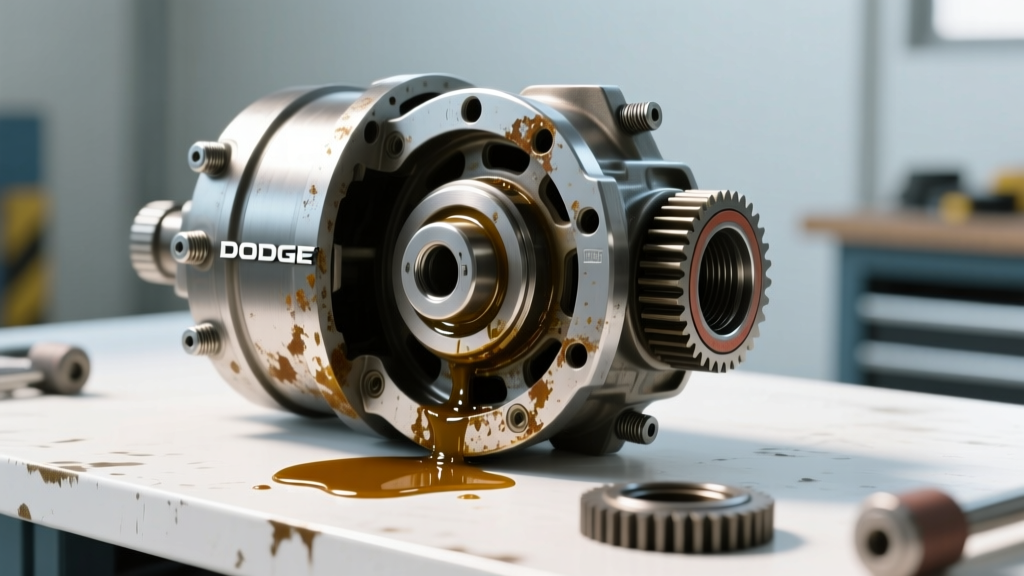
Before tearing into seals and bearings, inspect the axle breather valve. The rear differential on Dodge Ram 1500 models is equipped with a one-way breather tube routed upward along the chassis. As the gear oil heats up during towing or highway driving, the internal air expands. If the breather valve becomes clogged with mud, ice, or debris, internal pressure spikes. This hydrostatic pressure will force gear oil past perfectly good pinion and axle shaft seals.
Diagnostic Tip: Locate the breather hose (usually capped with a small plastic or brass check valve near the frame rail above the axle). Remove the cap and blow through it. If it is restricted, replace it with a new Mopar breather valve (P/N 52070301AA) before condemning your seals.
Ram 1500 Differential Leak Diagnostic Matrix
Use the following matrix to pinpoint the origin of your gear oil leak. Clean the entire axle housing with brake cleaner, dry it with compressed air, and take the truck for a 10-mile drive to trace the fresh fluid path.
| Leak Location | Identifying Symptoms | Common OEM / Aftermarket Part | Est. DIY Cost |
|---|---|---|---|
| Pinion Seal | Fluid slung forward onto driveshaft, crossmembers, and undercarriage. | Mopar 52070300AA / SKF 23485 | $25 - $45 |
| Axle Shaft Seal | Fluid inside wheel well, coating brake rotors and backing plates. | Timken SET10 / National 710928 | $30 - $60 (per side) |
| Diff Cover / RTV | Seeping from rear perimeter (AAM) or front dropout mating surface (ZF). | Mopar RTV (04883971) or Lube Locker | $15 - $40 |
| Fill / Drain Plug | Wetness directly around the threaded plug on the housing or dropout. | Replacement Crush Washer or Plug | $5 - $12 |
Deep Dive: Pinion Seal Replacement & Preload Physics
Replacing the pinion seal on an AAM axle seems straightforward, but it harbors a massive trap for inexperienced mechanics: the crush sleeve. The pinion bearing preload on most Ram 1500 AAM axles is set by a one-time-use crush sleeve. When you remove the pinion nut to swap the seal, you risk altering the bearing preload.
The Rotating Torque Method
- Measure Before Disassembly: With the rear wheels off the ground and brake calipers removed, use an inch-pound dial torque wrench on the pinion nut. Measure the rotating torque required to turn the pinion shaft (typically 15–25 in-lbs for used bearings). Write this number down.
- Mark the Alignment: Use a paint pen to mark the pinion yoke, the nut, and the pinion shaft threads. This gives you a baseline for reassembly.
- Extract and Replace: Use a yoke puller to remove the yoke. Pry out the old seal. Lubricate the lip of the new seal (e.g., SKF 23485) with fresh gear oil and tap it in flush with the housing bore.
- Re-torque to Preload: Reinstall the yoke and the original pinion nut. Tighten the nut while checking the rotating torque every few turns. Your target is the original recorded torque plus 3 to 5 in-lbs to account for the drag of the new seal lip. Never exceed 280 ft-lbs on the nut. If you overshoot the preload, you must replace the crush sleeve and start over, or you will overheat and destroy the pinion bearings within 500 miles.
Expert Upgrade: If your Ram 1500 is used for heavy towing, consider upgrading to a Solid Spacer Kit (available from Ring-Pinion.com and other drivetrain specialists). This eliminates the crush sleeve entirely, allowing you to safely remove and reinstall the pinion yoke for seal swaps without ever altering the bearing preload.
Axle Shaft Seal and Bearing Service
Unlike older C-clip axles found on lighter import trucks, the rear differential on Dodge Ram 1500 models utilizes a semi-floating, bolt-in axle shaft design. This makes seal replacement significantly more manageable without dropping the entire differential cover.
Step-by-Step Axle Seal Replacement
- Remove the rear wheel, brake caliper (hang it securely to avoid stretching the ABS line), and the brake rotor.
- Locate the four axle shaft retainer nuts on the backing plate (typically 15mm or 1/2-inch). Remove them using an impact wrench or breaker bar.
- Attach a slide hammer with an axle-pulling jaw to the wheel studs. A few sharp pulls will extract the axle shaft from the housing tube.
- Inspect the axle shaft bearing surface. If the bearing has spun or pitted the shaft, the axle shaft must be replaced or sleeved.
- Press out the old seal and bearing assembly. Press in the new Timken SET10 (or equivalent) bearing and National 710928 seal. Ensure the seal is seated to the exact factory depth; pushing it in too far will block the internal fluid return hole, causing an immediate re-leak.
- Reinsert the axle shaft, ensuring the splines engage the differential side gears without bending the seal lip. Torque the retainer plate nuts to 45 ft-lbs (61 Nm).
The ZF vs. AAM Cover Conundrum: Fluid Changes & Leaks
As we service newer trucks in 2026, the distinction between AAM and ZF axles dictates your repair strategy. If you have an AAM 10.5 or 9.25 axle, you will find a 10-bolt or 12-bolt rear cover. Drain the fluid, scrape the old RTV, and reseal using a high-quality reusable gasket like a Lube Locker or fresh Mopar RTV (P/N 04883971). Torque the cover bolts in a crisscross pattern to 25 ft-lbs.
However, if your Ram 1500 is equipped with the ZF rear axle, there is no rear cover to remove. The rear is a welded steel hemisphere. To change the fluid or diagnose an internal issue, you must:
- Drain via Suction: Use a fluid extraction pump inserted through the fill plug hole to suck out the old gear oil.
- Front Dropout Leaks: If a ZF axle is leaking from the front, it is the third-member O-ring or gasket. Repairing this requires unbolting the driveshaft, removing the front dropout assembly, and replacing the large O-ring seal. This is a complex procedure requiring precise pinion depth and backlash reset, best left to drivetrain specialists.
Fluid Specifications and Refill Protocol
Using the correct fluid is critical for the longevity of the ring and pinion gears, as well as the Trac-Lok limited-slip clutch packs. According to the Mopar Official Parts Catalog and service manuals, the standard recommendation is a synthetic 75W-85 or 75W-90 gear oil.
| Axle Type | Fluid Capacity | OEM Fluid Recommendation | LSD Additive Required? |
|---|---|---|---|
| AAM 9.25 | ~2.2 Liters | Mopar 75W-85 Synthetic (68218655AB) | Yes (if equipped with Trac-Lok) |
| AAM 10.5 | ~2.6 Liters | Mopar 75W-90 Synthetic | Yes (if equipped with Trac-Lok) |
| ZF Rear Axle | ~1.8 - 2.1 Liters | ZF Specific / Mopar 75W-85 | Varies by exact ZF sub-model |
Limited Slip Additive Warning: If your Ram 1500 features a Trac-Lok limited-slip differential, you must add one bottle of Mopar Limited Slip Friction Modifier (P/N 04318060AB). Failing to add this will result in severe chatter, binding, and eventual destruction of the clutch packs during low-speed turns. Always perform a figure-eight test drive in a parking lot after a fluid change; if chatter persists, add an additional ounce of modifier.
Cost Analysis: DIY vs. Dealership Repair
Understanding the financial landscape of differential repairs helps you make informed decisions. Based on current RockAuto Parts Database pricing and average dealership labor rates:
- Pinion Seal Replacement: DIY costs roughly $35 for the seal and a tube of RTV. A dealership will typically charge 1.5 hours of labor plus parts, totaling $350–$450.
- Axle Shaft Seal & Bearing: DIY requires a slide hammer and a hydraulic press (or a trip to a local machine shop to press the bearing on/off), costing about $80 total out of pocket. Dealership labor for pulling the shaft, pressing the bearing, and refilling fluid usually exceeds $500 per side.
- Brake Contamination Penalty: If you ignore an axle seal leak and gear oil saturates your brake pads and rotors, you will need to replace the brake hardware. Add $150–$250 per side to your repair bill. Fix leaks the moment they are detected.
By understanding the specific architecture of your Ram's rear axle, respecting the physics of bearing preload, and utilizing the correct synthetic lubricants, you can eliminate differential leaks and ensure your truck's drivetrain survives the next 100,000 miles of towing and hauling.