The Traction Imperative: Why Upgrade to a Locking Differential?
When pushing a vehicle beyond the limits of street driving—whether crawling over Moab slickrock, pulling a heavy trailer up a muddy grade, or running high-horsepower drag radials at the track—an open differential becomes a severe liability. Open diffs route torque to the path of least resistance, leaving you stranded when a single wheel loses grip. Upgrading to a locking differential forces both wheels on an axle to rotate at the exact same speed, guaranteeing maximum traction. However, installing a locker is only half the battle. Because the differential housing must be opened to swap the carrier, selecting and applying the correct differential gasket sealant is critical to prevent catastrophic fluid leaks under extreme axle articulation and thermal cycling.
Understanding Locking Differential Types
Before tearing into your axle housing, you must choose the right locking mechanism for your specific use case. The market is dominated by three primary architectures, each with distinct mechanical behaviors and maintenance requirements.
| Locker Type | Operation | Best Application | Street Manners |
|---|---|---|---|
| Selectable (Air/Elec) | Driver-actuated via switch | Rock crawling, daily-driven trail rigs | Smooth (Open when unlocked) |
| Automatic (Detroit) | Torque-biasing, unlocks in turns | Heavy towing, mud, snow, budget builds | Harsh (Clicking/binding in turns) |
| Spool/Mini-Spool | Permanently locked | Dedicated drag racing, competition crawling | Unusable on pavement (Tire chirping) |
Selectable Lockers: Eaton ELocker vs. ARB Air Locker
For modern builds requiring dual-purpose manners, selectable lockers are the gold standard. The Eaton Performance ELocker (Part #19818-01 for GM 8.5-inch 30-spline axles, approx. $650-$720) utilizes an electromagnetic mechanism. It requires only two wires routed through the axle tube, eliminating the need for bulky air compressors and pneumatic lines. Conversely, the ARB Air Locker (e.g., RD116 for Dana 44, approx. $1,050) uses pneumatic pressure. While ARB requires an onboard air system, it offers instantaneous engagement and is largely immune to the electrical gremlins that can plague poorly soldered ELocker harnesses in deep water crossings.
Automatic Lockers: The Detroit Locker
If your rig is a dedicated trail toy or heavy-duty tow rig, the Detroit Locker (Eaton #225SL-16 for Dana 60, approx. $750) remains unbeatable for sheer mechanical brute force. By replacing the entire carrier with a ratcheting gear mechanism, it locks under load and automatically unlocks during cornering to prevent axle wind-up. According to Dana Spicer engineering guidelines, automatic lockers must be paired with high-spline-count axle shafts (minimum 33-spline for Dana 60s) to handle the sudden shock-loading when the ratchets engage.
The Critical Role of Differential Gasket Sealant in Upgrades
When you crack open a differential housing to install a new locker, the OEM pre-cut gasket or factory RTV bead is destroyed. Reusing old gaskets or relying on cheap, generic silicones is a guaranteed path to gear oil contamination on your brakes and eventual ring-and-pinion failure due to starvation. Choosing a high-grade differential gasket sealant engineered for high-torque, high-vibration environments is non-negotiable.
RTV Silicone vs. Pre-Cut Gaskets: Which to Choose?
Many enthusiasts debate whether to use a pre-cut cork/rubber gasket or a formed-in-place RTV (Room Temperature Vulcanizing) silicone. For performance applications, RTV is vastly superior. Axle housings, particularly stamped steel covers on Ford 8.8 or GM 10-bolt axles, flex under heavy loads. Pre-cut gaskets can extrude or tear when the cover deflects. A properly applied bead of high-performance RTV acts as both a sealant and a structural adhesive, reinforcing the cover-to-housing mating surface.
| Sealant Product | Type | Cure Time | Best Use Case |
|---|---|---|---|
| Permatex Ultra Black (80050) | RTV Silicone | 24 Hours | High-flex stamped steel covers, daily drivers |
| Permatex The Right Stuff (29208) | Elastomeric | 90 Minutes | Fleet repairs, quick reassembly, rigid cast housings |
| Fel-Per RDS 55336 | Cork/Rubber | N/A | Restorations, cast-iron housings with deep grooves |
As noted in the Permatex Gasket Makers technical data sheets, Ultra Black is formulated specifically for high-torque and high-vibration applications, making it the ideal differential gasket sealant for off-road rigs where the axle housing is subjected to impacts from rocks and debris.
Precision Installation and Torque Specifications
The most expensive differential gasket sealant on the market will fail if the prep work and torque sequence are ignored. Follow this exact protocol for a leak-free locker installation:
- Surface Preparation: Scrape all old RTV from both the housing and the cover using a plastic gasket scraper to avoid gouging the mating surfaces. Follow up with a lint-free rag soaked in aerosol brake cleaner. The metal must be surgically clean and completely dry.
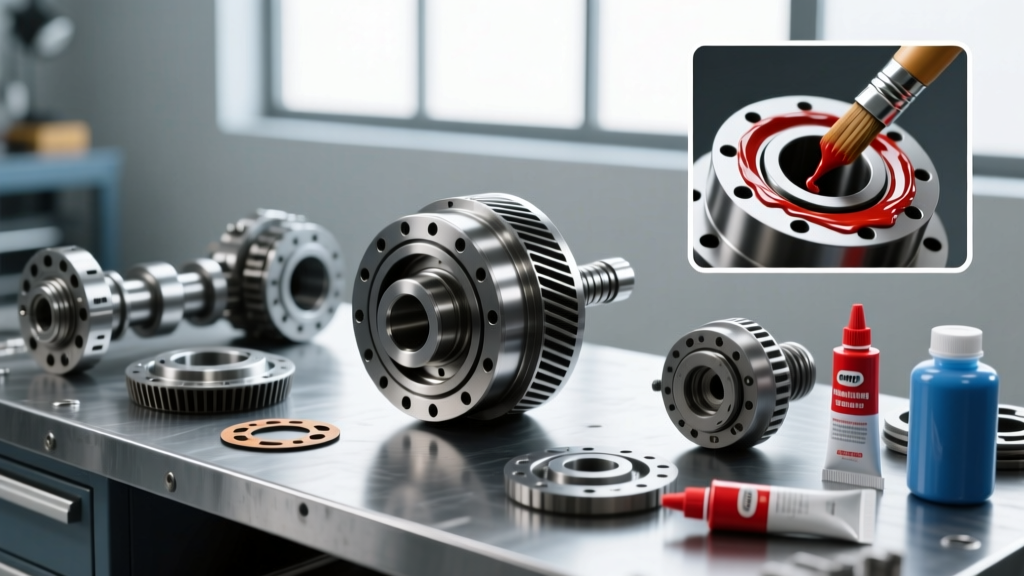
- Sealant Application: Apply a continuous 3/16-inch bead of RTV around the inner perimeter of the bolt holes. Ensure you circle every bolt hole completely to prevent oil from wicking through the threads. Do not over-apply; excess silicone will squeeze into the housing, break off, and clog the differential oil pickup or pinion bearings.
- Assembly Window: Install the cover within 10 minutes of applying the sealant. If a skin forms on the RTV, it will not bond to the opposing surface.
- Torque Sequence and Specs: Always use a crisscross (star) pattern to draw the cover down evenly. Overtorquing will warp stamped steel covers, creating gaps that no sealant can bridge.
- Dana 30/44 (1/4-20 bolts): 15-20 lb-ft
- Ford 8.8 (5/16-18 bolts): 22-28 lb-ft
- GM 8.5/8.6 10-Bolt (M8x1.25): 18-22 lb-ft
- Dana 60 (3/8-16 bolts): 30-35 lb-ft
- Curing Time: Do not fill the differential with gear oil until the RTV has fully cured (minimum 24 hours for standard silicones). Filling it early will wash out the uncured sealant.
Expert Tip: When routing the ELocker wiring harness or ARB air line through the axle tube, use a dedicated bulkhead fitting sealed with high-temp thread sealant. Applying standard RTV over the wire hole is a temporary fix that will inevitably leak when the axle tube flexes.
Fluid Selection and Break-In for Locking Differentials
Once the differential gasket sealant has cured, the final step is filling the axle. This is where many DIYers make a fatal error. Limited-slip differentials (LSDs) require friction modifiers to prevent clutch-pack chatter. Locking differententials do not have clutch packs. Adding an LSD friction modifier to a Detroit Locker or an ELocker can degrade the internal lubrication film and lead to premature wear of the ratcheting gears or electromagnetic armatures.
Use a high-quality, GL-5 rated synthetic gear oil. For standard street and light trail use, a 75W-90 is sufficient. For heavy towing, extreme rock crawling, or vehicles running 37-inch tires and larger, step up to a 75W-140 to maintain film strength under high shear loads. Fill the housing until the oil level is exactly at the bottom of the fill hole threads. For the first 500 miles, keep speeds below 50 MPH to allow the new locker gears and bearings to seat properly, then drain and refill the axle to remove microscopic metal shavings generated during the break-in phase.