Understanding the 2004 Tundra Drivetrain Architecture
The first-generation Toyota Tundra (2000-2006) is renowned for its overbuilt drivetrain, particularly when paired with the legendary 4.7L 2UZ-FE V8 or the 3.4L 5VZ-FE V6. However, when diagnosing driveline vibrations, binding, or gear whine, enthusiasts and mechanics often face a complex web of interconnected components. While many owners immediately suspect the 2004 Toyota Tundra rear differential when hearing a howl or feeling a clunk, the root cause frequently lies upstream in the center differential and AWD/4WD engagement systems.
Unlike modern crossovers with electronically controlled clutch-pack center differentials, the 2004 Tundra utilizes a robust, chain-driven VF2A transfer case that houses a mechanical center differential. This center diff is responsible for splitting torque between the front and rear axles, preventing driveline bind when operating on high-traction surfaces. Furthermore, the front axle engagement is managed by Toyota's Automatic Disconnecting Differential (ADD) system. To accurately diagnose drivetrain symptoms, we must evaluate the center differential, the AWD/4WD engagement mechanics, and the rear axle as a single, cohesive ecosystem.
Center Differential vs. Rear Differential: Symptom Matrix
Misdiagnosing a center differential issue as a rear axle failure is a costly mistake that leads to unnecessary teardowns. Below is a diagnostic matrix to help you isolate the source of your drivetrain complaints.
| Symptom | Operating Condition | Likely Culprit | Verification Test |
|---|---|---|---|
| Severe chassis bind / hopping | Turning on dry pavement in 4H | Center diff stuck in locked position; Shift actuator failure | Shift to 4L and back to 4H; check transfer case shift linkage and actuator motor |
| Howling / Whining noise | Deceleration (coast-down) at 45-55 mph | Rear differential pinion bearing wear; Ring and pinion backlash excessive | Check rear diff fluid for metallic glitter; measure pinion rotational torque |
| Grinding or clunking on engagement | Shifting from 2H to 4H while rolling | Front ADD (Automatic Disconnecting Differential) vacuum actuator delay | Inspect vacuum lines on the front diff housing; test ADD solenoids |
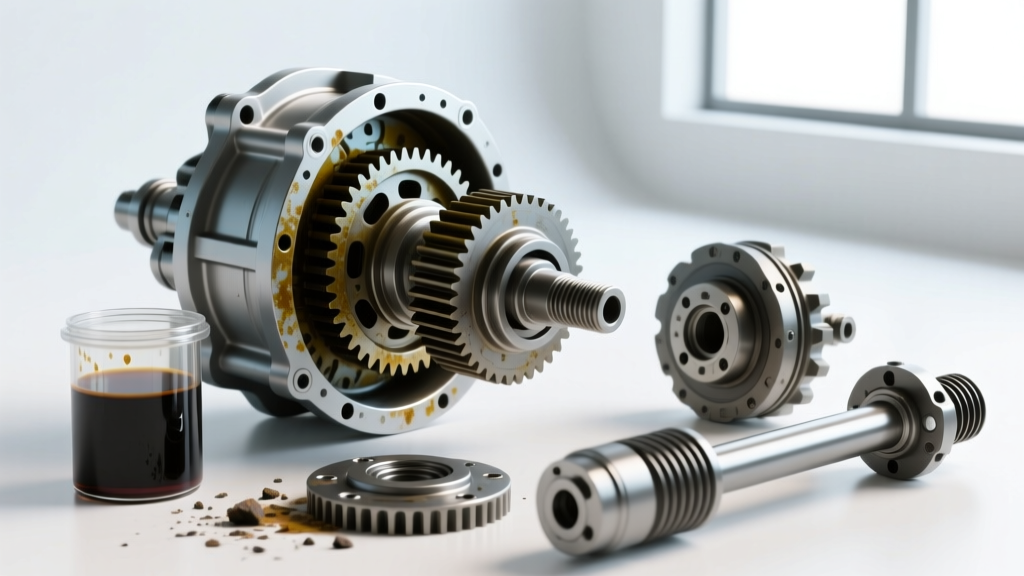
| High-pitched whine under load | Accelerating from 30-60 mph | Transfer case chain stretch or center diff bearing failure | Drain transfer case fluid; inspect for brass synchro material or steel chain flakes |
Deep Dive: Center Differential and AWD/4WD Systems
The VF2A Transfer Case Center Differential
The center differential in the 2004 Tundra is integrated directly into the transfer case. In 4H (Four-High), the center differential allows for a slight speed difference between the front and rear driveshafts, which is critical for preventing axle bind on dry pavement. When you shift into 4L (Four-Low), a mechanical lock is engaged, forcing the front and rear driveshafts to spin at the exact same RPM. If the shift rails or the electronic shift actuator motor fails to fully return to the 4H or 2H position, the center diff remains locked, causing severe tire chirping and driveline stress.
Troubleshooting the Shift Actuator: The actuator motor is mounted on the exterior of the transfer case. Corrosion on the electrical pins or internal gear stripping is common in high-mileage trucks. According to data shared on the i8mud Technical Forums, cleaning the actuator contacts and applying dielectric grease resolves intermittent 4WD engagement issues in over 40% of first-gen Tundra cases.
The Front ADD (Automatic Disconnecting Differential)
Toyota's AWD/4WD system utilizes a vacuum-operated ADD on the front axle to disconnect the passenger-side axle shaft when in 2WD, reducing parasitic drag and improving fuel economy. If the vacuum hoses running from the engine bay to the front differential actuator become brittle or cracked, the front axle will fail to engage, or worse, partially engage, causing a horrific grinding noise from the front differential. Always inspect the ADD vacuum solenoid valves located on the passenger side inner fender well before condemning the transfer case.
Diagnosing the 2004 Toyota Tundra Rear Differential
Once the center differential and AWD engagement systems are ruled out, focus shifts to the rear axle. The 2004 Tundra V8 models are equipped with a massive 9.5-inch ring gear (often referred to as the Tundra 3rd member), while V6 models typically use an 8.0-inch setup. Both utilize a hypoid gear design, which requires extreme-pressure (EP) lubrication.
Pinion Bearing Preload and Backlash
A common failure point on the 9.5-inch rear differential is the pinion bearing. If you hear a howl specifically when lifting off the throttle, the pinion bearing is likely pitted. Replacing this bearing requires strict adherence to rotational torque specifications. According to the Toyota Technical Information System (TIS), the pinion nut torque is roughly 123 lb-ft, but this is a baseline. The true measurement is rotational torque: used bearings should exhibit 1.5 to 2.5 in-lbs of rotational drag, while new bearings require 4 to 6 in-lbs. Over-tightening the pinion nut will crush the spacer sleeve too far, destroying the new bearing within 500 miles.
Fluid Specifications, Capacities, and Torque Specs
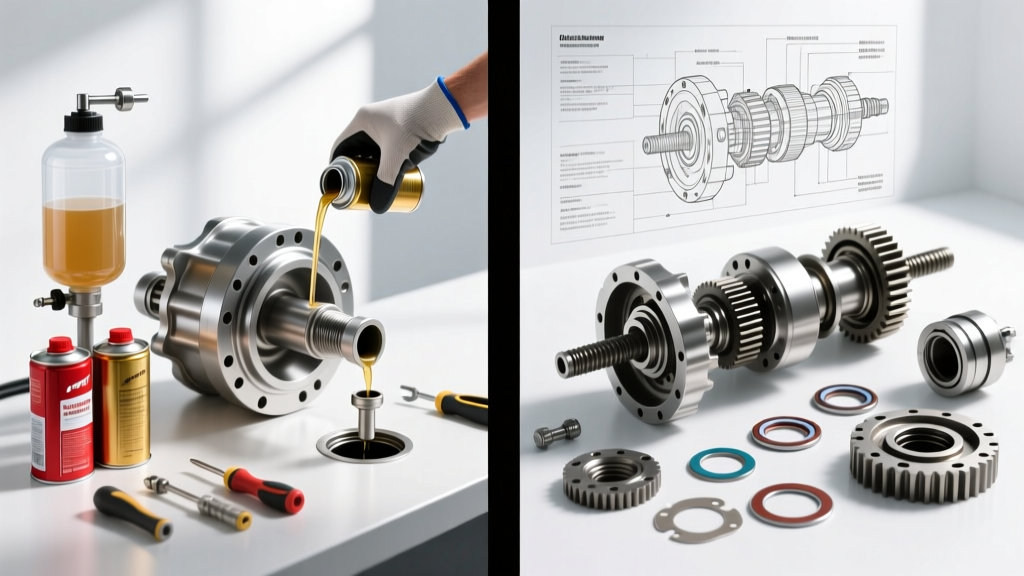
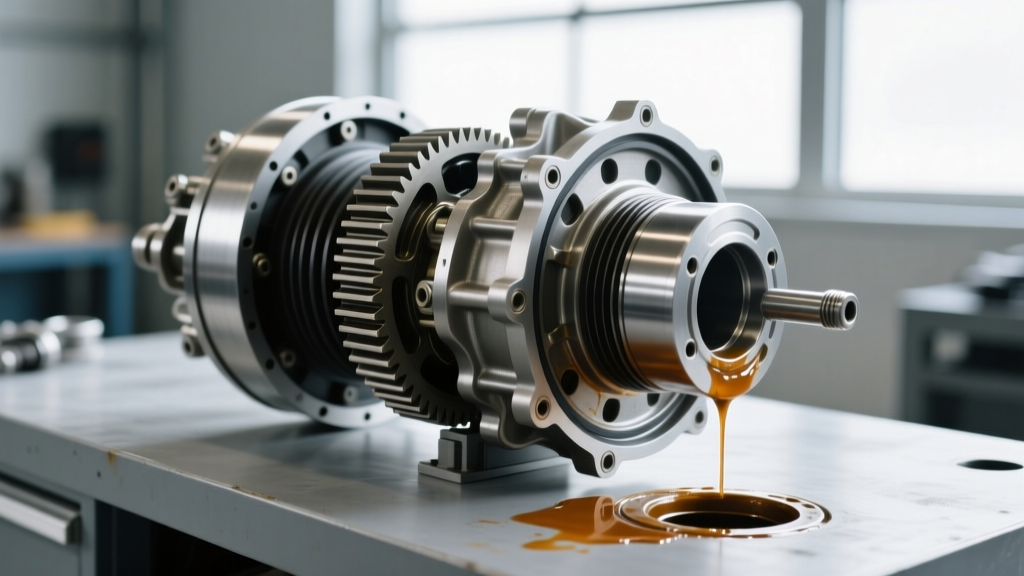
Proper fluid maintenance is the lifeblood of the Tundra's AWD and differential systems. Using the incorrect viscosity can lead to synchro grinding in the transfer case or catastrophic hypoid gear wear in the rear axle. Below are the 2026 industry-standard specifications and OEM torque values for the 2004 Tundra drivetrain.
| Component | Fluid Specification | Capacity | Drain/Fill Plug Torque |
|---|---|---|---|
| VF2A Transfer Case (Center Diff) | Toyota LT 75W-85 (GL-5) or 75W-90 GL-5 | 1.27 Liters (1.34 qt) | 30 lb-ft (40 Nm) |
| 9.5-inch Rear Differential | API GL-5 75W-90 Synthetic | 3.2 Liters (3.4 qt) | 30 lb-ft (40 Nm) |
| 8.0-inch Rear Differential | API GL-5 75W-90 Synthetic | 2.4 Liters (2.5 qt) | 30 lb-ft (40 Nm) |
| Front Differential (with ADD) | API GL-5 75W-90 | 1.5 Liters (1.6 qt) | 30 lb-ft (40 Nm) |
Note: Always use a high-quality synthetic gear oil from reputable brands like Red Line or Amsoil. As detailed in the Red Line Synthetic Oil Gear Lubricant Guide, synthetic GL-5 fluids maintain their shear stability and extreme-pressure sulfur/phosphorus additive packages far longer than conventional mineral oils, which is critical for the high-offset hypoid gears in the Tundra's rear differential.
The Importance of the Friction Modifier
If your 2004 Tundra is equipped with the optional TRD Limited-Slip Differential (LSD) in the rear, you must add a friction modifier (typically 3-4 oz) to the 75W-90 gear oil. Failing to do so will result in chattering and binding during low-speed, tight-radius turns. However, do not add friction modifier to the transfer case center differential or the front open differential, as it can reduce the locking capability of the transfer case synchros and cause shift issues.
Summary: A Systematic Approach to Drivetrain Diagnosis
Troubleshooting the AWD, center differential, and rear axle systems on a 2004 Toyota Tundra requires a methodical approach. Start by verifying the operation of the transfer case shift actuator and the front ADD vacuum system to rule out engagement faults. Next, isolate noise and vibration by testing under load versus coast-down conditions. Finally, when servicing the 2004 Toyota Tundra rear differential or the center diff, strictly adhere to OEM fluid capacities, GL-5 specifications, and precise torque sequences. By treating the drivetrain as an interconnected AWD system rather than isolated axles, you can accurately diagnose faults, eliminate driveline bind, and ensure your Tundra remains reliable for hundreds of thousands of miles.