The Critical Role of Gear Oil in Your Tacoma's Drivetrain
The rear differential in a Toyota Tacoma is a marvel of high-torque engineering, utilizing a hypoid ring and pinion gear set that operates under extreme sliding friction. Unlike standard spur gears, hypoid gears require specialized extreme pressure (EP) additives found exclusively in API GL-5 rated gear oils. As we navigate the 2026 automotive landscape, with Tacomas ranging from the legendary 2nd-generation workhorses to the advanced 4th-generation (2024-2026) turbo-hybrid models, the fundamental need for pristine Toyota Tacoma rear differential fluid remains unchanged. When this fluid degrades, shears, or becomes contaminated, the acoustic and mechanical symptoms are distinct. Proper diagnosis separates a simple $40 fluid service from a $2,500 ring-and-pinion replacement.
Top 5 Symptoms of Degraded Rear Differential Fluid
Diagnosing differential health begins with sensory feedback. Before dropping the drain plug, pay close attention to the following acoustic and physical indicators.
1. High-Pitched Whining or Howling on Deceleration
A howling noise that peaks during deceleration (engine braking) is a classic symptom of worn pinion bearings or degraded gear oil. The Toyota Tacoma rear differential fluid acts as a hydrodynamic wedge between the pinion gear and the ring gear. When the fluid loses its viscosity due to thermal breakdown, the microscopic gap closes, leading to metal-on-metal harmonic resonance. If the whine changes pitch exactly in proportion to vehicle speed (not engine RPM), the differential is your primary suspect.
2. Chatter or Binding During Low-Speed Turns
If you drive a Tacoma equipped with a mechanical Limited Slip Differential (LSD)—common in TRD Sport models—a chattering or hopping sensation during tight, low-speed turns indicates depleted friction modifiers. The OEM Toyota Tacoma rear differential fluid requires a specific friction modifier additive (Part# 08885-81060) to allow the clutch packs to slip smoothly. When the fluid ages, the modifier burns off, causing the clutches to grab and release violently.
3. Metallic Glitter on the Magnetic Drain Plug
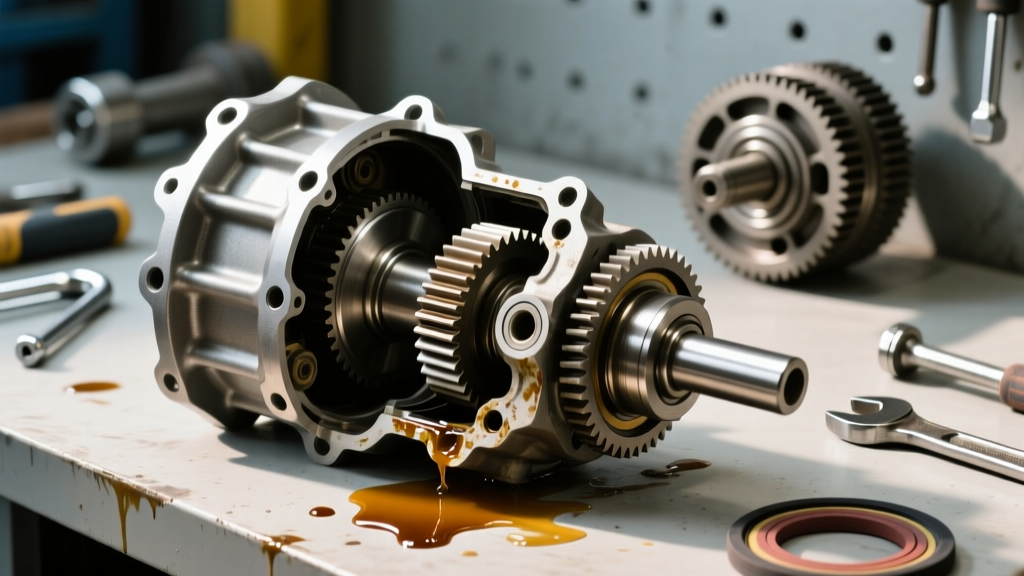
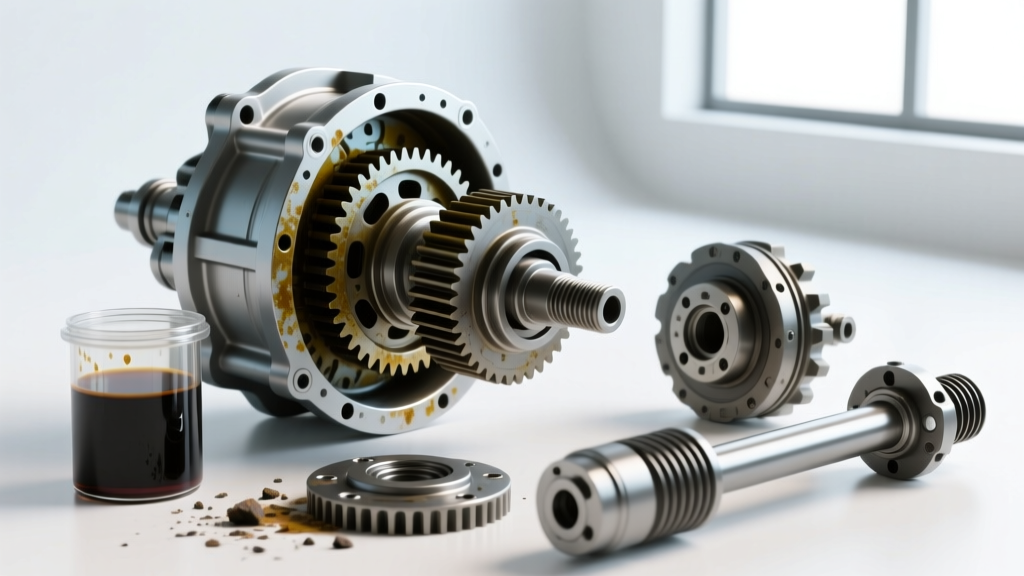
The Tacoma's rear differential drain plug features a built-in magnet designed to capture ferrous wear metals. During a diagnostic drain, inspect the plug closely. A fine, dark grey "fuzz" is normal wear for a differential with over 60,000 miles. However, if you find chunky metallic flakes, spiraled shavings, or brass-colored dust (indicating thrust washer wear), the fluid has failed to protect the internal components, and a teardown is imminent.
4. Fluid Leaks and Low Volume
Low fluid volume is a silent killer of Tacoma axles. Inspect the pinion seal (where the driveshaft mates to the differential) and the inner axle seals. A common failure point on 3rd-generation Tacomas (2016-2023) is a clogged axle breather valve. When the differential heats up, internal pressure rises. If the breather is clogged with mud or debris, the pressure blows out the pinion seal, rapidly depleting your Toyota Tacoma rear differential fluid and leading to catastrophic gear seizure.
5. Excessive Heat and Burnt Odor
After a highway run or towing session, carefully place your hand near the differential housing (avoiding the exhaust). If it is too hot to touch and emits a sharp, sulfuric "rotten egg" odor, the EP additives in the GL-5 fluid have thermally cracked. This burnt fluid loses its film strength, leaving the hypoid gears vulnerable to micro-welding and spalling.
Tacoma Rear Differential Noise Diagnostic Matrix
Use this matrix to isolate the exact internal component failing based on the acoustic signature of your Tacoma.
| Noise Type | Driving Condition | Probable Cause | Fluid-Related? |
|---|---|---|---|
| Howling / Whining | Deceleration (Coasting) | Pinion Bearing Wear / Low Fluid | Yes (Viscosity Loss) |
| Growling | Acceleration (Under Load) | Ring Gear Backlash / Worn Teeth | Partial (EP Additive Failure) |
| Clunking | Shifting from Drive to Reverse | Excessive Gear Lash / Worn Spider Gears | No (Mechanical Wear) |
| Chatter / Hop | Tight Low-Speed Turns | LSD Clutch Pack Bind | Yes (Modifier Depletion) |
| Clicking | Constant Speed | Damaged Axle Bearing / Debris in Sump | No (Physical Damage) |
OEM Fluid Specifications and Capacity Chart
Using the correct viscosity and API rating is non-negotiable. Below are the exact specifications for Toyota Tacoma rear differentials, updated to include the 4th-generation (2024-2026) platforms.
| Generation / Trim | Ring Gear Size | OEM Fluid Spec | Capacity |
|---|---|---|---|
| 2nd & 3rd Gen (Standard) | 8.0-inch | 75W-85 API GL-5 | 3.0 L (3.17 qt) |
| 2nd & 3rd Gen (e-Locker) | 8.0-inch | 75W-85 API GL-5 | 3.0 L (3.17 qt) |
| 4th Gen (SR / SR5 / TRD Sport) | 8.0-inch | 75W-85 API GL-5 | 3.0 L (3.17 qt) |
| 4th Gen (TRD Off-Road / Pro) | 8.75-inch | 75W-85 API GL-5 | 3.4 L (3.59 qt) |
Expert Note: Toyota Genuine Hypoid Gear Oil SX (Part# 08885-02606) is the factory fill. An excellent, highly stable aftermarket alternative is Mobil 1 Synthetic Gear Lube 75W-90, which provides superior shear stability for heavy towing.
Step-by-Step Diagnostic and Service Procedure
Performing a diagnostic fluid swap requires precision. Never use an impact wrench on the differential plugs, as the aluminum or thin-stamped steel housings can crack or strip.
Tools and Materials Required
- 10mm Hex (Allen) Socket or L-Wrench
- Torque Wrench (inch-pounds and foot-pounds capable)
- Fluid Transfer Pump
- Brake Cleaner and Shop Towels
- 3.5 Quarts of 75W-85 or 75W-90 GL-5 Gear Oil
- Crush Washers (Optional but recommended for drain plug)
The Drain, Inspect, and Refill Phase
- Preparation: Drive the Tacoma for 15 minutes to bring the differential fluid up to operating temperature. Warm fluid flows faster and carries suspended contaminants out more effectively.
- Fill Plug First: Crucial Step. Always remove the top FILL plug before removing the bottom DRAIN plug. If the fill plug is seized or strips, you do not want to be stranded with an empty differential.
- Drain and Inspect: Remove the drain plug. Allow the fluid to drain into a catch pan for 15 minutes. Inspect the magnetic tip and the fluid color. Milky fluid indicates water intrusion through a compromised axle seal or submerged breather.
- Refill: Reinstall the drain plug. Torque the drain plug to 36 ft-lbs (49 Nm). Using your transfer pump, fill the differential with your chosen Toyota Tacoma rear differential fluid until it begins to weep out of the bottom threads of the fill hole.
- Final Torque: Reinstall the fill plug and torque to 36 ft-lbs (49 Nm).
E-Locker Actuator vs. Internal Fluid Issues
Owners of TRD Off-Road and TRD Pro Tacomas frequently misdiagnose electronic locker (e-Locker) actuator failures as internal gear or fluid problems. If your rear end binds or fails to engage, verify the actuator motor first. The e-Locker utilizes a small DC motor and a limit switch housed on the outside of the differential pumpkin. Moisture ingress into the actuator connector causes corrosion, preventing the locking collar from engaging. If the dashboard e-Locker light flashes endlessly, diagnose the electrical circuit and actuator motor before condemning the internal differential fluid or mechanical locking collar.
Authoritative References
For factory service manuals, wiring diagrams, and technical service bulletins (TSBs) regarding Tacoma drivetrain maintenance, consult Toyota TechInfo. For independent tribology data and gear oil shear-stability testing, reference the archives at Bob Is The Oil Guy (BITOG).