The Automatic Transmission Dilemma: Why Your Trailblazer Has No Clutch Pedal
Clutch pedal problems—specifically soft, hard, spongy, or vibrating sensations—are universally associated with manual transmissions. However, the 2003 Chevy Trailblazer is equipped exclusively with the GM 4L60-E four-speed automatic transmission. Therefore, a literal manual clutch pedal does not exist in this vehicle. When Trailblazer owners report "clutch pedal problems," they are actually experiencing severe drivetrain and harmonic feedback transferring through the chassis to the brake pedal, dead pedal, and floorboard.
As of 2026, these SUVs are over two decades old. Degraded rubber engine mounts and worn drivetrain components amplify vibrations that were once isolated. This model-specific diagnostic guide bridges the gap between driver terminology and mechanical reality, focusing on the two primary culprits causing pedal feedback: the mechanical cooling fan clutch and the hydraulic Torque Converter Clutch (TCC).
Harmonic Resonance: The 2003 Chevy Trailblazer Fan Clutch
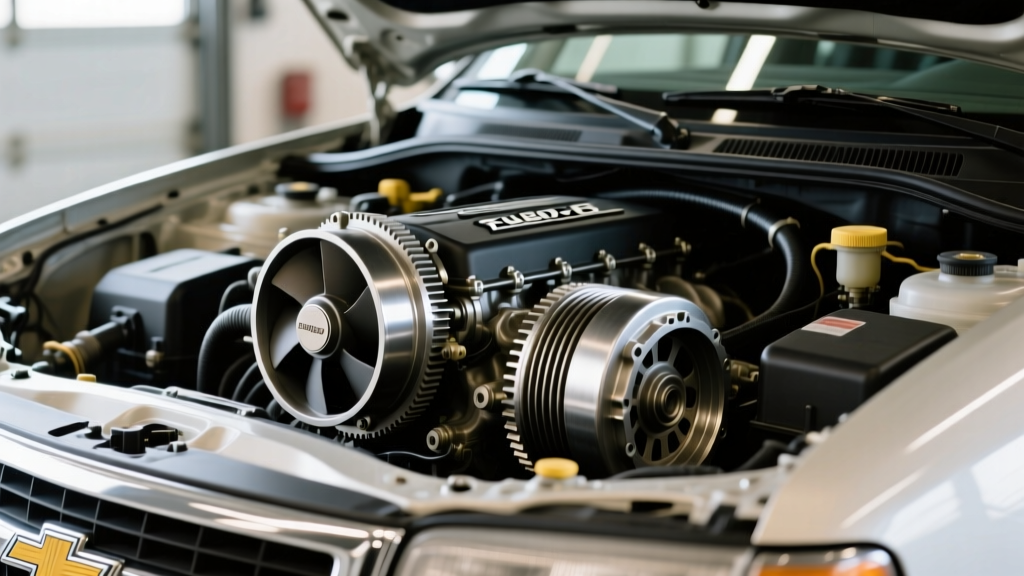
When owners search for solutions to a failing 2003 chevy trailblazer fan clutch, they rarely expect it to cause pedal vibration. The Trailblazer's 4.2L LL8 (Vortec 4200) inline-6 is a physically long engine. When the mechanical fan clutch begins to fail—either by seizing, leaking its internal silicone fluid, or developing bearing play—it creates a massive harmonic imbalance at the front of the engine.
This imbalance is transferred directly through the water pump shaft, into the engine block, and down through the aging motor mounts into the chassis. Drivers often feel this low-frequency vibration in the left-side floorboard and brake pedal, misinterpreting it as a "vibrating clutch pedal."
Fan Clutch Diagnostic Specifications
- OEM Part Number: ACDelco 210267 (GM 15029904)
- Wrench Size: 32mm (Use a dedicated fan clutch wrench set like OTC 4504 or GM J-41240 to avoid stripping the water pump snout)
- Thread Direction: Standard Right-Hand (Reverse of many Ford/Chrysler applications)
- Symptom Trigger: Vibration peaks between 1,800 and 2,200 RPM, even when the vehicle is stationary in Park.
4L60-E Torque Converter Clutch (TCC) Shudder
If the vibration occurs specifically while driving between 35 and 50 MPH under light throttle, or if the brake pedal feels "hard" and pushes back against your foot at a red light, you are dealing with the 4L60-E Torque Converter Clutch (TCC). The TCC uses a Pulse Width Modulation (PWM) solenoid to smoothly lock the engine to the transmission input shaft, eliminating slippage and improving fuel economy.
Hard and Vibrating Pedal Sensations
When the TCC PWM solenoid fails or the valve body bore wears out, the TCC may fail to disengage when you come to a stop. The engine remains mechanically locked to the wheels, pushing the vehicle forward against your brake pedal. This makes the brake pedal feel unusually hard and causes a violent shudder as the engine struggles against the brakes, mimicking a stalling manual clutch.
Soft Pedal and Shudder Sensations
Conversely, if the TCC friction material is worn or the fluid is degraded, the clutch will slip during the apply phase. This creates a "rumble strip" sensation that travels up the steering column and floorboard, which drivers often describe as a soft or slipping clutch pedal feel. In 2026, using the correct fluid is critical to resolving this without dropping the transmission pan.
Diagnostic Matrix: Fan Clutch vs. TCC vs. Hydraulics
Use this matrix to accurately pinpoint the source of your pedal problems based on RPM, speed, and pedal feel.
| Symptom Reported | Actual Mechanical Fault | RPM / Speed Dependency | Primary Component to Inspect |
|---|---|---|---|
| Vibrating Pedal (Stationary) | Harmonic Fan Clutch Imbalance | 1,800 - 2,200 RPM (In Park) | 2003 Chevy Trailblazer Fan Clutch & Water Pump Bearing |
| Hard / Pushing Pedal | TCC Fails to Release at Idle | 0 MPH, In Gear (Braking) | 4L60-E TCC PWM Solenoid & Valve Body |
| Shudder / Soft Feel | TCC Slip / Friction Wear | 35 - 50 MPH (Light Throttle) | Torque Converter & Dexron VI Fluid |
| Spongy Pedal | Aerated Brake Fluid / ABS Fault | During Braking Events | Brake Master Cylinder & ABS Modulator |
Step-by-Step Model-Specific Repair Guide
1. Replacing the Mechanical Fan Clutch
If your diagnostic test confirms the vibration is RPM-dependent while stationary, the fan clutch must be replaced. Do not attempt to use standard open-end wrenches; the clearance between the fan blades and the water pump pulley requires specialized tools.
- Remove the upper radiator shroud (10mm bolts) to gain access to the fan clutch nut.
- Use a 32mm fan clutch wrench on the nut, and a secondary wrench on the water pump pulley to hold it stationary.
- Break the nut loose (Standard Right-Hand Thread). If the water pump bearing is original to 2003, inspect it for lateral play. A wobbling water pump will destroy a new fan clutch within 5,000 miles.
- Install the new ACDelco 210267 fan clutch. Torque the nut to 40 lb-ft.
2. Resolving 4L60-E TCC Shudder and Pedal Pushback
If the issue is drivetrain-related (TCC shudder or failure to release), begin with the fluid and solenoid before considering a torque converter replacement.
- Fluid Upgrade: The original 2003 manual calls for Dexron-III. This has been superseded by Dexron-VI (ACDelco 10-9395). Dexron-VI features superior shear stability and friction modifiers that frequently cure mild TCC shudder. A standard pan drop and filter change on the 4L60-E requires exactly 5.0 quarts.
- Solenoid Testing: If the TCC fails to release (causing the hard pedal feel), test the TCC PWM solenoid. Access the transmission pan, locate the PWM solenoid, and measure resistance with a multimeter. A healthy solenoid should read between 10 and 15 ohms at room temperature. If it reads out of spec, replace it with an ACDelco 214-1893.
- Valve Body Wear: If the solenoid tests fine but shudder persists, the TCC regulator valve bore in the aluminum valve body is likely worn—a common 4L60-E failure point after 150,000 miles. Installing a Sonnax TCC regulator valve kit (Part No. 77754-04K) restores proper hydraulic pressure and eliminates the shudder.
The "Spongy" Pedal Misconception
Finally, if the pedal feels genuinely spongy (lacking hydraulic resistance), this is entirely unrelated to the transmission or the fan clutch. A spongy brake pedal in a 2003 Trailblazer is caused by aerated brake fluid, a failing brake master cylinder, or a faulty ABS hydraulic modulator. However, because a failing fan clutch introduces high-frequency vibration into the chassis, it can mask the tactile feedback of the brake pedal, leading owners to incorrectly diagnose a "soft clutch" when they actually need a complete brake fluid flush using DOT 3 or DOT 4 synthetic fluid.
Summary and 2026 Maintenance Advice
Diagnosing pedal problems on an automatic SUV requires translating driver complaints into mechanical realities. By isolating whether the vibration is RPM-dependent (pointing to the 2003 chevy trailblazer fan clutch) or speed/load-dependent (pointing to the 4L60-E TCC), you can avoid unnecessary transmission rebuilds and target the exact failing component. Always refer to the GM Owner Center Archives for baseline torque specifications, and ensure you are using modern Dexron-VI fluid to protect aging 4L60-E internals.