In heavy industry applications—ranging from mining ball mills and rock crushers to oilfield drawworks and marine propulsion—the drivetrain faces immense inertial loads. To mitigate shock loading and prevent catastrophic gear shearing, engineers rely on massive centrifugal clutches equipped with heavy-duty friction bands. While modern iterations often use sintered bronze or synthetic Kevlar, high-thermal-mass applications and specialized hoisting winches still utilize centrifugal clutch leather bands. Heavy industry operators actuate these systems via a robust hydraulic or pneumatic foot pedal that pre-tensions the band or controls the lock-up mechanism before centrifugal force fully engages.
When clutch pedal problems arise in these industrial environments, they are rarely simple mechanical failures. A soft, hard, spongy, or vibrating pedal indicates complex hydraulic, pneumatic, or material science issues within the actuation circuit or the friction interface. This model-specific repair guide delves into the exact diagnostics, torque specifications, and material tolerances required to troubleshoot clutch pedal anomalies in heavy-duty centrifugal band clutches.
Understanding the Actuation Pedal in Centrifugal Band Clutches
Unlike a standard automotive diaphragm spring clutch, the 'pedal' in a heavy-industry centrifugal clutch system is actually a precision foot valve or master cylinder actuator. In systems like the Wichita Airflex VC series or National Oilwell Varco (NOV) Emsco hoist drives, the operator's foot pedal routes either 120 PSI pneumatic air or up to 3,000 PSI of specialized hydraulic fluid to an actuation ring. This ring forces the leather friction blocks outward against the inner diameter of the clutch drum, providing initial lock-up before the centrifugal weights take over the primary torque transfer.
Because the pedal is essentially a high-pressure fluid displacement valve, pedal feel is the primary diagnostic window into the health of the entire engagement system.
Diagnostic Matrix: Pedal Symptoms vs. Root Causes
Use the following diagnostic table to cross-reference pedal feel with system pressure readings taken at the master cylinder output port.
| Pedal Symptom | System Pressure | Root Cause Indicator | Corrective Action |
|---|---|---|---|
| Soft / Spongy | < 1,200 PSI (Hydraulic) or < 60 PSI (Air) | Hygroscopic fluid aeration, leather friction dust infiltrating master cylinder seals | Flush MIL-PRF-83282 fluid, rebuild master cylinder, replace seals |
| Hard / Binding | > 3,500 PSI (Spiking) | Glazed leather bands, seized clevis pivot pins, collapsed high-pressure hoses | Hone cylinder bore, replace band segments, lubricate pivot linkage |
| Vibrating / Chatter | Fluctuating rapidly | Uneven leather wear, out-of-balance centrifugal weights, harmonic resonance | Micrometer band measurement, dynamic shaft balancing, burnish new bands |
Troubleshooting Soft and Spongy Pedal Actuation
A spongy pedal in a heavy-duty industrial drive is almost exclusively a fluid dynamics issue. In hydraulic actuation systems, the fluid is subjected to extreme thermal cycling. Over time, standard DOT 4 or generic hydraulic fluids absorb moisture (hygroscopy). When the clutch drum reaches operational temperatures of 450°F to 600°F, the heat transfers back through the actuation piston, boiling the water content in the fluid and creating compressible air pockets.
The 3,000 PSI Bleeding Procedure
To resolve a spongy pedal, you must completely purge the system using a high-temperature synthetic fluid like MIL-PRF-83282.
- Isolate the actuation ring from the main drum to prevent accidental engagement.
- Connect a high-pressure pneumatic bleeder to the master cylinder reservoir, maintaining exactly 45 PSI of constant pressure.
- Open the bleed valves at the furthest actuation piston, allowing fluid to flow until no micro-bubbles are visible in the sight glass.
- Torque the bleeder screws to 18 lb-ft and verify pedal firmness. Free travel should be exactly 1.5 inches before resistance is felt.
Pro-Tip: If the pedal remains spongy after bleeding, inspect the master cylinder bore. Fine leather dust from the friction bands often bypasses the drum seals and contaminates the hydraulic fluid, acting as a lapping compound that scores the cylinder bore and destroys the internal O-rings.
Resolving Hard Pedal Resistance and Binding
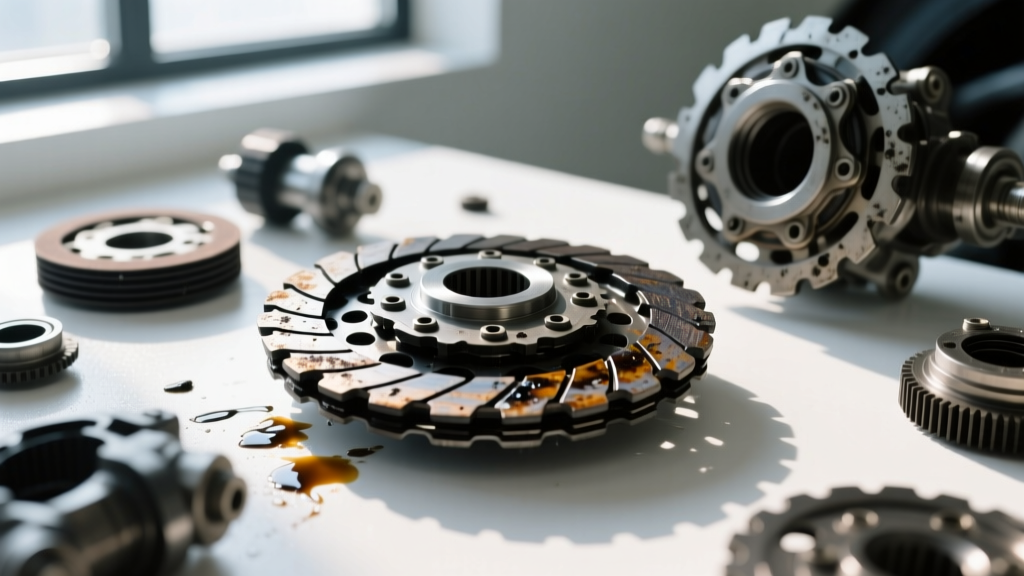
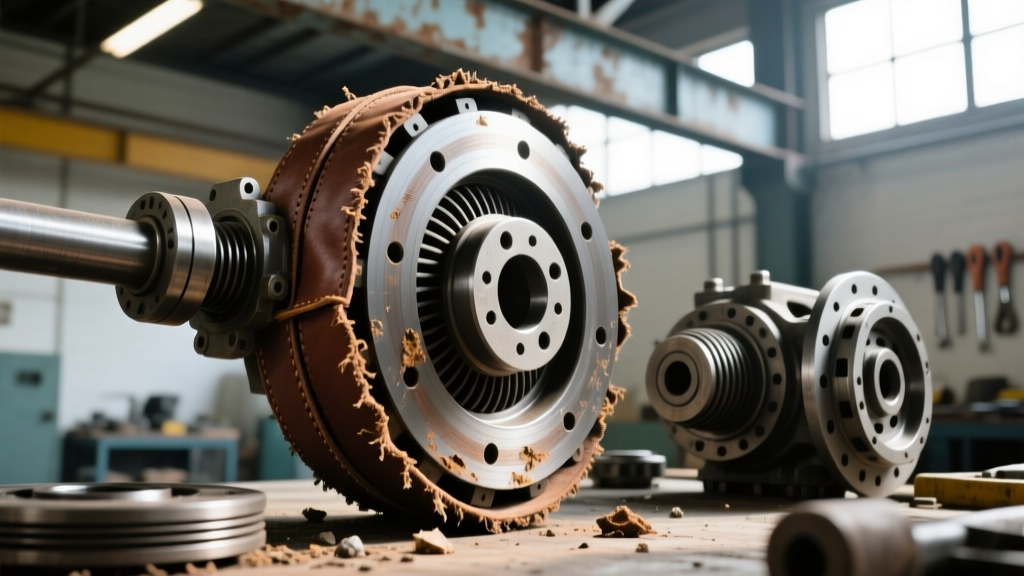
An abnormally hard pedal requires excessive operator force and usually indicates mechanical binding or severe friction material degradation. In centrifugal clutch leather bands, the leather is heavily impregnated with phenolic resins and brass wire for thermal stability. When subjected to prolonged slipping or inadequate cooling airflow, the phenolic resin can melt and re-harden, creating a glass-like, glazed surface on the leather.
When the leather is glazed, the coefficient of friction drops drastically. The operator subconsciously pushes the pedal harder to achieve lock-up, over-pressurizing the hydraulic circuit. This leads to spiked pressure readings (>3,500 PSI) and eventual hose rupture.
Inspection and Replacement Specs
Remove the inspection cover and measure the leather friction blocks using an outside micrometer.
- New Thickness: 0.500 inches
- Minimum Service Limit: 0.250 inches
- Glaze Check: Run a fingernail across the surface. If it feels like smooth glass and leaves no mark, the band is glazed and must be replaced.
Eliminating Pedal Vibration and High-Frequency Chatter
A vibrating pedal—often described by heavy machinery operators as a 'buzzing' or 'chatter' felt through the steel toe of their boot—occurs during the initial slip phase of engagement. This is caused by the stick-slip phenomenon, where the leather friction blocks alternately grab and release the steel drum surface at a high frequency.
Causes of Industrial Clutch Chatter
- Uneven Wear Patterns: If the leather blocks are not wearing evenly, the actuation ring applies uneven radial pressure, causing the drum to deflect microscopically.
- Centrifugal Weight Imbalance: The internal flyweights that assist in engagement can become packed with mining dust or debris, causing dynamic imbalance at high RPMs.
- Harmonic Resonance: Misalignment between the prime mover (diesel engine or electric motor) and the clutch input shaft.
The Burnishing Protocol
If you have just installed new centrifugal clutch leather bands, pedal vibration is normal until the 'burnishing' process is complete. Heavy industry standards require a controlled burnish to mate the leather to the drum's microscopic imperfections.
Burnishing Procedure: Restrict the engine or motor RPM to 40% of its rated speed. Engage the clutch pedal to maintain a 15% slip rate (monitoring drum temperature with an IR pyrometer to ensure it does not exceed 400°F). Maintain this controlled slip for 2 to 3 hours until the leather surface shows a uniform, dark friction signature. This eliminates initial pedal chatter and extends band life by up to 40%.
2026 Sourcing and Replacement Costs for Leather Friction Bands
The supply chain for heavy-industry friction materials has shifted significantly as of 2026. Due to updated EPA and global environmental regulations regarding airborne friction dust and phenolic off-gassing, pure organic leather bands are being rapidly phased out in favor of brass-wire-impregnated leather composites and advanced aramid fibers. These modern composites mimic the high-thermal-mass properties of traditional leather while eliminating hazardous dust.
When budgeting for a complete clutch pedal and friction band overhaul on a heavy-duty rock crusher or drawworks drive, expect the following 2026 market pricing:
- Complete Leather Composite Band Kit (Segmented): $4,500 to $8,200 depending on drum diameter (typically 30 to 60 inches).
- Hydraulic Master Cylinder Rebuild Kit (3,000 PSI rated): $850 to $1,400.
- Pneumatic Foot Valve Assembly (Heavy-Duty Cast Iron): $600 to $950.
Always source OEM or certified aftermarket friction elements. Utilizing substandard friction materials not only leads to immediate pedal chatter and spongy actuation due to rapid material breakdown, but it also risks catastrophic drum scoring, which can turn a $6,000 band replacement into a $45,000 drum and shaft rebuild.
Final Diagnostic Recommendations
Troubleshooting clutch pedal problems in heavy industry requires looking beyond the pedal itself. The pedal is merely the messenger for the hydraulic and friction systems. By systematically checking fluid integrity, measuring leather band thickness to the thousandth of an inch, and adhering to strict torque and burnishing specifications, maintenance teams can eliminate downtime and ensure smooth, shock-free engagement in the most demanding industrial environments on earth.