The Drivetrain Duo: Understanding the Transfer Case and Differential Relationship
For any off-road enthusiast or daily commuter, performing a Jeep Wrangler rear differential fluid change is a fundamental maintenance milestone. However, beginners often treat the rear axle and the transfer case as completely isolated systems. In reality, they are deeply interconnected partners in your Wrangler’s drivetrain. Power flows from the engine, through the transmission, into the transfer case, and finally down the rear driveshaft to the rear differential.
The transfer case (such as the NV241 Command-Trac or NV242 Selec-Trac) is responsible for splitting torque between the front and rear axles. When you shift into 4WD Low, the transfer case multiplies torque significantly—up to 4:1 in Rock-Trac models. This multiplied torque is sent directly to the rear differential’s ring and pinion gears. If the transfer case is binding, low on fluid, or suffering from internal chain stretch, it can send erratic shockloads down the driveshaft, prematurely destroying the rear differential bearings and gears. Understanding this relationship is the key to diagnosing driveline vibrations and ensuring your Jeep survives the harshest trails in 2026 and beyond.
Why Service Both Systems Together?
While the rear differential requires heavy-duty gear oil, the transfer case typically runs on Automatic Transmission Fluid (ATF). Despite the different fluids, their service intervals heavily overlap, usually landing around the 30,000 to 60,000-mile mark depending on off-road usage. Performing your Jeep Wrangler rear differential fluid change at the same time as a transfer case service saves you from crawling under the Jeep twice, ensures cross-system integrity, and gives you a chance to inspect the rear driveshaft CV joints and U-joints that connect the two components.
Fluid Capacity and Specification Chart (JK & JL Wranglers)
Using the correct fluid is non-negotiable. The wrong viscosity can lead to catastrophic gear failure or transfer case clutch pack burnout. Below is the definitive fluid guide for modern Wranglers.
| Component | Model / Axle Type | Fluid Specification | Capacity (Approx.) |
|---|---|---|---|
| Rear Differential | Dana 44 (JK) / M220 (JL) | 75W-85 API GL-5 Gear Oil | 4.0 Pints (1.9L) |
| Rear Differential (Heavy Duty) | Dana 44 / M220 (Towing/Rubicon) | 75W-140 API GL-5 Synthetic | 4.0 Pints (1.9L) |
| Transfer Case | NV241 / NV241OR (Command/Rock-Trac) | Mopar ATF+4 | 2.0 - 2.5 Quarts |
| Transfer Case | NV242 (Selec-Trac) | Mopar ATF+4 | 2.5 Quarts |
Note: If your Wrangler is equipped with a Trac-Lok limited-slip rear differential, you must add a specific friction modifier additive to the gear oil to prevent clutch chatter during tight turns. Reference your official Jeep owner's manual for your specific VIN's equipment list.
Step-by-Step: Tackling the Jeep Wrangler Rear Differential Fluid Change
Now that we understand how the transfer case feeds torque into the axle, let’s execute the rear differential service. Modern JK and JL Wranglers feature a Dana 44 or M220 rear axle that typically includes a drain plug, making this job incredibly beginner-friendly compared to older axles that require prying off the cover and scraping RTV silicone.
Tools Required
- 3/8-inch and 1/2-inch drive ratchets
- Fluid transfer pump
- Drain pan (minimum 5-quart capacity)
- Torque wrench (inch-pounds and foot-pounds)
- Shop towels and brake cleaner
The Drain and Fill Procedure
- Level the Jeep: Ensure the Wrangler is on a flat, level surface. Jacking the axle up to remove the wheels will cause the fluid to sit below the fill hole, leading to an under-filled differential.
- Remove the Fill Plug First: Located on the front-facing side of the differential housing (the pumpkin), the fill plug is usually a 3/8-inch square drive. Never remove the drain plug before verifying the fill plug is loose. If the fill plug is seized, you will be stuck with an empty differential.
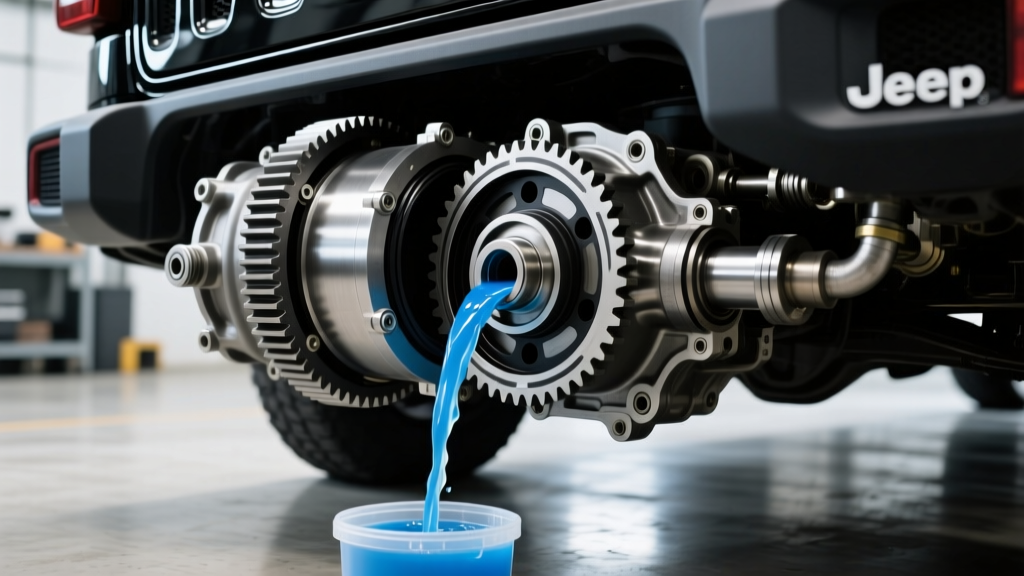
- Drain the Old Gear Oil: Remove the lower drain plug (also a 3/8-inch square drive) and let the fluid drain. Inspect the magnetic tip of the drain plug. A small amount of fine metallic paste is normal, but large metal shards indicate ring and pinion failure.
- Reinstall and Torque the Drain Plug: Clean the threads and reinstall the drain plug. The exact torque specification for the Dana 44 / M220 drain plug is 25 lb-ft.
- Pump in the New Fluid: Using your transfer pump, fill the differential with your chosen 75W-85 or 75W-140 GL-5 gear oil until it reaches the bottom edge of the fill hole. For Trac-Lok equipped axles, mix the friction modifier into the first bottle of gear oil before pumping.
- Reinstall the Fill Plug: Torque the fill plug to 25 lb-ft.
The Transfer Case Connection: Inspecting the NV241 and NV242
With the rear differential secured, slide forward to the transfer case. The relationship between these two components means that a failing transfer case output shaft seal can leak ATF directly onto the rear driveshaft, which then slings fluid onto the hot exhaust or rear differential cover, creating a burning smell and masking rear diff leaks.
To service the transfer case, locate the fill and drain plugs on the rear output housing. Like the differential, remove the fill plug first. The NV241 and NV242 use standard ATF+4. Pump in the fluid until it weeps out of the fill hole, then reinstall and torque the plugs to 15 to 20 lb-ft. Overfilling the transfer case can cause fluid to aerate and foam at high highway speeds, leading to overheating and degraded clutch packs.
Understanding the Vent Tube System
Both the rear differential and the transfer case feature breather vent tubes. As these components heat up during driving, the air inside expands. When you plunge into a cold water crossing, the rapid temperature drop creates a vacuum. If your vent tubes are not routed high up into the engine bay or body tub, the vacuum will suck water past the axle seals and transfer case output seals, turning your gear oil and ATF into a milky, useless emulsion. Always inspect your vent lines during this service to ensure they are free of kinks, cracks, and debris.
Common Beginner Mistakes to Avoid
- Using Standard GL-5 in Yellow Metal: While your Dana 44 is fine with standard GL-5, never use standard GL-5 in manual transmissions or certain transfer cases that contain yellow metal synchronizers, as the sulfur additives will corrode them. Stick strictly to ATF+4 for the Wrangler transfer case.
- Ignoring the Chatter: If you skip the limited-slip additive in a Trac-Lok rear diff, you will experience a violent shuddering or 'chatter' from the rear end during low-speed parking lot turns. This is the clutch packs binding and tearing.
- Over-torquing the Cover Bolts: If you are working on an older JK or an axle without a drain plug that requires cover removal, the 10mm or 13mm cover bolts are easily snapped. Torque them in a star pattern to just 13 lb-ft using high-tack RTV silicone, not cheap paper gaskets which tend to leak.
Cost Breakdown: DIY vs. Dealership in 2026
Servicing the drivetrain at a dealership has become increasingly expensive. By understanding the transfer case and differential relationship, you can maintain both systems for a fraction of the cost.
| Service Type | Dealership / Off-Road Shop Cost | DIY Cost (Premium Synthetics) |
|---|---|---|
| Rear Differential Fluid Change | $150 - $220 | $45 - $65 |
| Transfer Case Fluid Service | $120 - $180 | $25 - $40 |
| Combined Drivetrain Service | $270 - $400 | $70 - $105 |
For more in-depth technical specifications, torque charts, and upgrade paths for your Dana axles and Spicer ring and pinion sets, consult resources like Dana's official off-road engineering guides or specialized Jeep parts suppliers such as Quadratec.
Final Thoughts on Drivetrain Synergy
A successful Jeep Wrangler rear differential fluid change is about more than just swapping out dirty oil; it is about acknowledging the mechanical synergy between your transfer case and your axles. By using the correct fluid viscosities, adhering to strict torque specifications, and understanding how low-range torque multiplication impacts your ring and pinion gears, you ensure that your Wrangler remains a reliable, trail-conquering machine for years to come.