The Reality of Wrangler Axle Leaks: Why They Happen
Whether you are daily-driving a 2018+ JL or wheeling a heavily modified 2007-2018 JK, the Dana 44 rear axle is a legendary piece of engineering. However, it is not immune to the harsh realities of off-road use, deep water crossings, and extreme temperature fluctuations. When seals dry out, breather tubes clog, or pinion flanges score, you end up losing critical lubrication. Maintaining the correct level and condition of your jeep wrangler rear differential fluid is not just a maintenance suggestion; it is the absolute difference between a reliable rig and a catastrophic ring-and-pinion failure on the trail.
As of 2026, aftermarket seal technology and OEM fluid formulations have improved, but the fundamental mechanical design of the Dana 44 still requires precise diagnostic and repair techniques. This model-specific guide bypasses the generic advice and dives straight into the exact procedures, part numbers, and torque specifications required to hunt down and repair rear differential leaks on Jeep Wranglers.
Pinpointing the Leak: Don't Guess, Verify
Before you order parts or drain the housing, you must identify the exact failure point. Gear oil is notorious for traveling along the axle tubes and chassis, making the origin of the leak deceptive. Here is the professional diagnostic protocol:
- The Degrease and Drive Method: Use a dedicated brake cleaner or engine degreaser to thoroughly wash the pinion yoke, differential cover, and both axle tubes. Drive the Wrangler for 15 miles, preferably at highway speeds to build internal crankcase pressure.
- The Baby Powder Trick: Dust the suspected areas (especially the pinion seal lip and axle shaft flanges) with talcum powder. The oil will immediately create a dark, unmistakable trail back to the source.
- UV Dye: For intermittent seepage, add a standard oil-soluble UV dye to the diff, run it for a week, and inspect with a 365nm UV flashlight.
The Four Primary Failure Points
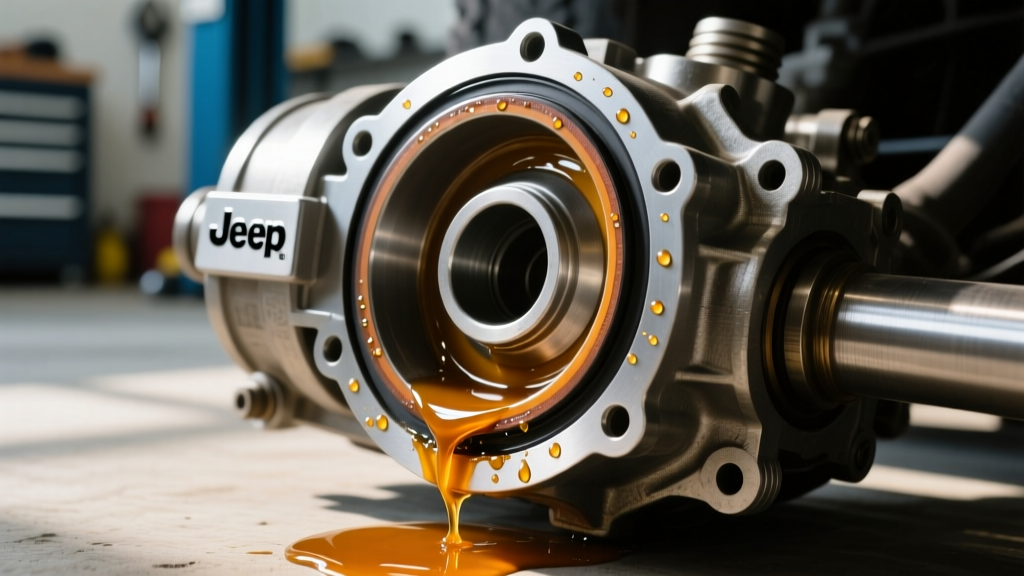
- Pinion Seal: Indicated by a radial spray pattern of oil on the driveshaft, skid plate, and exhaust. Caused by a scored yoke surface or clogged breather.
- Axle Shaft Seals: Oil weeping from behind the brake backing plate, often contaminating the rear brake pads and rotors.
- Differential Cover: Usually a result of warped stamped-steel covers, stripped threads, or failing RTV/gasket material.
- Axle Breather Tube: Not a leak itself, but the root cause of pinion and axle seal blowouts when clogged with mud.
Repair Procedure 1: The Pinion Seal (Dana 44)
The pinion seal is the most common casualty on a Wrangler. Water intrusion from river crossings accelerates the rusting of the pinion yoke sealing surface, which acts like sandpaper on the rubber seal lip. For this repair, you will need a National 20430 or SKF 20430 pinion seal, a flange holding tool, and an inch-pound torque wrench.
Step-by-Step Pinion Seal Replacement
Warning: The Dana 44 uses a crush sleeve to set bearing preload. Over-tightening the pinion nut will crush the sleeve further, requiring a complete differential teardown to fix. Always use the 'mark and return' method for DIY repairs.
- Mark Everything: Use a paint pen to mark the exact position of the pinion nut relative to the pinion threads, and the yoke relative to the pinion shaft. Count the exact number of exposed threads.
- Remove the Driveshaft: Unbolt the rear driveshaft from the companion flange (typically 8mm or 10mm 12-point bolts). Secure the shaft out of the way.
- Extract the Yoke: Use a specialized flange holding tool (or a heavy-duty strap wrench) to break the pinion nut loose. Remove the nut and use a steering wheel puller to extract the yoke. Never hammer the yoke off, as this will shatter the fragile pinion bearing cage.
- Swap the Seal: Pry out the old seal. Inspect the bore for scoring. Lubricate the outer metal edge of the new seal with a thin layer of RTV, and pack the inner rubber lip with fresh gear oil. Drive it in evenly using a seal installer tool until it sits perfectly flush.
- Reassembly and Preload Check: Reinstall the yoke and thread the nut back on. Tighten the nut to your paint pen marks. Finally, use your inch-pound torque wrench on the pinion nut to measure rotational preload. For a used bearing setup, you should see 15 to 25 in-lbs of rotational resistance. If it is lower, tighten the nut in 5 ft-lb increments until the spec is met. If you exceed 25 in-lbs, you have crushed the sleeve too far and must replace it.
Repair Procedure 2: Axle Shaft Seals (The JK vs. JL Distinction)
Replacing axle shaft seals is where many DIYers hit a wall because the procedure varies wildly between Wrangler generations.
JK Wrangler (2007-2018) Dana 44
On the JK Dana 44, the axle shaft seal sits behind the press-on axle bearing. You cannot simply pull the shaft and pry the seal out. You must unbolt the four axle retainer nuts (13mm), slide the shaft out, and take it to a machine shop or use a 20-ton shop press to press off the bearing and retainer ring. The bearing is destroyed during removal. You must install a new seal (Timken 710983) and a new bearing/race set (Timken SET 10), then press it all back together. This is a critical E-E-A-T distinction that generic guides often miss.
JL Wrangler (2018-Present) Dana 44 / M220
Stellantis updated the JL rear axle design. While some heavy-duty JL applications still use a press-fit bearing, many standard JL Dana 44s utilize a serviceable seal that can be pulled with a specialized blind-hole seal puller without removing the bearing from the shaft. Always verify your specific axle tag (e.g., M200 vs M220) before ordering parts.
The Hidden Saboteur: The Axle Breather Tube
'If you replace a pinion seal twice in one year, your problem isn't the seal. Your problem is a clogged breather.' — Master Drivetrain Technician
The factory Jeep breather tube is a short plastic hose capped with a cheap check-valve, mounted low on the axle tube. When submerged in mud or water, this valve clogs. As the differential heats up during driving, the air inside expands. With nowhere to vent, the internal pressure forces gear oil past the weakest point—usually the pinion seal. The Fix: Remove the factory cap and route a 5/16-inch polyurethane hose up into the engine bay or high onto the frame rail, terminating in a high-flow, water-resistant breather filter (like those from ARB or Rugged Ridge).
Fluid Specifications, Additives, and Refill Protocol
Once the leaks are sealed, refilling with the correct jeep wrangler rear differential fluid is paramount. As of 2026, Mopar recommends specific synthetic blends depending on your axle ratio and towing package.
| Parameter | JK Dana 44 (Standard) | JL Dana 44 (M220) | Rubicon / Max Tow |
|---|---|---|---|
| Fluid Capacity | ~2.0 Quarts (1.9L) | ~2.4 Quarts (2.3L) | ~2.4 Quarts (2.3L) |
| Viscosity Spec | 75W-85 API GL-5 | 75W-85 API GL-5 | 75W-140 Synthetic GL-5 |
| OEM Part Number | 68218655AC | 68218655AC | 68218657AC |
| Trac-Lok Additive | 2.5 oz (if LSD equipped) | 2.5 oz (if LSD equipped) | 2.5 oz (if LSD equipped) |
Pro-Tip on Friction Modifiers: If your Wrangler is equipped with a Trac-Lok limited-slip differential, you must add exactly 2.5 oz of Mopar Friction Modifier (P/N 68333596AA) before filling with gear oil. Failing to do so will result in severe clutch-pack chatter during tight, low-speed turns. Conversely, if you have an aftermarket locking differential (like an ARB Air Locker or Eaton E-Locker), do not use the friction modifier, as it can degrade the locking mechanism's friction materials over time. For deeper technical specifications on axle gearing and aftermarket differential setups, consult Quadratec's comprehensive Dana 44 wiki.
Cost Analysis: DIY vs. Professional Shop
Understanding the financial breakdown helps you decide whether to tackle the repair in your driveway or hand it off to a drivetrain specialist.
- Pinion Seal (DIY): $25 - $40 (Seal, RTV, Gear Oil). Requires specialized tools like a flange puller.
- Pinion Seal (Shop): $350 - $550. Labor-intensive due to the precise preload measurement required.
- Axle Shaft Seal (DIY - JK): $60 - $90 (Seal, Bearing, Fluid). Assumes you have access to a 20-ton shop press.
- Axle Shaft Seal (Shop - JK): $450 - $700 per side. Includes labor for pulling the shaft, pressing bearings, and bleeding brakes if contaminated.
For authoritative OEM service intervals and technical service bulletins (TSBs) regarding axle seal weeping, always reference the official Mopar Service portal or consult bearing manufacturers like Timken's automotive seal division for cross-reference part numbers.
Final Torque Specifications Reference
Keep this cheat sheet handy when reassembling your Wrangler's rear axle. Over-torquing the diff cover can warp stamped steel, while under-torquing the driveshaft bolts can lead to catastrophic u-joint failure.
- Differential Cover Bolts (M8): 25 - 30 ft-lbs
- Axle Shaft Retainer Nuts: 35 - 45 ft-lbs (Apply Blue Loctite 242)
- Driveshaft Flange Bolts (12-point): 74 ft-lbs (Replace if threads are stretched)
- Pinion Nut (Rotational Preload Target): 15 - 25 in-lbs (Used bearings)
By methodically diagnosing the leak source, respecting the crush-sleeve preload parameters, and utilizing the correct 2026 fluid specifications, you can ensure your Wrangler's Dana 44 survives the next 100,000 miles of abuse, whether on the highway or deep in the rocks.