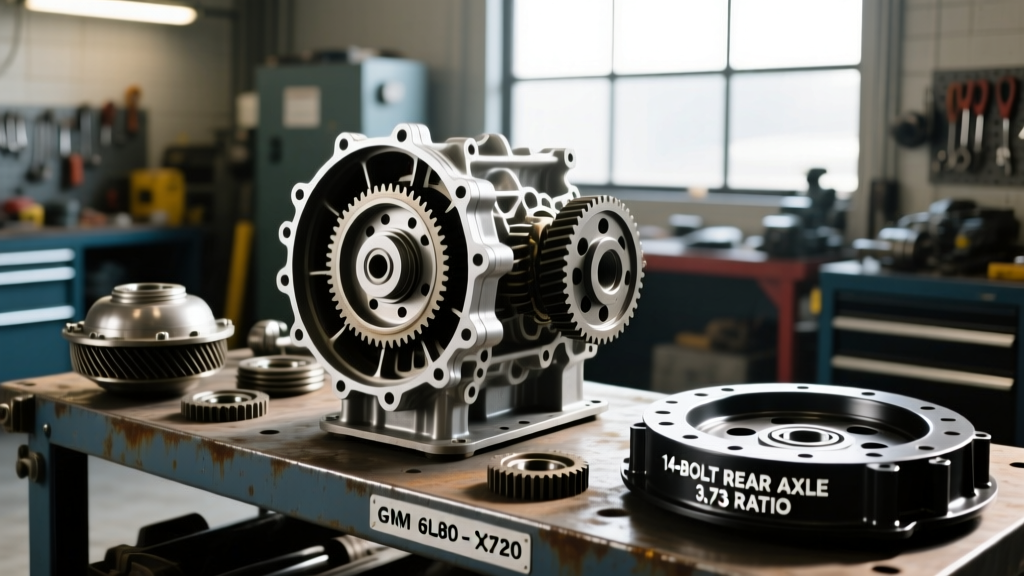
If you have ever found yourself asking, what does gear ratio mean, you are not alone. For many automotive enthusiasts and daily commuters alike, the drivetrain is a mysterious black box of spinning metal. However, understanding gear ratios is the key to unlocking better fuel economy, improved towing capacity, and faster acceleration. At AutoGearNexus, we believe in stripping away the jargon and giving you the exact mechanical truths you need.
In this beginner-friendly explainer, we are going to answer the fundamental question of what gear ratio means, and then dive deep into the most critical multiplier in your drivetrain: the final drive ratio (often called the axle ratio). Whether you are driving a modern truck with a 10-speed automatic or wrenching on a classic muscle car with a GM 10-bolt rear end, this guide will give you the technical depth and practical data you need.
The Core Question: What Does Gear Ratio Mean in Plain English?
At its most basic level, a gear ratio is a mathematical expression of rotational leverage. It compares the number of teeth on a driven gear to the number of teeth on a drive gear. When you ask, 'what does gear ratio mean' in a practical sense, you are really asking: How many times must the input shaft spin to make the output shaft spin exactly one time?
If a drive gear has 10 teeth and the driven gear has 40 teeth, the ratio is 4.00:1. The input (drive) gear must spin four complete times to turn the output (driven) gear one time. This trade-off sacrifices rotational speed in exchange for multiplied torque. This principle of mechanical advantage is what allows a 4,000-pound truck to pull a 10,000-pound trailer up a steep grade without the engine stalling.
Demystifying the Final Drive Ratio (Axle Ratio)
While your transmission (whether it is a classic 4L60E, a modern ZF 8HP, or a Ford 10R80) provides multiple gear ratios to keep the engine in its optimal powerband, the final drive ratio is the last point of torque multiplication before power reaches the wheels. In rear-wheel-drive and four-wheel-drive vehicles, this takes place inside the differential housing via the ring and pinion gear set.
How the Ring and Pinion Work Together
The pinion gear is attached to the end of the driveshaft. It meshes with the much larger ring gear, which is bolted to the differential carrier. Because the ring gear is significantly larger and has far more teeth than the pinion, it acts as a massive torque multiplier. For example, if your ring gear has 41 teeth and your pinion gear has 11 teeth, you divide 41 by 11 to get a final drive ratio of 3.73:1. This means the driveshaft turns 3.73 times for every single revolution of the rear axles and wheels.
Real-World Axle Configurations and Applications
To understand how final drive ratios apply to real vehicles, we need to look at the hardware. Different axle housings are engineered to handle specific torque loads, and their ring gear diameters dictate their strength. Below is a comparison chart of some of the most common final drive axles found on the road and in the salvage yards today.
| Axle Type | Ring Gear Diameter | Common Final Drive Ratios | Best Application |
|---|---|---|---|
| GM 8.5-inch 10-Bolt | 8.5 inches | 3.42, 3.73, 4.10 | Classic Street/Strip & Restomods |
| Ford 8.8-inch | 8.8 inches | 3.55, 3.73, 4.10 | Daily Driving, Light Towing, Mustangs |
| Dana 44 | 8.5 inches | 3.73, 4.10, 4.56, 4.88 | Off-Road, Jeeps, Heavy Crawling |
| GM 11.5-inch 14-Bolt | 11.5 inches | 3.73, 4.10 | Heavy Duty Towing (2500/3500 Trucks) |
| ZF 8HP (Transaxle) | N/A (Helical Drop) | 3.15, 3.46 | Modern RWD/AWD Performance Cars |
How Final Drive Ratios Affect Your 2026 Daily Driver
As we navigate the automotive landscape of 2026, CAFE (Corporate Average Fuel Economy) standards and emissions regulations have heavily influenced final drive ratios. Modern vehicles equipped with 8-speed and 10-speed automatic transmissions (like the GM 10L90) feature incredibly low first gears (often 4.69:1). Because the transmission provides so much low-end multiplication, automakers can install numerically lower (taller) final drive ratios, such as 2.73:1 or 3.15:1, in the rear axle.
- Numerically Lower (e.g., 2.73:1): The driveshaft turns fewer times per wheel revolution. This reduces engine RPM at highway speeds, maximizing fuel economy. However, it reduces low-end torque, making the vehicle feel sluggish off the line and reducing towing capability.
- Numerically Higher (e.g., 4.10:1): The driveshaft turns more times per wheel revolution. This multiplies engine torque heavily, providing explosive acceleration and excellent towing power, but it causes the engine to scream at high RPMs on the highway, destroying fuel efficiency.
Calculating Your Final Drive: The Tire Spin Method
You do not need to pull the differential cover to find out what gear ratio means for your specific truck or car. You can calculate the final drive ratio using the highly accurate Tire Spin Method. This requires a floor jack, a jack stand, and a piece of chalk.
Pro-Tip: Never work under a vehicle supported only by a hydraulic floor jack. Always use properly rated jack stands placed on the factory axle tubes or designated pinch welds.
- Lift and Secure: Jack up the rear of the vehicle so both rear tires are off the ground. Secure it on jack stands.
- Mark the Driveshaft: Use chalk or a paint pen to make a highly visible mark on the rear driveshaft and the differential housing.
- Mark the Tire: Make a mark on the bottom of the driver-side rear tire and the floor (or place a reference object directly under it).
- Spin and Count: Rotate the rear tire exactly one full revolution (360 degrees) while counting how many times the driveshaft spins.
- Interpret the Data: If the driveshaft turns roughly 3 and 3/4 times, you have a 3.73 ratio. If it turns just over 4 times, you have a 4.10 ratio. If it turns slightly more than 3 times, you likely have a 3.08 or 3.23.
Upgrading Your Final Drive: Costs, Kits, and Torque Specs
If your current axle ratio does not match your vehicle's purpose—perhaps you have installed larger 35-inch off-road tires and your truck feels completely gutless—you will need to swap the ring and pinion. According to industry leaders like Motive Gear, matching your gear ratio to your tire diameter is critical to restoring your speedometer accuracy and transmission shift points.
A high-quality ring and pinion set typically costs between $180 and $320. However, you must also purchase a Master Install Kit (usually $110 to $160), which includes new Timken or Koyo carrier bearings, pinion bearings, crush sleeves, and shims. Professional installation labor generally ranges from $800 to $1,200 per axle, as setting up a differential requires precision measuring tools.
Critical Torque Specifications for the DIY Wrencher
If you are tackling a GM 8.5-inch 10-bolt or a Ford 8.8-inch axle rebuild yourself, you must adhere to strict torque specifications. Guesswork here will result in catastrophic gear failure within the first 50 miles.
- Ring Gear Bolts: Typically 1/2'-20 or 3/8'-24 threads. Torque to 55-65 lb-ft. You must apply a medium-strength threadlocker (like Red Loctite 272) to these bolts. Do not use impact wrenches to tighten them.
- Carrier Bearing Caps: Torque to 60-80 lb-ft depending on the specific axle housing. Crucial: Always mark the bearing caps with a stamp or punch before removal. They are line-bored with the housing and cannot be swapped side-to-side.
- Pinion Nut (Crush Sleeve Method): This is not a standard torque spec. You tighten the pinion nut (often requiring up to 150-200 lb-ft of force) while constantly measuring rotational drag with an inch-pound torque wrench. Used pinion bearings require 15-25 in-lbs of drag; brand new bearings require 20-35 in-lbs. Once you hit the target drag, stop immediately.
- Backlash Specification: Measured with a dial indicator at the ring gear's edge. Most street applications require between 0.006 and 0.010 inches of backlash. Adjust this by moving the carrier side-shims.
For those sourcing parts, retailers like Summit Racing offer comprehensive packages that bundle the gears, install kits, and necessary setup tools, ensuring you have the correct pinion depth shims to achieve the proper gear contact pattern.
Summary: Putting the Knowledge into Gear
So, what does gear ratio mean when all is said and done? It is the ultimate tuning parameter for your vehicle's drivability. The final drive ratio dictates the personality of your car or truck. By understanding the mechanical leverage of the ring and pinion, utilizing the tire spin method to verify your current setup, and respecting the precise torque specs required for an axle rebuild, you transition from a passive driver to an informed automotive enthusiast. Whether you are crawling over rocks in a Dana 44 or cruising the highway in a ZF 8HP-equipped sports sedan, the math behind the metal is what keeps you moving forward.