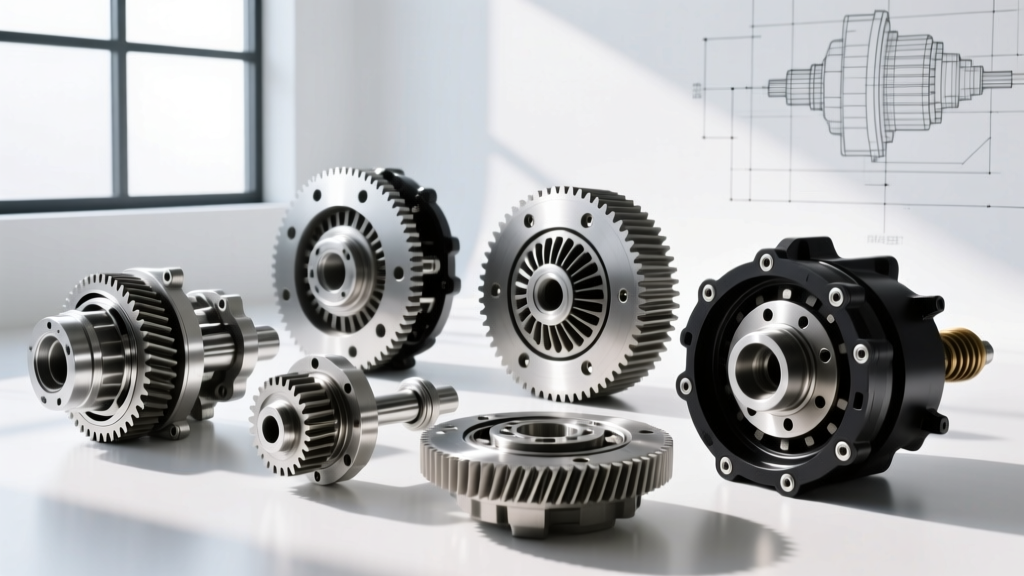
The "Dino" vs. Dyno Dilemma: Do Gear Ratios Change Horsepower?
A common search query we see in the tuning community is: does the cars gear ratios affect the dino reading? To answer this, we must first correct the terminology—enthusiasts are referring to a chassis dynamometer (often mistyped as "dino"). The short answer is both yes and no. Your engine produces the same amount of power regardless of the gearing; however, the measured power at the wheels on a chassis dyno can fluctuate wildly based on the gear selected, the type of dynamometer being used, and the final drive ratio.
To understand why a 4.10:1 rear axle ratio might yield a different peak horsepower number than a 3.08:1 ratio on the exact same engine, you must first understand the physics of the dyno sweep and, fundamentally, how to calculate gear ratio sets. This technical deep-dive will break down the math, the mechanical losses, and the real-world hardware specifications required to optimize your drivetrain for both the street and the dyno cell.
How to Calculate Gear Ratio: The Foundational Math
Before analyzing dyno data, you must know how to calculate gear ratio multipliers across your entire driveline. The fundamental formula for any gear set is:
Gear Ratio = Number of Teeth on Driven Gear / Number of Teeth on Drive Gear
Step 1: Transmission Gear Set Calculation
Inside an automatic transmission like the GM 4L60E or a manual like the Tremec T-56 Magnum, power is transferred through input and output shafts via clusters of gears. For example, if the input shaft (drive) has 20 teeth and the countershaft/output (driven) has 60 teeth in first gear, the calculation is 60 / 20 = 3.00:1. This means the engine crankshaft must rotate three full times to turn the transmission output shaft once. According to TREMEC Performance, understanding these internal steps is critical for mapping out RPM drops during shifts and ensuring the engine stays in its peak volumetric efficiency (VE) window.
Step 2: Final Drive Ratio (Axle) Calculation
The rear differential multiplies the transmission's output further. If you are installing a new Richmond Gear ring and pinion set, you count the teeth. A common performance setup features a 41-tooth ring gear and a 10-tooth pinion gear.
Calculation: 41 / 10 = 4.10:1.
To find the Final Drive Ratio for a specific gear, you multiply the transmission gear ratio by the axle ratio. If your 4L60E is in 1st gear (3.06:1) and your rear end is 4.10:1, your final drive ratio is 12.54:1 (3.06 x 4.10). This massive multiplication is what gets a heavy vehicle off the line, but it also heavily influences parasitic loss.
The Physics: How Gear Ratios Manipulate Dyno Data
When you strap a car down to an inertia dynamometer (like a Dynojet), the heavy steel drums have a fixed mass. The software calculates horsepower by measuring how quickly the engine can accelerate that known mass over time (Power = Torque x RPM / 5252). Here is where the gear ratio drastically alters the reading:
- RPM Sweep Rate: A numerically higher gear ratio (e.g., 4.56:1) will accelerate the dyno drums much faster than a 3.08:1 ratio. If the sweep rate is too fast, the engine's ECU may not have enough time to adjust fuel trims, or a turbocharger may not have the exhaust residence time to fully spool, resulting in an artificially lower peak horsepower reading.
- Parasitic Drivetrain Loss: Lower (numerically higher) gears require deeper pinion depths, thicker gear oils, and create more friction. A 4.10 gear set will absorb more horsepower as heat and mechanical friction than a 3.08 set, reducing wheel horsepower (WHP) even if flywheel horsepower remains identical.
- Tire Deflection: Higher torque multiplication at the wheels causes greater rear tire sidewall deflection and slip on the dyno rollers, skewing the data.
As noted by the engineers at SuperFlow Dynamometers, eddy-current and water-brake dynos can control the load to simulate a specific sweep rate, mitigating the gear ratio variable, but street-driven inertia dynos are entirely at the mercy of your final drive ratio.
Final Drive & Wheel Torque Multiplication Chart
To visualize how gearing affects the torque applied to the dyno rollers, consider an engine producing a flat 400 lb-ft of torque, paired with a GM 4L60E transmission and varying rear axle ratios.
| Transmission Gear | Trans Ratio | Axle Ratio (Option A) | Axle Ratio (Option B) | Wheel Torque (3.08 Axle) | Wheel Torque (4.10 Axle) |
|---|---|---|---|---|---|
| 1st Gear | 3.06:1 | 3.08:1 | 4.10:1 | 3,769 lb-ft | 5,018 lb-ft |
| 2nd Gear | 1.63:1 | 3.08:1 | 4.10:1 | 2,008 lb-ft | 2,673 lb-ft |
| 3rd Gear (1:1) | 1.00:1 | 3.08:1 | 4.10:1 | 1,232 lb-ft | 1,640 lb-ft |
| 4th Gear (OD) | 0.70:1 | 3.08:1 | 4.10:1 | 862 lb-ft | 1,148 lb-ft |
Note: Wheel torque values assume zero parasitic drivetrain loss for theoretical comparison. Real-world WHP will be 12-18% lower due to friction.
Real-World Setup: GM 8.5" 10-Bolt & 4L60E Hardware Specs
Calculating the ratio is only half the battle; executing the build with precision tolerances ensures the gear set does not destroy itself under the immense torque multiplication calculated above. When setting up a GM 8.5-inch 10-bolt rear end with a 4.10:1 ratio, you must adhere to strict OEM and aftermarket specifications.
- Ring Gear Bolt Torque: 55-65 lb-ft. Always use Loctite 242 (Blue) and left-handed thread inserts if upgrading to aftermarket ARP bolts.
- Pinion Nut Torque: 220-250 lb-ft to crush the collapsible pinion spacer and achieve the correct bearing preload.
- Bearing Preload: 15-25 inch-pounds of rotating torque (measured with a dial inch-pound torque wrench).
- Backlash Specification: 0.006" to 0.010". Measured at the ring gear teeth using a magnetic dial indicator. If backlash is too tight, the gears will whine and overheat on the dyno; if too loose, the impact loading during a 6,000 RPM clutch dump will shatter the ring gear teeth.
For comprehensive installation tolerances and shim calculation charts, Ring & Pinion Tech Support provides some of the most accurate differential setup manuals in the industry.
Factoring in Tire Diameter (Effective Gear Ratio)
When determining how your car will behave on the dyno or the drag strip, you must calculate the Effective Gear Ratio. Changing your tire diameter alters the final leverage point. If you swap from a 26-inch tall drag radial to a 28-inch tall street tire, you have effectively "shortened" your gear ratio, making the car feel sluggish and reducing the torque applied to the dyno rollers.
Effective Gear Ratio Formula:
(New Tire Diameter / Old Tire Diameter) x Original Gear Ratio = Effective Ratio
Example: (28 / 26) x 4.10 = 4.41. By simply changing tires, your 4.10 gear now acts mathematically like a 4.41 gear. This increased multiplication will accelerate the dyno drums faster, potentially causing the ECU to pull ignition timing if the sweep rate exceeds the knock sensor calibration thresholds.
Standardizing Your Baseline: The 1:1 Rule
Because of the variables outlined above, professional tuning facilities adhere to a strict rule: Always perform baseline and tuning pulls in the gear closest to a 1:1 ratio.
In a 4-speed 4L60E, 3rd gear is 1.00:1. In a ZF 8HP70, 5th gear is roughly 1.00:1. In a Tremec T-56 Magnum, 4th gear is 1:1. Testing in a 1:1 gear eliminates the internal transmission multiplication variable, reduces parasitic gear mesh losses, and provides the most accurate representation of true engine output minus standard rear-end friction. Furthermore, pulling in 1:1 prevents the dangerous over-speeding of the transmission input shaft and output bearings that can occur when running high-horsepower builds through numerically high overdrive gears on an inertia dyno.
Ultimately, while the engine's internal combustion efficiency doesn't change based on the ring and pinion installed out back, the physical measurement of that power is entirely at the mercy of leverage, friction, and rotational mass. Master the math, set your pinion depth correctly, and always tie the car down in 1:1.