The Drivetrain Synergy: Matching the GM 6L80 to the 14-Bolt Axle
When performing a transmission swap, rebuilding a drivetrain, or diagnosing performance issues in late-model GM trucks, understanding the relationship between your gearbox and your differential is paramount. Specifically, knowing how to determine gear ratio in a rear end is a critical diagnostic and planning step when pairing the legendary GM 6L80 six-speed automatic transmission with the heavy-duty GM 10.5-inch 14-bolt rear axle. Whether you are building a dedicated tow rig, a desert runner, or a daily-driven Silverado 2500HD, the mathematical harmony between your transmission's internal planetary gearsets and your rear axle's ring and pinion dictates your vehicle's mechanical destiny.
Transmission Gear Ratios Explained: The 6L80 Benchmark
Before diving into the rear axle, we must establish the baseline of the transmission. The GM 6L80 (RPO MYC) is a heavy-duty, rear-wheel-drive six-speed automatic designed to handle up to 664 lb-ft of input torque. To understand why rear-end identification matters, we first need to look at transmission gear ratios explained through the lens of the 6L80's internal architecture.
- 1st Gear: 4.03:1 (Aggressive torque multiplication for heavy launches)
- 2nd Gear: 2.36:1
- 3rd Gear: 1.53:1
- 4th Gear: 1.15:1
- 5th Gear: 0.85:1 (Overdrive)
- 6th Gear: 0.67:1 (Deep Overdrive for highway cruising)
The 6L80 features a wide 6.04:1 overall ratio spread. This massive spread allows the transmission to provide brute-force low-end crawling while maintaining exceptionally low highway RPMs. However, this deep 0.67:1 sixth gear means that if your rear end ratio is too low (numerically), the engine will lug, the torque converter will constantly unlock, and the transmission will hunt for gears on inclines. Conversely, if the rear ratio is too high (numerically), you lose the fuel economy benefits of that 0.67 overdrive. This is exactly why learning how to determine gear ratio in a rear end is the first step in any 6L80 swap or differential regear.
Final Drive Ratio: The Mathematical Reality
The final drive ratio at the wheels is the product of the transmission gear multiplied by the rear axle ratio. For example, if you are in 1st gear (4.03) with a 4.10 rear axle, your final drive ratio is 16.52:1 (4.03 x 4.10). This means the engine turns 16.52 times for every single revolution of the rear wheels. In 6th gear (0.67) with that same 4.10 axle, the final drive is 2.74:1. Understanding this math allows you to use an online gear ratio calculator to predict your exact RPM at 70 MPH based on your tire diameter.
How to Determine Gear Ratio in a Rear End: GM 14-Bolt 10.5" Guide
The GM 10.5-inch 14-bolt rear axle is a staple in 3/4-ton and 1-ton GM trucks. It features a massive ring gear, 35-spline axle shafts, and unparalleled durability. If the axle tag is missing and the previous owner's build sheet is long gone, here are the four definitive methods to identify your ratio.
Method 1: Decoding the RPO Codes
The easiest, non-invasive way to find your ratio is by checking the Regular Production Option (RPO) sticker in the glovebox. Look for the following two-letter codes:
- GU6: 3.42:1 (Common in lighter duty applications, poor for 6L80 towing with large tires)
- GT4: 3.73:1 (The factory sweet spot for stock-height 2500HD trucks)
- GT5: 4.10:1 (Ideal for heavy towing and 35-inch tires)
- HC4: 4.56:1 (Rare, usually found in severe-duty or commercial chassis cabs)
Note: If you see G80, that indicates the Eaton Gov-Lok automatic locking differential, not the ratio itself.
Method 2: The Axle Tube Stamp
GM stamps the axle ratio, build date, and manufacturing plant on the front passenger-side axle tube. You will need a wire wheel, brake cleaner, and a shop rag. Look for a string of numbers and letters. The first three digits often indicate the ratio. For example, a stamp reading 410 or 4 10 indicates a 4.10:1 ratio. Be aware that rust and years of road grime can make these stamps nearly illegible, necessitating the physical methods below.
Method 3: The Tire Spin Method (No Tools Required)
If the truck is on a lift or you have a floor jack, you can determine the ratio by counting rotations. This method is highly accurate for standard open differentials or locked Gov-Lok units.
- Safely lift the rear axle so both tires are off the ground.
- Put the transmission in Neutral and release the parking brake.
- Mark the driveshaft and one rear tire with chalk or bright paint.
- Rotate the rear tire exactly one full revolution (360 degrees) while counting the driveshaft rotations.
Interpreting the Spins:
- Driveshaft turns ~3.25 times = 3.42 ratio
- Driveshaft turns ~3.75 times = 3.73 ratio
- Driveshaft turns ~4.10 times = 4.10 ratio
- Driveshaft turns ~4.50 times = 4.56 ratio
Pro-Tip: If you have an open differential and only one wheel is off the ground, you must spin that wheel TWO full revolutions and count the driveshaft, or spin it one revolution and multiply the driveshaft count by two.
Method 4: Counting Ring and Pinion Teeth
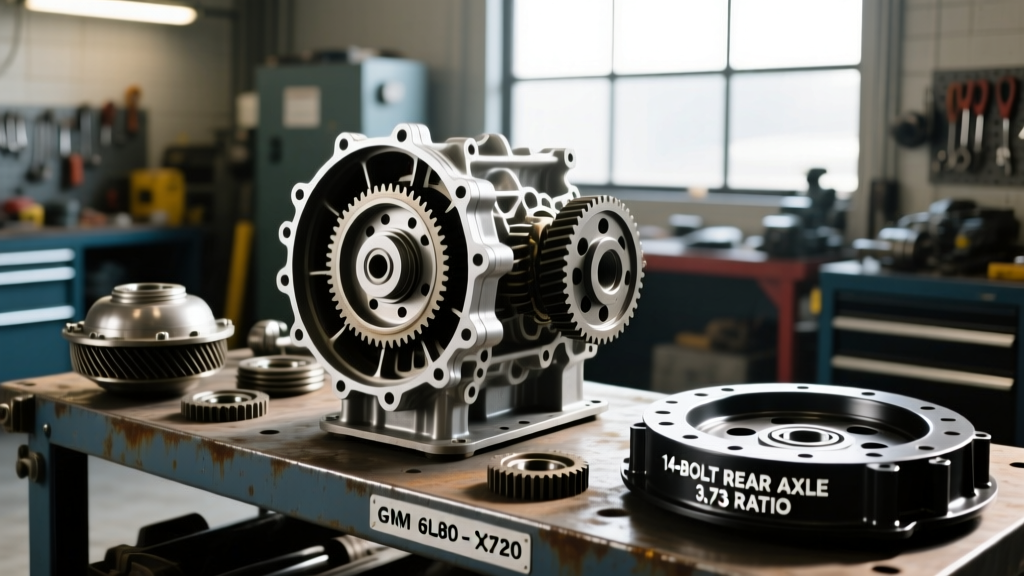
The only 100% foolproof method, especially on a rebuilt axle, is removing the differential cover and counting the teeth. For the GM 10.5" 14-bolt, the differential cover is held on by 14 bolts (typically 15mm or 9/16").
Drain and Fill Specs: Before removing the cover, drain the fluid. The 14-bolt holds approximately 3.5 to 4.0 quarts of 75W-90 GL-5 synthetic gear oil. When reinstalling the cover, use a high-quality RTV silicone (like Permatex Black) or a reusable Lube Locker gasket. Torque the cover bolts in a crisscross pattern to 25-30 lb-ft.
Once open, count the teeth on the large ring gear and the small pinion gear. Divide the ring gear teeth by the pinion teeth:
- 41 Ring / 11 Pinion = 3.73
- 41 Ring / 10 Pinion = 4.10
- 41 Ring / 9 Pinion = 4.56
Most quality manufacturers like Yukon Gear & Axle also stamp the ratio directly on the edge of the ring gear (e.g., "41-11").
Drivetrain Matching Chart: 6L80 & 14-Bolt Combinations
To illustrate why identifying your rear end ratio is vital for transmission longevity, review the chart below. This assumes a 6L80 transmission, 35-inch tall tires, and a cruising speed of 70 MPH in 6th gear (0.67:1 overdrive).
| Rear Axle Ratio | Final Drive (6th Gear) | Approx. RPM @ 70 MPH (35" Tires) | Best Application |
|---|---|---|---|
| 3.42:1 | 2.29:1 | 1,450 RPM | Empty highway cruising, poor towing performance, high trans temps on grades. |
| 3.73:1 | 2.50:1 | 1,580 RPM | Factory standard. Good balance for stock tires and moderate towing. |
| 4.10:1 | 2.74:1 | 1,740 RPM | Optimal for 35" tires, heavy towing (10k+ lbs), keeps 6L80 in its powerband. |
| 4.56:1 | 3.05:1 | 1,930 RPM | Severe off-road crawling, 37"+ tires, constant max-GCVW commercial towing. |
Real-World Repair Costs & Part Numbers
If your tire spin test or tooth count reveals a ratio that doesn't match your 6L80's torque characteristics or your tire size, a regear is necessary. Here is what you can expect to invest in a GM 10.5" 14-bolt regear in 2026:
Parts Breakdown
- Ring & Pinion Set: $280 - $450 (Yukon, Motive Gear, or Revolution Gear). Part number example: Yukon YG GM10.5-410 for a 4.10 set.
- Master Install Kit: $160 - $220. Includes Timken bearings, pinion shims, crush sleeve, and pinion nut. (Crucial: Never reuse the old crush sleeve or pinion nut). Part number example: Yukon YK GM10.5-14B.
- Gear Oil & Additive: $60 - $90 for 4 quarts of 75W-90 Synthetic and a bottle of friction modifier if swapping to a clutch-type limited slip (though the factory Gov-Lok does not require modifier).
Labor & Machine Shop Costs
Setting up a 14-bolt requires precise measurement of pinion depth, backlash (typically 0.006" - 0.010"), and bearing preload. If you are not doing this in your own garage with a dial indicator and inch-pound torque wrench, expect to pay a drivetrain specialist between $800 and $1,200 in labor. Always verify the shop's experience with heavy-duty 14-bolt axles, as the massive ring gear requires specialized pullers and presses that standard lube shops do not possess.
Final Thoughts on Drivetrain Optimization
Understanding transmission gear ratios explained through the 6L80's wide spread highlights the importance of the final drive. A 6L80 paired with a 3.42 rear end and 35-inch tires will result in excessive torque converter slip, overheated transmission fluid, and premature wear to the 3-4-5-6 clutch pack. By taking the time to properly identify your axle via RPO codes, the tire spin method, or physical tooth counting, you ensure your truck operates exactly as GM's powertrain engineers intended. For further technical specifications on differential setups and bearing tolerances, consult the experts at Differential Masters or your local GM dealer's powertrain department.