Why Upgrade Your Tundra’s Front Differential?
The Toyota Tundra is a formidable platform for overlanding and off-road exploration, but its factory front open differential is a notorious weak point when traction gets scarce. Whether you are navigating rocky trails in Moab or pulling a heavy rig through deep snow, an open front differential will route power to the wheel with the least resistance, leaving you stranded. Upgrading to a selectable front locker transforms the Tundra’s Independent Front Suspension (IFS) into a true 4x4 system. However, installing a locker requires a complete teardown, meaning you must address bearing preloads, gear backlash, and critically, fluid volumes. When planning a drivetrain overhaul, confirming the exact Toyota Tundra front differential oil capacity is your first step before ordering seals, crush washers, and synthetic gear oils.
Selecting the Right Front Locker: Air vs. Electric vs. Cable
For the Tundra’s IFS front axle, selectable lockers are the gold standard. They provide 100% mechanical lockup when engaged, yet allow the front wheels to turn freely and maintain factory steering geometry when disengaged. Here is how the top three architectures compare for the Tundra platform.
1. ARB Air Locker
The ARB Air Locker uses compressed air to actuate an internal pneumatic piston that engages the locking collar. It is widely considered the most robust option for severe rock crawling. For the Gen 2 Tundra (8.0-inch reverse rotation), the ARB RD143 is the go-to part. For the Gen 3 (9.5-inch), you will need the ARB RD215. The downside? You must mount an onboard air compressor and route an air line through the axle housing, which requires drilling the differential carrier and using specialized bulkhead fittings.
2. Eaton E-Locker
The Eaton E-Locker (Part# 19961-010 for 8.0-inch applications) utilizes an electromagnetic coil to push the locking collar. It requires only a simple 12V wiring harness and a dash switch, eliminating the need for an air compressor. Engagement is slightly slower than an air locker, and the internal electromagnetic coil can be vulnerable to extreme shock loads, but for 90% of overlanders, the ease of installation is unmatched.
3. OX Locker
The OX Locker uses a mechanical cable actuation system. By pulling a lever in the cabin, a heavy-duty shift fork engages the locker. It is entirely immune to electrical gremlins and air leaks, making it a favorite for expedition vehicles traveling far from civilization. However, routing a mechanical cable through the IFS suspension without binding requires meticulous attention to detail.
Front Locker Comparison Matrix
| Locker Brand | Actuation Type | Gen 2 (8.0") Part # | Engagement Speed | Est. Price (2026) |
|---|---|---|---|---|
| ARB Air Locker | Pneumatic (Air) | RD143 | Instant | $1,050 - $1,150 |
| Eaton E-Locker | Electromagnetic | 19961-010 | 0.5 - 1.0 Sec | $900 - $1,000 |
| OX Locker | Mechanical Cable | Dana 8.0 IFS | Instant (Manual) | $1,200 - $1,350 |
Source: Pricing and fitment data aggregated from Summit Racing Differential Lockers and manufacturer catalogs.
Mastering the Toyota Tundra Front Differential Oil Capacity
One of the most common mistakes DIY mechanics make during a front differential rebuild is overfilling or underfilling the IFS housing. Because the front differential is integrated into the transaxle/IFS subframe, the fill port is located on the side of the aluminum carrier. The only accurate way to measure the Toyota Tundra front differential oil capacity is to fill the housing until the fluid reaches the bottom threads of the fill hole and begins to weep out.
Gen 2 (2007–2021) 8.0-Inch IFS Capacity
For the second-generation Tundra, the front 8.0-inch reverse-rotation differential holds approximately 1.6 Liters (1.69 Quarts) of gear oil. If you have installed an aftermarket locker like the ARB RD143, the internal displacement of the pneumatic piston and locking collar may reduce the total volume by a fraction of a quart. Always purchase two quarts of gear oil to ensure you have enough to reach the fill plug.
Gen 3 (2022–Present) 9.5-Inch IFS Capacity
Toyota significantly upgraded the front axle for the third-generation Tundra, moving to a robust 9.5-inch ring and pinion to handle the twin-turbo V6 i-FORCE MAX torque. The front differential oil capacity for the Gen 3 9.5-inch IFS is approximately 2.1 Liters (2.22 Quarts). You will need three quarts of fluid on hand for a complete drain and fill.
Gear Oil Viscosity and Additive Requirements
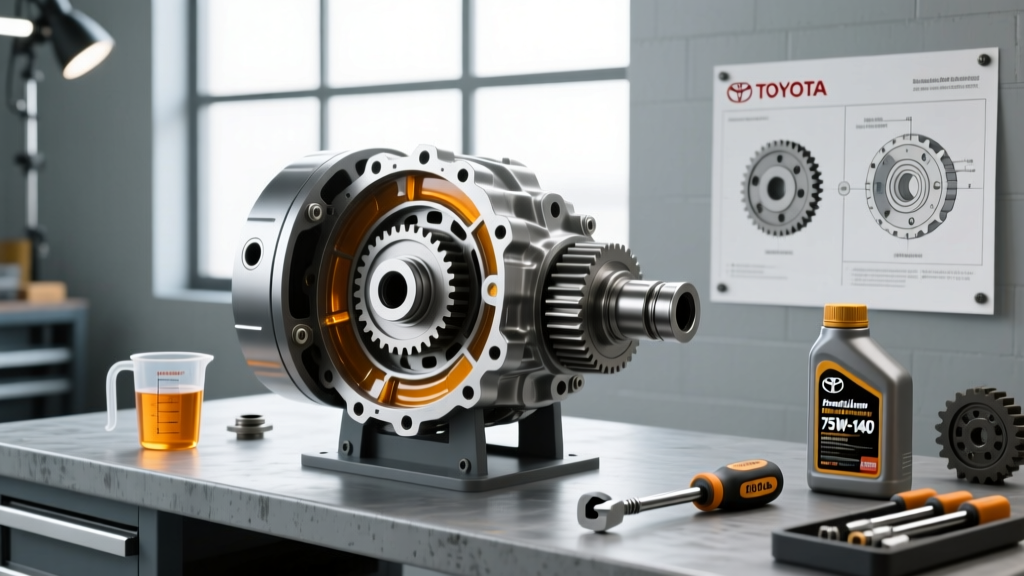
Selecting the correct gear oil is just as critical as knowing the capacity. Toyota factory service manuals typically specify SAE 75W-85 API GL-5 gear oil (Toyota Genuine Part# 08885-81080). However, when upgrading to an aftermarket selectable locker and running larger 35-inch tires, a heavier viscosity provides better shock load protection.
- Amsoil Severe Gear 75W-90: Excellent for heavy towing and rock crawling. The thicker 90-weight film resists shearing under high torque.
- Red Line 75W-85 GL-5: Maintains the factory viscosity but offers superior synthetic base stocks for high-temperature stability.
- Mobil 1 Synthetic 75W-90: A highly accessible, cost-effective option that meets all GL-5 requirements.
Critical Warning: Never use gear oils containing 'Friction Modifiers' (often labeled for Limited Slip Differentials or LSDs) in a selectable front locker. Friction modifiers are designed for clutch-pack LSDs and can cause the internal locking collars of an ARB or Eaton locker to slip, bind, or wear prematurely. Standard GL-5 without LSD additives is mandatory.
Critical Torque Specs and Installation Best Practices
Reassembling the front differential requires strict adherence to torque specifications to prevent catastrophic failure under load. According to data verified via the Toyota Technical Information System (TIS) and ARB 4x4 Installation Guides, use the following baseline specs:
Drain, Fill, and Crush Washers
The front differential drain and fill plugs typically require a 10mm or 12mm hex bit. Torque both plugs to 29 ft-lbs (39 Nm). You must replace the aluminum crush washers every time you service the fluid. The standard Toyota part number for the 12mm drain plug gasket is 12157-10010, and for the 14mm fill plug, it is 90430-14014 (verify with your local dealer based on your specific VIN, as plug sizes vary slightly between 2014 and 2018 models).
Locker and Ring Gear Assembly
- Ring Gear to Locker Bolts: 75 - 85 ft-lbs. Must use Red Loctite 272 (high strength) on the threads. Left-hand thread on some reverse rotation applications—verify before applying torque!
- Bearing Cap Bolts: 58 ft-lbs. Ensure bearing cap alignment marks match perfectly to maintain factory gear backlash (typically 0.005" - 0.007").
- ARB Bulkhead Fitting: Hand tight plus 1/8th turn. Do not overtighten, or you will crack the differential carrier housing.
The 500-Mile Break-In Protocol
Whether you are installing a new ring and pinion alongside your locker, or just the locker itself, a proper break-in procedure is non-negotiable. The internal components of the Eaton E-Locker and the machining tolerances of the ARB collar require a bedding-in period.
- First 100 Miles: Drive primarily on paved roads at varying speeds between 30 and 50 mph. Avoid towing, heavy throttle inputs, and locking the front differential on high-traction surfaces (which can cause driveline wind-up and snap axle shafts).
- 100 to 500 Miles: Gradually introduce highway speeds, but do not exceed 65 mph. Avoid sustained high-speed cruising to prevent excessive heat buildup in the new gear oil.
- 500-Mile Fluid Change: Drain the front differential fluid immediately after the 500-mile mark. You will likely find a fine metallic paste on the magnetic drain plug. This is normal wear from the locker collars and ring gear mating surfaces. Refill with fresh 75W-85 or 75W-90 GL-5 gear oil to the fill plug weep hole.
By pairing the right selectable locker with meticulous attention to the Toyota Tundra front differential oil capacity and break-in protocols, your IFS axle will deliver years of reliable, traction-rich performance on the most demanding trails.