The Drivetrain vs. HVAC Confusion: Diagnosing the Real Slip
When drivers experience a sudden loss of power, erratic engagement, or strange noises from the engine bay, internet searches often blur the lines between cabin comfort and drivetrain propulsion. It is surprisingly common for frustrated motorists to end up searching for how to reset ac clutch relays or compressor cycling switches when their manual transmission is actually slipping under load, or when their automatic transmission's internal wet clutches are failing. While an HVAC compressor clutch relay reset might fix your air conditioning, it will do absolutely nothing to restore hydraulic pressure to a failing ZF 8HP mechatronic unit or replace the burnt organic friction material on your Tremec T56 Magnum.
As of 2026, with modern vehicles relying heavily on complex electronic adaptation tables and high-torque drivetrain configurations, accurately identifying true drivetrain clutch wear signs and lifespan indicators requires a rigorous, technical approach. This deep-dive explainer strips away the HVAC confusion and provides transmission-specific diagnostics, exact measurement thresholds, and real-world replacement data for both manual and automatic clutch systems.
Manual Transmission Wear Indicators: Beyond the Pedal Feel
The traditional 'third-gear stall test' is a rudimentary way to check for clutch slip, but modern high-performance manual transmissions require more precise diagnostic metrics. Let us examine the physical and operational wear signs of the ubiquitous Tremec T56 Magnum and similar heavy-duty manual gearboxes.
Operational Symptoms of Organic Disc Degradation
- Engagement Point Migration: A healthy hydraulic clutch system should engage roughly 1 to 1.5 inches from the floor. As the friction disc wears (losing its 8.2mm original thickness), the engagement point creeps higher toward the top of the pedal travel. If you are engaging the clutch within a half-inch of full release, the disc is critically thin.
- Load-Dependent Slip: Unlike an AC compressor clutch that clicks audibly when engaging, a slipping drivetrain clutch manifests as a flare in RPMs without a proportional increase in vehicle speed, most noticeable in 4th or 5th gear at wide-open throttle (WOT) between 3,500 and 5,000 RPM.
- Chatter and Shudder: Often misdiagnosed as bad engine mounts, clutch chatter upon takeoff is frequently caused by uneven friction material wear, hot spots on the flywheel, or oil contamination from a leaking rear main seal or transmission input shaft seal.
Physical Measurement Specifications
When the transmission is dropped, visual inspection is not enough. You must measure. According to Tremec's official T56 Magnum specifications, the input shaft is a robust 1-1/8-inch 26-spline design. However, the clutch assembly requires strict tolerances:
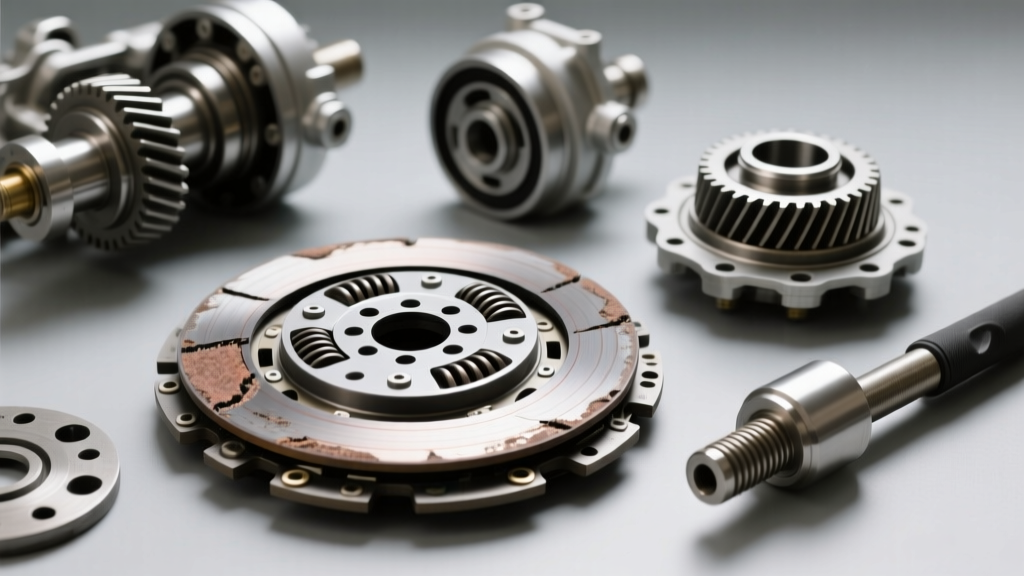
- Friction Disc Thickness: New organic discs typically measure 8.0mm to 8.5mm. The absolute wear limit threshold is 2.5mm. Anything below this risks the steel rivets gouging the flywheel friction surface.
- Flywheel Runout: Using a magnetic base dial indicator, measure the flywheel face runout. The maximum allowable Total Indicator Reading (TIR) is 0.005 inches. Exceeding this guarantees clutch chatter and premature release bearing failure.
- Flywheel Step Height: Critical for diaphragm spring geometry. A step height that deviates more than 0.010 inches from the OEM specification will alter the clamping load, leading to premature slip or excessive pedal effort.
Automatic Transmission Clutch Pack Wear: ZF 8HP and GM 6L80
Automatic transmissions utilize multiple wet clutch packs (friction discs and steel separator plates bathed in ATF) to execute gear changes. Diagnosing wear here requires reading adaptation data and analyzing physical debris, not just feeling a pedal.
ZF 8HP Adaptation Value Diagnostics
The ZF 8HP (8HP45, 70, 90) is the gold standard for modern automatics. It uses clutches A through E. As the friction material wears, the mechatronic unit must increase the hydraulic fill volume and time to achieve seamless gear changes. Using advanced OBD-II Bluetooth tuning tools or OEM software like BMW ISTA, you can read the Clutch Adaptation Values.
Diagnostic Rule of Thumb: If the clutch fill time adaptation for a specific gear ratio (e.g., Clutch A for 1st-2nd-3rd gear) exceeds +120ms to +150ms from the baseline factory calibration, the clutch pack clearance has expanded beyond the hydraulic piston's efficient stroke range. A slip fault (e.g., P0730 Gear Ratio Incorrect) is imminent.
For a deeper understanding of ZF hydraulic wear, Sonnax's technical resource on ZF 8HP mechatronic sleeve leaks and clutch adaptation highlights how internal cross-leaks can mimic clutch pack wear, making pressure testing mandatory before tearing down the unit.
GM 6L80 Wave Plate Fatigue
The GM 6L80 is notorious for a specific mechanical failure that mimics standard clutch wear: the 3-5-R clutch wave plate (OEM Part # 24236933). Over time, the stamped steel wave plate fatigues and fractures. This causes immediate slip in 3rd, 5th, and Reverse gears, and dumps metallic debris into the transmission pan. If you drop the pan of a 6L80 and find curved, shiny metal shards alongside standard clutch friction dust, the wave plate has failed, destroying the adjacent clutch steels.
Friction Material Science and Lifespan Expectations
Choosing the right replacement material dictates both the lifespan and the drivability of the vehicle. Below is a comparative analysis of common clutch friction materials used in aftermarket and OEM replacements.
| Friction Material | Avg. Torque Capacity | Est. Lifespan (Street) | Engagement Characteristic |
|---|---|---|---|
| Organic (Full-Face) | 350 - 450 lb-ft | 60,000 - 80,000 miles | Smooth, progressive, forgiving |
| Cerametallic (Puck) | 600 - 850 lb-ft | 30,000 - 50,000 miles | Aggressive, prone to low-speed chatter |
| Carbon-Kevlar Blend | 500 - 700 lb-ft | 40,000 - 60,000 miles | Firm, requires heat for optimal bite |
| Sintered Iron | 900+ lb-ft | 10,000 - 20,000 miles | On/Off switch, race-only application |
Essential Diagnostic Tools and Alignment Specs
Proper diagnosis and replacement require precision tools. Guesswork leads to warranty claims and comebacks. Every professional drivetrain shop must utilize the following:
- Dial Indicator with Magnetic Base: Mandatory for checking flywheel runout (Max 0.005") and bellhousing bore alignment. If the bellhousing TIR exceeds 0.005", the transmission input shaft will bind, destroying the pilot bearing and causing premature clutch wear. Offset dowel pins (available in 0.007", 0.014", and 0.021" offsets) are required to correct this.
- Clutch Alignment Mandrel: A universal alignment tool is insufficient for modern tight-tolerance splines. Use a dedicated mandrel matching the exact input shaft dimensions (e.g., 1-1/8" x 26-spline for Tremec, or 15/16" x 23-spline for older T5 applications).
- Hydraulic Line Pressure Gauge: For automatics, verifying line pressure at the transmission case port ensures the pump is capable of clamping the worn clutch packs before authorizing a full rebuild.
2026 Replacement Costs and OEM Part Sourcing
The cost of addressing clutch wear varies wildly depending on the architecture. Sourcing high-quality OEM or OEM-equivalent parts from manufacturers like Sachs or LuK is critical to ensuring the lifespan indicators match factory expectations.
- Manual Transmission (e.g., Ford Mustang GT / Tremec MT-82): A complete LuK RepSet (Disc, Pressure Plate, Release Bearing) costs between $280 and $350. Add $150 for a resurfaced or new OEM flywheel. Labor typically runs $800 to $1,200, bringing the total out-the-door cost to roughly $1,300 - $1,700.
- Automatic Transmission (e.g., BMW F-Series / ZF 8HP70): Replacing the internal clutch packs requires a master overhaul kit. A genuine Sachs ZF 8HP clutch and seal kit costs $850 to $1,100. However, because the mechatronic unit must be removed and the transmission dropped, labor costs range from $1,500 to $2,200. Furthermore, the mechatronic sleeve and adapter seals must be replaced simultaneously to prevent cross-leaks that would burn up the new clutches within 5,000 miles.
Conclusion: Focus on the Drivetrain
While knowing how to reset an AC clutch relay is a useful trick for a hot summer day, it has zero bearing on the mechanical reality of your vehicle's drivetrain. True clutch wear signs—whether manifested as adaptation limit faults in a ZF 8HP, metallic debris in a GM 6L80 pan, or pedal migration in a Tremec T56—require immediate, mechanically sound diagnostics. By relying on precise measurements, OEM adaptation data, and high-quality replacement components, you can accurately assess clutch lifespan and restore your vehicle's power delivery to factory specifications.